
M&A Vietnam 2026: The Comprehensive Strategic Guide for Foreign Investors

M&A Vietnam 2026: A Comprehensive Strategic Guide for Foreign Investors and Business Acquisition
1. The Strategic Convergence: Vietnam’s Economic Ascendance in 2026
The year 2026 represents a pivotal juncture in Vietnam’s economic narrative, marking the transition from a post-pandemic recovery phase to a new era of high-value, innovation-led development. For global investors, the Vietnamese market has evolved from a satellite manufacturing base into a primary strategic destination for mergers and acquisitions (M&A) and sophisticated foreign direct investment (FDI). This transformation is anchored by a remarkable macroeconomic performance in the first quarter of 2026, where the Gross Domestic Product (GDP) expanded by 7.8% on-year—the strongest first-quarter growth on record for the nation.
This economic momentum is not merely a cyclical rebound but the result of a fundamental restructuring of the country's growth drivers. While the industrial and construction sectors grew by 8.9%, the service sector followed closely at 8.2%, signaling that Vietnam’s stability is increasingly supported by domestic demand and high-end services rather than a singular reliance on low-tech exports. The political landscape, characterized by the confirmation of a new leadership structure following the 14th National Party Congress, has provided the market with a five-year window of policy continuity and economic visibility. General Secretary Tô Lâm’s practical, results-oriented leadership style has resonated with international observers, particularly his emphasis on delivering critical infrastructure and establishing stable, transparent rules for private capital.
For foreign investors, the "Why Now?" of 2026 is driven by a shift in investment behavior. The traditional Greenfield investment model, which involves lengthy land clearances and permitting processes (often taking 2-3 years), is increasingly being bypassed in favor of strategic M&A. Acquiring existing entities allows investors to leverage established distribution networks, secure "clean" land banks, and utilize pre-existing licenses, thereby shortening market entry timelines to a matter of months. This guide serves as an exhaustive blueprint for navigating this complex but rewarding landscape, integrating macroeconomic insights, legal breakthroughs, and sectoral analyses.
2. Macroeconomic Fundamentals and the 2026 Growth Trajectory
Vietnam’s macroeconomic environment in 2026 is defined by "disciplined ambition." The government has set a target of at least 10% GDP growth for the year, a figure supported by the National Statistics Office's projections of double-digit growth in the second, third, and fourth quarters. While international organizations like the World Bank and the Asian Development Bank maintain more conservative forecasts in the range of 6.3% to 7.4%, the underlying data suggests a highly resilient foundation.
Macroeconomic Performance Indicators (Q1 2026)
| Indicator | Value/Growth Rate | Context & Implications |
| GDP Growth (Q1 2026) | 7.8% (Record High) |
Driven by industry (8.9%) and services (8.2%). |
| Index of Industrial Production (IIP) | +9% Year-on-Year |
Manufacturing expanded 9.7%, led by metals and chemicals. |
| Retail Sales & Services | $72.3 Billion (+12.1%) |
Reflects strong domestic consumption and middle-class expansion. |
| Realized FDI | $27.62 Billion (2025 Base) |
Highest level in 5 years, showing strong disbursement momentum. |
| Registered FDI (Jan 2026) | $2.57 Billion |
Singapore led with 41.5%, followed by South Korea at 21.4%. |
| Export Growth (2025) | +17% ($475 Billion) |
Electronics and machinery remain the key export engines. |
The divergence between the ambitious 10% domestic growth target and the ~7% international forecasts highlights the government’s reliance on three major "levers": consumption, which accounts for over 60% of GDP; infrastructure development, which the state aims to raise to 10% of GDP; and real estate development, which contributes roughly 15% to the economy when factoring in indirect multipliers. Fiscal and monetary policies remain coordinated to unlock capital for businesses, while wage reforms and consumer stimulus measures are expected to sustain the 100-million-strong domestic market.
3. Strategic Trade Agreements and Global Integration
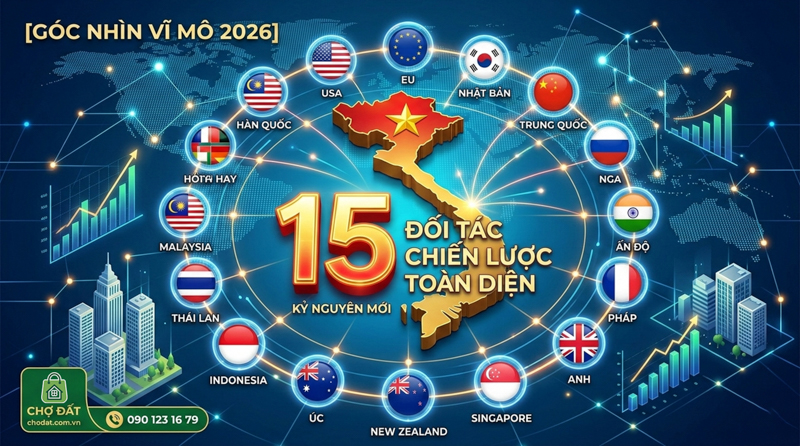
Vietnam’s position as a "multi-aligned" trade hub is its most potent competitive advantage in 2026. The country’s extensive network of Free Trade Agreements (FTAs) allows investors to bypass geopolitical volatility and access major global markets with preferential tariffs.
The EVFTA: A "Golden Window" for EU Market Access
The EU-Vietnam Free Trade Agreement (EVFTA) has entered its sixth year of implementation, placing Vietnam in a "golden window" as tariff elimination schedules near completion. By 2030, the EU will eliminate 99.2% of all tariff lines on Vietnamese exports. For M&A investors, acquiring a Vietnamese manufacturing firm is the fastest way to gain "Rules of Origin" compliance and export high-tech goods, textiles, or machinery to Europe duty-free. However, the 2026 landscape requires a deeper focus on the EU’s Green Deal standards, including the Carbon Border Adjustment Mechanism (CBAM) and the Digital Product Passport (DPP).Investors are increasingly targeting local companies that have already implemented origin-tracing and sustainability compliance systems to avoid future penalties.
The CPTPP and RCEP: Diversifying Regional Sourcing
The Comprehensive and Progressive Agreement for Trans-Pacific Partnership (CPTPP) continues to be a catalyst for high-standard regulatory reforms. It is projected to boost Vietnam's GDP by 1.3 percentage points by 2035 by enabling the shift from low-tech manufacturing to complex goods like medical devices and vehicles. Simultaneously, the Regional Comprehensive Economic Partnership (RCEP) has simplified regional supply chains, allowing for a "single rule of origin" across 15 Asia-Pacific countries, making Vietnam an ideal "China + 1" destination for Japanese, South Korean, and Chinese investors.
4. The M&A Market Evolution: Trends, Participant Profiles, and Valuation Shifts
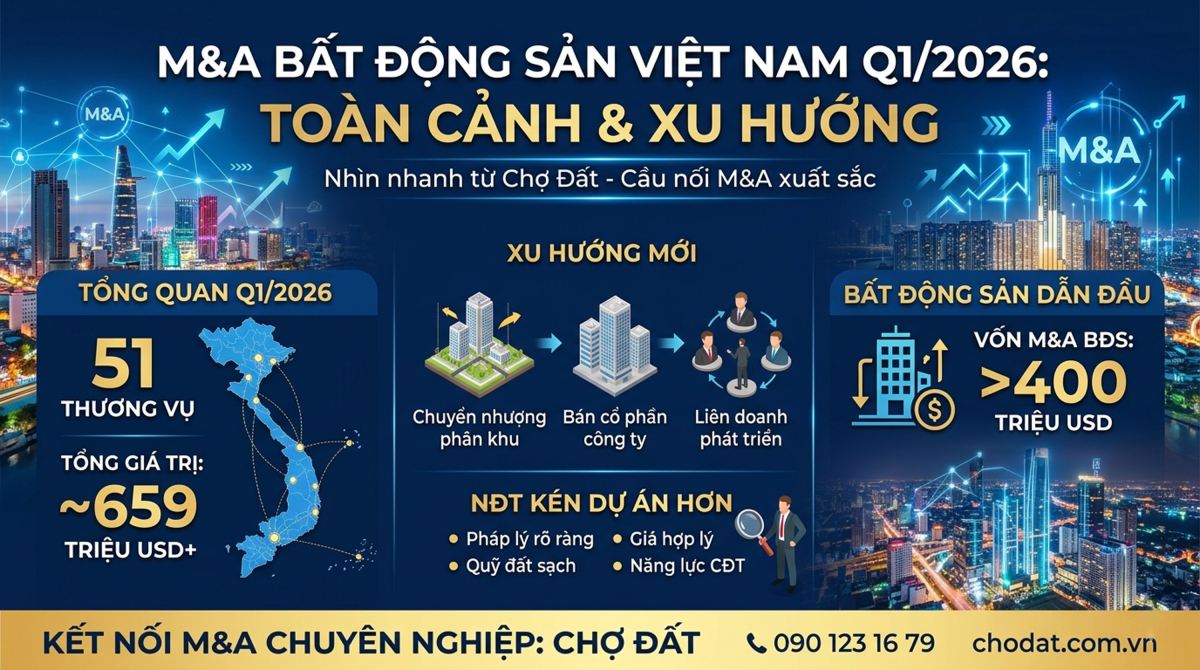
The Vietnamese M&A market in 2026 is characterized by strategic maturity. The era of speculative, high-volume dealmaking has transitioned into a "flight to quality". Total disclosed transaction values in 2025 reached approximately $8.7 billion, up 26% from the previous year, despite a moderate decline in total deal volume to 367 transactions. This indicates that while the market is more selective, the average transaction quality and strategic value have increased.
Key Themes Shaping the 2026 M&A Landscape
-
A Buyer’s Market: High global interest rates and a disciplined approach to capital deployment have shifted bargaining power toward buyers. Headline valuations have moderated compared to the 2021-2022 peaks, and deal structures now frequently incorporate earn-outs and vendor financing to bridge valuation gaps between buyers and sellers.
-
Strategic Restructuring: Domestic conglomerates are increasingly using divestments to streamline their operations and strengthen their balance sheets. High-profile examples include VinFast’s $1.5 billion restructuring and VNPT’s planned auction of its stake in Maritime Bank (MSB).
-
Mid-Market Dominance: While selective mega-deals support the total value, the market remains primarily mid-market led ($20M - $100M). Average deal sizes have stabilized at roughly $29.4 million, reflecting a return to sustainable transaction distributions.
Investor Profiles by Origin (2025-2026)
| Country | Market Share (Value) | Sector Preferences |
| Singapore | ~27% - 41% |
Real Estate, Healthcare, Fintech, Cash-generative platforms. |
| Vietnam | ~30% - 50% |
Real Estate land banks, Banking restructuring, Food & Beverage. |
| Japan | ~9% |
Industrial, Manufacturing, Material-linked assets, Retail (Aeon). |
| South Korea | ~5% - 21% |
Electronics, Chemicals, Logistics, High-tech manufacturing. |
| United States | ~7% |
Healthcare, High-end Real Estate, Technology. |
5. Sector Deep-Dives: Where the Smart Money is Flowing
High-End Real Estate and Branded Residences
Vietnam has emerged as the world’s fourth-largest market for branded residences, trailing only the US, Saudi Arabia, and Mexico. With over 50 projects associated with 34 international brands (such as Marriott, IHG, and Accor), this segment has shifted from coastal resort destinations into major urban centers like Ho Chi Minh City and Hanoi. The appeal for foreign investors lies in the relative value; luxury units in HCMC are still 24-39% cheaper than in Bangkok, while Phu Quoc offers a 21-63% discount compared to Bali or Phuket.
The market is maturing from a sales-driven "guaranteed yield" model toward an operating-discipline model. Investors are now prioritizing projects with clear owner-alignment and long-term management quality. Large-scale developments like Grand Marina Saigon (Masterise Homes & Marriott) and The Rivus (Elie Saab) demonstrate the appetite for ultra-luxury assets among both foreign purchasers and the rising Vietnamese affluent class.
Industrial Real Estate and the Logistics Backbone
The industrial segment is arguably the most resilient pillar of the 2026 real estate market. Occupancy rates in the Southern Economic Zone (HCMC, Binh Duong, Dong Nai) have reached 90%, with average land prices climbing to $191 per square meter. The Northern market (Bac Ninh, Hai Phong) continues to be driven by the electronics cluster, with occupancy hovering around 87%.
A critical shift in 2026 is the preference for "Speed-to-Market." Foreign manufacturers increasingly favor Ready-Built Factories (RBF) and Ready-Built Warehouses (RBW), which allow for a 3-6 month setup compared to the 18-24 months required for Greenfield builds. Furthermore, the logistics sector, now valued at $45-$50 billion and growing at 14-16% annually, is attracting significant M&A interest as companies seek to optimize high operational costs (currently 16-20% of GDP) through port-linked warehousing and modern cold storage.
High-Tech, Semiconductors, and the Digital Economy
Vietnam is aggressively moving up the global value chain. The electronics sector's export value in 2025 rose 140% relative to 2019, and the country is now a focal point for semiconductor manufacturing and AI research.The digital economy is expected to maintain a growth rate of 22-25% annually, fueling demand for domestic server infrastructure. Data center capacity is projected to reach 950 MW by 2030, with foreign capital flowing into digital technology parks and high-tech zones that offer special 70-year operating terms and fast-track procedures.
Healthcare and Education: "Back-to-Basics" Resilience
Healthcare M&A has become a primary target for Singaporean and US private equity firms seeking cash-generative platforms. Driven by structural under-capacity and a growing middle class, hospital networks, diagnostics, and specialty clinics (such as Medlatec Group, which saw a $150M investment from Ares Management) are clearing at reasonable multiples. Similarly, the education sector is buoyed by a demographic surge and the urgent need for skills upgrading to support the high-tech workforce.
6. The Legal Revolution: Decoding the 2024-2026 Regulatory Transformation
One of the most significant barriers for foreign investors—bureaucratic delay—is being addressed through a fundamental restructuring of Vietnam’s investment and land laws.
The New Law on Investment (Effective March 1, 2026)
The 2026 Investment Law introduces the most revolutionary change in decades: the ability to form a company before project approval. Foreign investors can now obtain an Enterprise Registration Certificate (ERC) first, enabling them to open bank accounts, sign office leases, and hire staff while their specific Investment Registration Certificate (IRC) is still pending.
Key Regulatory Changes:
-
Removal of Licensing for 38 Sectors: The law has cut the list of conditional business lines to 198, removing licensing for tax services, customs brokerage, and certain construction activities.
-
Decentralization: Provincial People's Committees now approve most projects (residential, seaports, airports), shifting decision-making closer to the project site and potentially accelerating timelines.
-
Fast-Track Green Channels: Projects in high-tech zones or free trade zones can bypass several major procedures, including construction permits and fire safety approvals, in exchange for a written undertaking of compliance.
The Land Law 2024 and Resolution No. 254 (2026)
The implementation of the Land Law 2024 (effective 2025) and the supplemental Resolution No. 254 (effective January 1, 2026) aim to resolve the "stalled project" bottleneck.
| Regulatory Mechanism | 2026 Update | Impact on M&A |
| Land Rent Payment |
Flexibility to switch between one-off and annual payments. |
Improves cash flow management for asset-heavy acquisitions. |
| Land Recovery |
State can reclaim land if 75% of users agree on compensation. |
Expedites land clearance for large-scale real estate M&A. |
| Land Price Lists |
Standardized lists used instead of specific valuations for most cases. |
Enhances transparency and bypasses valuation bottlenecks. |
| Operating Terms |
New terms up to 50-70 years for transferred projects. |
Protects investment longevity for project transferees. |
7. The Step-by-Step M&A Process in Vietnam 2026
Navigating a deal in Vietnam requires a balance between speed and meticulous compliance.
Phase 1: Pre-Deal Sourcing and Strategic Intent
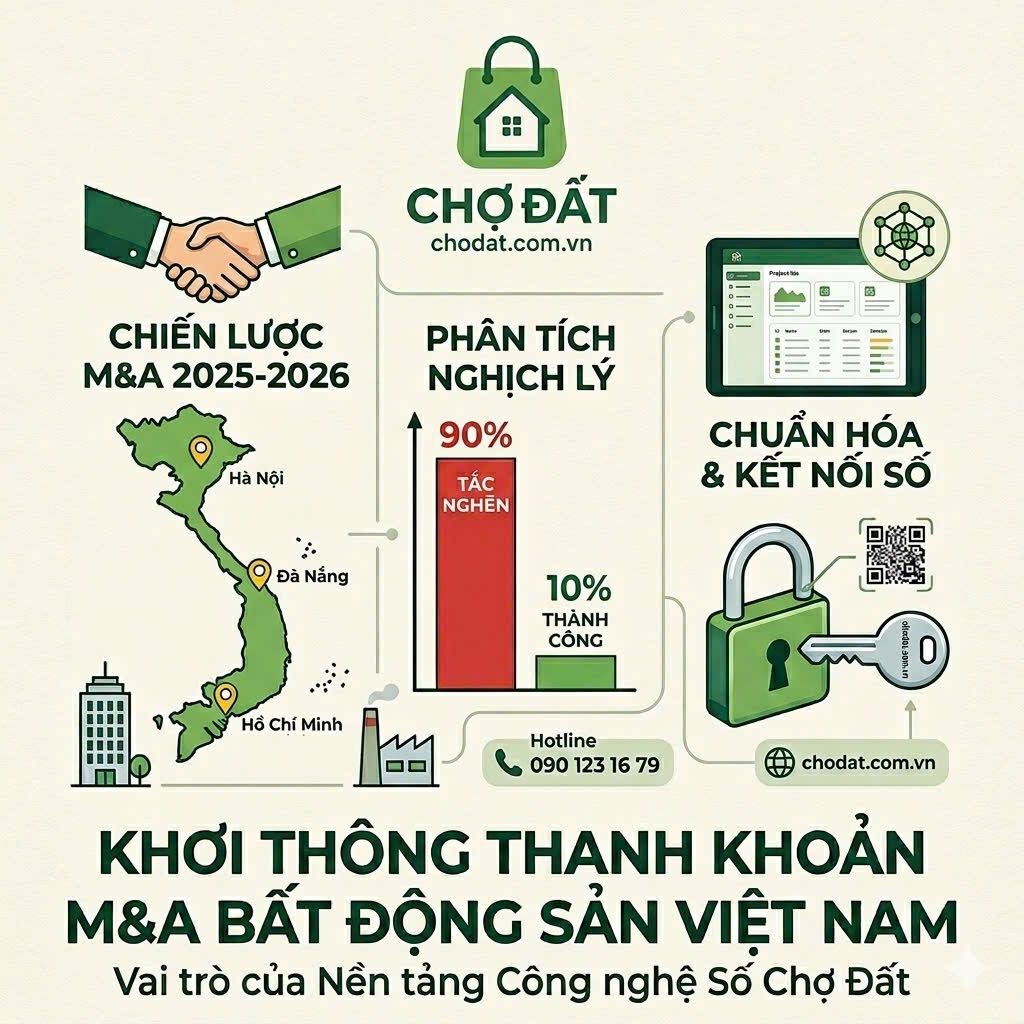
In a market where high-quality assets are scarce, "off-market" sourcing is critical. Many high-potential targets in Vietnam are not publicly listed. Investors are increasingly utilizing platforms like Chợ Đất to analyze Search Intent and identify motivated sellers (businesses seeking to divest non-core assets or family businesses facing succession pressure).
Phase 2: Multi-Dimensional Due Diligence (DD)
Due Diligence in 2026 has expanded beyond financial and legal audits.
-
ESG and Technical DD: With EU standards like CBAM coming into effect, acquirers must audit a target's carbon footprint and energy efficiency.
-
Land Use History: Given the 2024-2026 reforms, verifying the "clean" status of land-use certificates and historical financial obligations to the state is paramount.
-
Antitrust/Competition: Transactions resulting in a market share >20% must file for clearance from the Vietnam Competition Commission (VCC). Phase II reviews can be lengthy, making early engagement with the VCC essential.
Phase 3: Structuring and Closing
Valuation gaps are common. To close deals, the use of "Exclusivity Agreements" and "No-Shop" provisions is standard.
-
Indirect vs. Direct Accounts: Payments for shares must be channeled through specialized Investment Capital Accounts (DICA/IICA) to comply with foreign exchange controls.
-
Post-Closing Registration: After the deal, the newly formed entity must update the National Enterprise Registration Database. The 2026 law shifts toward "Post-Registration Oversight," meaning the burden of compliance falls on the investor after the transaction is completed.
8. Common Pitfalls and Risk Mitigation
Despite the positive outlook, foreign investors must navigate several inherent risks.
The "Clash of Cultures" and Integration Risks
The most significant cause of post-merger failure in Vietnam is the inability to align working cultures and decision-making architectures. Many Vietnamese firms operate under centralized, informal leadership. When acquired by a multi-national corporation, the loss of key personnel or the slowing of decision-making can destroy deal value. Integration must be treated as an "operating priority" from day one, not a downstream task.
Legal and Liability Inheritances
Acquiring a company means inheriting all historical financial and legal liabilities. "Unforeseen conflicts" regarding tax enforcement or environmental compliance can arise years later. Investors are advised to use expert agencies for due diligence and, where possible, structure acquisitions as "Asset Purchases" rather than "Share Purchases" to limit historical exposure, despite the potentially higher tax rate (up to 20%).
9. Chợ Đất: Integrating Data Intelligence into the M&A Lifecycle
In the high-stakes environment of 2026, Chợ Đất (chodat.com.vn) serves as the strategic gateway for foreign investors and project owners to connect through transparency and data-driven insights.
Strategic Capabilities of Chợ Đất
-
Search Intent Analysis: Unlike traditional listing sites, Chợ Đất utilizes AI-driven marketing and predictive analytics to understand what global investors are searching for (e.g., "Ready-built factory in Binh Duong" vs. "Branded residences in District 1"). This allows project owners to position their assets precisely within the buyer's journey.
-
The "Mega-Pillar" Information Strategy: Chợ Đất provides high-value intellectual content that solves the dual barriers of information asymmetry and regulatory complexity. By integrating the "Insight -> Legal/Process -> Solution" framework, the platform ensures that investors enter negotiations with a realistic understanding of the market.
-
M&A Marketing with AI Oversight: Utilizing advanced tools for content generation and SEO, Chợ Đất ensures that high-quality M&A opportunities achieve "Top-of-Mind" status on both traditional Google search and the emerging "AI-Search" engines (Perplexity, ChatGPT, etc.).
-
High-End Networking: Under the leadership of CEO & Founder Hoàn Nguyễn, Chợ Đất maintains a vast network of "clean" land banks and businesses ready for divestment, bridging the gap between foreign capital and local opportunities.
10. Conclusion and Actionable Recommendations
Vietnam’s M&A landscape in 2026 is a "New Dawn" for the disciplined investor. The record GDP growth of 7.8% in Q1, the revolutionary "ERC before IRC" licensing sequence, and the rise of Vietnam as a global hub for branded residences and high-tech manufacturing create a compelling investment thesis. However, success is no longer guaranteed by mere presence; it requires a data-driven, strategic approach.
Actionable Recommendations for Foreign Investors:
-
Prioritize Speed-to-Market: Leverage the 2026 Investment Law to establish your entity and hire talent while IRC approvals are pending.
-
Seek Asset-Backed Quality: Target sectors with strong unit economics and clear demand, such as healthcare and industrial logistics, avoiding over-leveraged or legally ambiguous assets.
-
Engage with Strategic Gateways: Utilize platforms like Chợ Đất to access off-market deals and data insights that traditional brokerages may overlook.
-
Audit for ESG Compliance: Ensure your target is ready for EU and US green standards to maintain export competitiveness under EVFTA and CPTPP frameworks.
For further strategic consultation or to explore high-potential M&A opportunities:
-
Website: chodat.com.vn
-
Hotline: +84 90 123 16 79 (Hoàn Nguyễn - CEO & Founder)
-
Address: 135/20 Nguyễn Cửu Vân, Binh Thanh District, Ho Chi Minh City.
FAQs for Foreign M&A Investors
Q: Can a foreign investor own 100% of a company in Vietnam in 2026? A: Yes, in most sectors including manufacturing, retail, and technology. However, "conditional" sectors like banking (30% cap) and certain logistics segments still have Foreign Ownership Limits (FOL).
Q: What is the typical timeline for an M&A deal? A: With the 2026 regulatory updates, the timeline has compressed. Strategic deals typically take 6 to 10 months, depending on the complexity of Due Diligence and whether a VCC Phase II review is triggered.
Q: Is "ERC before IRC" available for all projects? A: It is available as an optional sequence for many projects, particularly those in strategic sectors, allowing for faster operational setup before final project approval.
|
Khuyến cáo:
Mọi bài viết - ý kiến đóng góp chân thành xin gửi về cho chúng tôi qua Email: chodat.com.vn0@gmail.com. Chúng tôi sẽ cập nhật và bổ sung theo quy định hiện hành của Bộ Thông tin và Truyền thông Việt Nam. Xin cảm ơn quý Anh/Chị độc giả.
|
Được tài trợ:
CÔNG CỤ TÌM MUA NHÀ ĐẤT GIÁ TỐT: AI SMART - MATCHING






















Bình Luận