Executive Summary & Investment Overview
Vietnam continues to serve as a cornerstone jurisdiction for international capital allocation across Southeast Asia. Establishing a foreign-invested enterprise requires navigating a structured regulatory pathway. From securing compliant commercial premises to obtaining dual-certificate authorization and managing cross-border capital flows, foreign investors must execute each phase with precision. This guide offers an institutional framework for international investors evaluating corporate formation in Vietnam, detailing statutory requirements, procedural milestones, risk mitigation strategies, and critical due-diligence protocols.
1. Macroeconomic Context and Strategic Rationale for FDI in Vietnam
Foreign direct investment into Vietnam has evolved from a labor-arbitrage manufacturing strategy into a sophisticated multi-sector ecosystem spanning technology, logistics, renewable energy, and advanced manufacturing. Institutional investors evaluating Vietnam must assess how macroeconomic stability, expanding free trade agreements (FTAs), and proactive infrastructure development create sustainable tailwinds for foreign enterprises.
Unlike emerging markets characterized by regulatory volatility, Vietnam maintains a structured legal framework overseen by national and provincial authorities. However, the operational reality demands rigorous localization strategies. Investors cannot rely solely on macro tailwinds; they must align corporate structures with domestic licensing authorities, industrial zone regulations, and sector-specific foreign ownership caps where applicable.
The Role of Foreign Direct Investment in Regional Supply Chains
Global supply chain diversification has cemented Vietnam's position as a premier alternative manufacturing and operational hub. Investors deploying capital here typically target export-oriented manufacturing, domestic consumer markets, or regional logistics platforms. Each vertical carries distinct regulatory expectations, particularly regarding environmental compliance, land use rights, and workforce localization.
Institutional Investor Alignment and Capital Allocation Strategy
When structuring an FDI entry, institutional funds and strategic acquirers must evaluate whether a greenfield setup or an acquisition vehicle best serves their investment horizon. Greenfield projects provide pristine operational control and clean balance sheets but require navigating the foundational licensing phases from inception.
2. Phase One: Securing Compliant Commercial Premises and Head Office Infrastructure
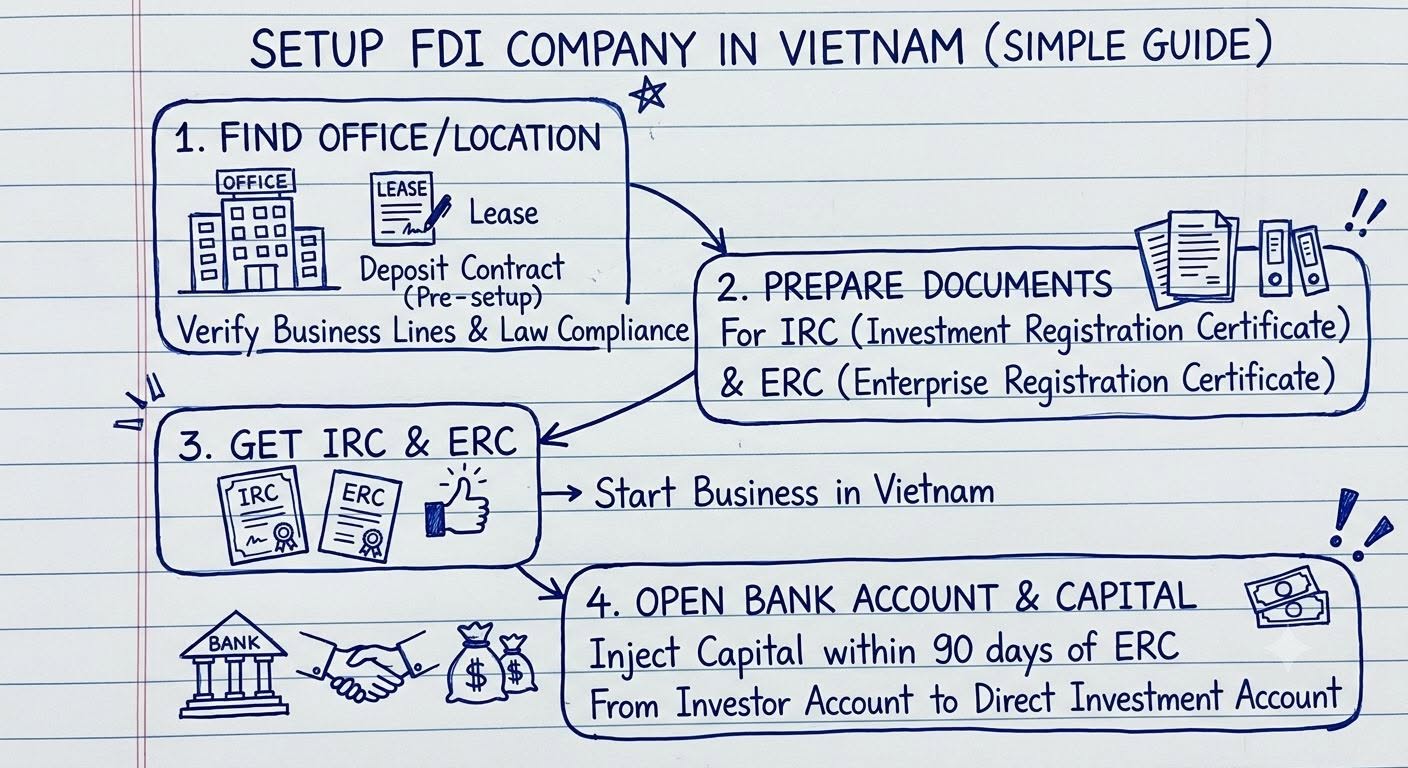
The foundation of any foreign-invested enterprise in Vietnam begins with physical infrastructure validation. Vietnamese corporate law mandates that every legal entity maintain a registered head office within the territory. For foreign-invested companies, this requirement extends beyond a mere mailing address; the selected location must correspond directly with the approved business lines and comply with local zoning ordinances.
During the initial planning stage, foreign investors must execute a deposit contract or memorandum of understanding with the property lessor. This preliminary agreement secures the physical space while corporate formation applications are compiled. Once the entity is officially established, the lease transitions into an official, binding contract executed between the lessor and the newly formed Vietnamese company.
Zoning and Business Line Compliance Analysis
A frequent operational bottleneck involves mismatching proposed business lines with the commercial classification of the real estate asset. For instance, light assembly or warehousing activities cannot be housed in standard residential-commercial mixed-use buildings unless specifically zoned as industrial or commercial logistics parks. Institutional investors must perform exhaustive zoning due diligence before committing capital to lease deposits.
Drafting Preliminary Lease Contracts vs. Official Corporate Leases
The transition from a deposit contract signed by the individual foreign investor to the official lease agreement executed by the Vietnamese entity requires careful legal drafting. Indemnity clauses, termination rights tied to licensing delays, and landlord cooperation covenants are critical elements that protect the investor during the pre-licensing window.
3. Phase Two: Regulatory Documentation and Dual-Certificate Application
Establishing an operational entity requires acquiring two foundational statutory instruments: the Investment Registration Certificate (IRC) and the Enterprise Registration Certificate (ERC). The IRC governs the foreign investment project itself, evaluating capital adequacy, economic sector eligibility, environmental impact, and tax incentives. The ERC acts as the corporate birth certificate, establishing the legal entity as a Vietnamese corporation.
Preparing the dossier for IRC and ERC issuance demands meticulous attention to detail. Dossiers typically include corporate charters, audited financial statements of the parent entity, proof of legal address, and detailed descriptions of the intended commercial activities. Provincial licensing authorities review these documents to ensure full alignment with national investment laws and international commitments such as WTO accession protocols.
Differentiating the Investment Registration Certificate (IRC) and Enterprise Registration Certificate (ERC)
| Certificate Type | Primary Regulatory Focus | Issuing Authority | Key Evaluation Criteria |
|---|---|---|---|
| Investment Registration Certificate (IRC) | Foreign investment project approval, capital scale, sector compliance. | Department of Planning and Investment (DPI) / IZ Management Boards | Business line legality, financial capability, land use needs. |
| Enterprise Registration Certificate (ERC) | Corporate entity formation, governance structure, legal representative. | Business Registration Office under DPI | Charter validity, shareholder identity, registered address. |
Overcoming Common Documentation Bottlenecks
Delays in licensing frequently stem from ambiguous business descriptions or consular legalization issues concerning foreign parent documents. Institutional investors must ensure that all overseas corporate documents are properly notarized, consularized, and translated into Vietnamese by certified translation agencies before submission to provincial authorities.
4. Phase Three: Post-Licensing Operational Activation and Setup
Upon receiving the IRC and ERC, the foreign-invested company transitions from a proposed venture to an active legal entity. However, holding the certificates does not immediately clear the company for full commercial operations. A series of mandatory post-licensing procedures must be executed without delay to achieve full operational readiness.
These operational steps include procuring the official company seal (digital and physical), registering digital signatures for tax filing and electronic invoicing, registering labor use plans, and fulfilling initial tax registration obligations with local tax bureaus. Failure to complete these administrative steps can trigger statutory penalties and stall commercial contracting.
Tax Registration and Electronic Invoicing Setup
Vietnam operates an advanced electronic tax administration system. Newly established FDI companies must integrate their accounting systems with licensed e-invoicing providers, register digital tokens for Value Added Tax (VAT) and Corporate Income Tax (CIT) declarations, and open mandatory corporate tax accounts with authorized commercial banks.
Statutory Labor and Social Insurance Registrations
Employing local and expatriate personnel requires formal registration with local labor departments and social insurance agencies. Foreign-invested employers must adhere to mandatory contribution schedules for social health, and unemployment insurance, alongside securing appropriate work permits and temporary residence cards for foreign managers and technical experts.
5. Phase Four: Banking Architecture and the 90-Day Capital Injection Mandate
Capital compliance is one of the most strictly enforced aspects of Vietnam's foreign exchange control regime. Following the issuance of the Enterprise Registration Certificate (ERC), the newly established Vietnamese company is legally obligated to open a Direct Investment Capital Account (DICA) denominated in foreign currency (or VND as permitted) with an authorized commercial bank operating in Vietnam.
Crucially, as established by regulatory compliance standards, the initial charter capital committed in the investment project must be injected from the investor's legitimate overseas bank account directly into the DICA of the Vietnamese company within 90 days from the issuance date of the ERC.
Mandatory Capital Injection Timeline
Initial capital should be injected from investor's legitimate bank account to Direct investment capital account of Vietnamese company within 90 days from the issuance date of ERC.
Mechanics of the Direct Investment Capital Account (DICA)
The DICA functions as a closed-loop financial conduit. All capital inflows for equity contributions, registered shareholder loans, and subsequent capital repatriations must pass through this specific account. Commercial banks act as frontline regulators, verifying the source of funds against anti-money laundering (AML) protocols and ensuring that remittances match the approved capital schedules in the IRC.
Implications of Failing the 90-Day Capital Window
Missing the 90-day capital injection deadline exposes both the parent investor and the local entity to regulatory sanctions, administrative fines by the State Bank of Vietnam, and mandatory project amendment procedures to reduce or reschedule registered capital. Institutional investors must coordinate treasury operations well in advance of ERC issuance to ensure seamless cross-border wire transfers.
6. Comprehensive Risk Analysis for Foreign Investors in Vietnam
While Vietnam offers compelling growth dynamics, institutional investors must systematically evaluate operational, regulatory, and financial risks. Unidentified zoning restrictions, delays in licensing approvals, foreign exchange restrictions, and evolving tax interpretations can materially impact project IRRs if not properly modeled.
Furthermore, intellectual property protection, labor disputes, and supply chain bottlenecks represent secondary risk vectors. Establishing a robust risk mitigation framework during the initial setup phase is essential for safeguarding invested capital.
Foreign Exchange and Repatriation Controls
Vietnam maintains managed capital accounts. While current account transactions (such as trade payments and service fees) enjoy broad freedom, capital account transactions—including dividend repatriation, loan repayments, and equity divestments—are strictly monitored through registered banking channels. Investors must ensure all profit distribution resolutions are supported by audited financial statements and tax clearance certificates.
Regulatory Shifts and Compliance Enforcement
Regulatory interpretation across different provincial departments (DPIs) can occasionally exhibit variance. An investor approved in one industrial province may encounter different documentary requirements in another. Maintaining transparent dialogue with local authorities and engaging experienced legal counsel is vital for navigating regulatory friction.
7. Due-Diligence Framework and Strategic Decision Criteria
Before committing capital to a Vietnamese FDI project, investment committees must execute a disciplined due-diligence protocol. This framework evaluates structural readiness, legal compliance, financial soundness, and operational feasibility.
Below is an institutional due-diligence checklist designed for foreign investors evaluating market entry in Vietnam:
| Due-Diligence Domain | Key Evaluation Focus | Verification Requirement |
|---|---|---|
| Real Estate & Zoning | Head office compatibility with business lines. | Land use rights certificate (LURC), lessor verification, deposit contract review. |
| Corporate Licensing | IRC and ERC scope alignment. | Consularized parent documents, sector ownership cap analysis. |
| Banking & Capital | DICA readiness and 90-day injection schedule. | Authorized bank agreements, cross-border remittance routing plan. |
| Tax & Labor | Electronic invoicing and statutory insurance compliance. | Tax bureau registration confirmation, labor plan submission records. |
8. Practical Next Steps for Institutional Investors
Executing an FDI setup in Vietnam requires a structured, multi-phase project management approach. Investors should avoid ad-hoc execution and instead follow a disciplined timeline from preliminary real estate due diligence to final DICA capital verification.
To accelerate your market entry and ensure full regulatory compliance, engage with qualified advisors who specialize in cross-border corporate structuring. Review your capital deployment schedule against the 90-day ERC rule and establish direct banking relationships early in the planning cycle.
9. Conclusion and Long-Term Outlook
Setting up an FDI company in Vietnam offers profound strategic advantages for international investors seeking expansion in high-growth Asian markets. By methodically addressing real estate zoning, securing dual IRC and ERC licensing, establishing compliant banking channels via the DICA, and respecting the 90-day capital injection deadline, foreign enterprises can build a durable foundation for long-term operational success.
Ready to Structure Your FDI Entry in Vietnam?
Chodat Invest provides institutional advisory and capital-raising support for foreign investors entering Vietnam. Connect with our team to evaluate your corporate structure, review due-diligence protocols, and streamline your market entry strategy.
Explore Investor Services10. Advanced Capital Structuring and Foreign Exchange Governance
Managing capital flows across international borders into Vietnam requires strict adherence to the regulations enforced by the State Bank of Vietnam (SBV). Beyond the foundational requirement of funding the Direct Investment Capital Account (DICA) within the 90-day statutory window following Enterprise Registration Certificate (ERC) issuance, foreign investors must establish sophisticated treasury protocols. These protocols ensure that all subsequent capital injections, shareholder loans, and profit distributions comply with foreign exchange controls without triggering administrative bottlenecks or delays in commercial banking operations.
Shareholder Loans vs. Equity Capital Allocations
Institutional sponsors frequently evaluate the optimal mix between equity capital and foreign shareholder loans. While equity establishes the permanent capital base registered under the Investment Registration Certificate (IRC), foreign loans offer flexible debt financing structures. However, medium- and long-term foreign loans exceeding one year must be formally registered with the State Bank of Vietnam. Failure to secure SBV loan registration before drawdown can severely restrict the borrower's ability to service interest and principal repayments through official banking channels.
Treasury Management Framework for Cross-Border Remittances
Key Treasury Compliance Pillars
- Ensure all initial capital remittances originate directly from the investor's verified, legitimate overseas bank account.
- Match every incoming wire transfer precisely with the approved capital contribution timeline documented in the IRC.
- Maintain comprehensive audit trails for all currency conversions executed through authorized commercial bank partners in Vietnam.
- Coordinate closely with corporate secretarial teams to reconcile accounting books with DICA statements prior to tax audits.
11. Operational Governance and Corporate Secretarial Best Practices
Once an FDI company successfully navigates the licensing and capital injection phases, ongoing corporate governance becomes the primary defense against regulatory non-compliance. Vietnamese enterprise law places significant legal responsibility on the designated Legal Representative. This individual holds ultimate accountability for statutory filings, tax declarations, and adherence to the approved business lines specified in the corporate charter and licensing certificates.
The Responsibilities of the Legal Representative
The Legal Representative can be a resident foreign national holding valid work permits and residency credentials or a Vietnamese citizen appointed by the foreign parent entity. Given the personal liability associated with corporate defaults, tax non-compliance, or unauthorized business scope expansion, institutional investors must implement robust internal controls, dual-authorization sign-offs, and comprehensive directors' and officers' oversight mechanisms.
Mandatory Annual Compliance Calendar
| Compliance Filing | Statutory Deadline | Responsible Authority | Core Focus |
|---|---|---|---|
| Annual Financial Audit | Within 90 days of fiscal year end | Independent Auditors & Tax Bureau | Statutory financial statement verification. |
| CIT Finalization Declaration | Within 90 days of fiscal year end | Local Tax Administration Office | Corporate income tax reconciliation. |
| Investment Project Report | Quarterly and Annually | Department of Planning and Investment (DPI) | Operational progress and capital deployment status. |
12. Mitigating Operational and Tax Compliance Risks During Scale-Up
As foreign-invested enterprises transition from initial setup to full commercial execution in Vietnam, management must maintain vigilant oversight over ongoing tax and operational obligations. While initial licensing and capital injections establish the legal baseline, ongoing tax audits and labor compliance reviews represent critical operational hurdles. Institutional investors should deploy internal audit protocols to reconcile monthly Value Added Tax (VAT) filings, withholding taxes on cross-border services, and transfer pricing documentation where intra-group transactions occur.
Transfer Pricing and Related-Party Transactions
Multinational corporations operating subsidiaries in Vietnam frequently engage in cross-border procurement, management services, or intellectual property licensing with affiliate entities. Vietnamese tax authorities enforce rigorous transfer pricing regulations aligned with international OECD standards. Local management must maintain contemporaneous documentation substantiating the arm's length nature of all related-party transactions to mitigate the risk of tax reassessments, late payment penalties, and profit adjustment determinations.
Navigating Labor Inspections and Employment Regulations
Employment compliance in Vietnam is governed by the Labor Code and strictly enforced by local labor departments. Foreign-invested companies must maintain standardized labor contracts, internal labor regulations (ILR) registered with competent state authorities, and transparent payroll systems. Special attention must be paid to statutory ratios for expatriate workers, mandatory work permit renewals, and accurate social, health, and unemployment insurance calculations.
13. Strategic Decision Framework for Post-Setup Expansion and Restructuring
Following successful stabilization, many institutional investors evaluate subsequent capital expansions, business scope modifications, or operational restructuring. Expanding licensed business activities or increasing registered charter capital requires formal amendment applications submitted to the provincial licensing authorities. Understanding the procedural friction points during expansion phases prevents costly operational interruptions.
Procedure for Expanding Business Lines and Operating Locations
Key Considerations for Scope Expansion
- Verify whether newly proposed commercial activities fall under conditional foreign investment sectors.
- Confirm that additional operational sites comply with industrial zoning and environmental impact assessment requirements.
- Submit amended Investment Registration Certificate (IRC) applications prior to executing commercial contracts in new verticals.
- Update Enterprise Registration Certificate (ERC) records to reflect changes in corporate scope or registered address.
Evaluating Greenfield Expansion Versus M&A Exit Pathways
When foreign sponsors contemplate liquidity events or regional portfolio realignments, they frequently weigh internal organic growth against equity divestment or secondary M&A transactions. Executing a clean share transfer in a Vietnamese entity requires regulatory approvals if the target operates in restricted sectors, alongside clearance of all outstanding tax and labor obligations. Early structuring during the initial setup phase ensures that the corporate vehicle remains attractive to future institutional buyers or strategic acquirers.
14. Strategic Liquidity Pathways and Exit Readiness for Foreign Sponsors
For institutional investors and private equity sponsors deploying capital into foreign-invested enterprises in Vietnam, designing an eventual exit strategy must begin during the initial corporate setup phase. Whether contemplating a strategic trade sale, secondary buyout, or cross-border restructuring, the cleanliness of the corporate ledger, adherence to foreign exchange regulations, and historical compliance with capital injection mandates directly dictate valuation realization and transaction velocity.
Share Transfer Approvals and Foreign Ownership Caps
When transferring equity ownership in a Vietnamese limited liability company or joint stock company to a new foreign or domestic investor, corporate secretarial teams must verify whether the target business lines are subject to statutory foreign ownership restrictions. Certain restricted sectors require prior approval from the Department of Planning and Investment (DPI) before equity transfer agreements can be legally executed and registered. Institutional sponsors must maintain transparent cap tables and verified share issuance records to prevent transaction delays.
Tax Clearance and Repatriation Mechanics upon Exit
Exit Repatriation Protocols
- Obtain comprehensive tax clearance certificates confirming that all corporate income tax, withholding tax, and value-added tax liabilities have been fully settled.
- Ensure that proceeds from share divestments are channeled through the approved Direct Investment Capital Account (DICA) or specialized indirect investment accounts as mandated by the State Bank of Vietnam.
- Reconcile all historical capital contributions, including the initial capital injected from the investor's legitimate bank account within 90 days from the issuance date of the ERC, against audit reports.
- Prepare comprehensive documentation packages for commercial banking partners to substantiate the legitimacy of outward capital remittances.
15. Stakeholder Communication and Institutional Oversight Protocols
Managing cross-border joint ventures and wholly foreign-owned subsidiaries requires transparent communication channels between the overseas parent organization and local executive management in Vietnam. Institutional investors should implement formal reporting frameworks that track regulatory filings, capital adequacy ratios, tax compliance status, and operational milestone achievements. Establishing clear governance guardrails ensures early detection of potential compliance drifts and safeguards the investment committee's strategic objectives.
Internal Audit Checklists for Ongoing Compliance
| Governance Check |
|---|
Investment Disclaimer
This publication is prepared by Chodat Invest for informational and educational purposes only. It does not constitute legal, tax, or investment advice. Foreign direct investment involves substantial risks, and regulatory requirements in Vietnam are subject to periodic administrative interpretation. Institutional investors should conduct independent due-diligence and retain qualified local legal and financial advisors before committing capital.
Non-Reliance
Readers and institutional participants acknowledge that this material is provided as a backend draft for review. Chodat Invest makes no representation or warranty as to the absolute completeness or ongoing accuracy of regulatory timelines described herein. No reliance should be placed on this content without independent verification and formal advisory engagement.