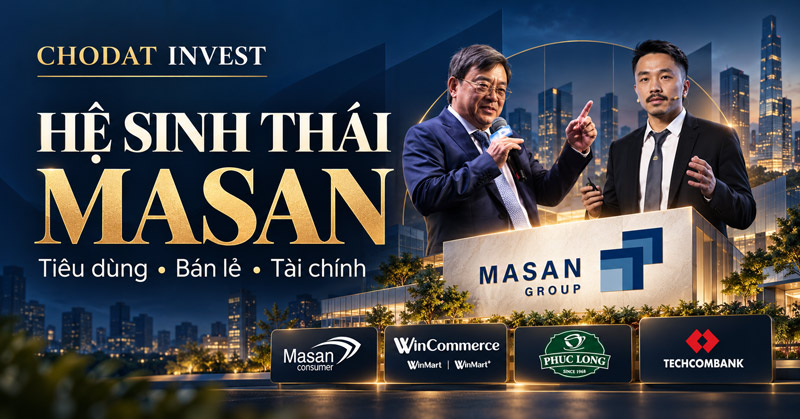
CHODAT INVEST / INSTITUTIONAL VIETNAM INTELLIGENCE / OCTOBER 2026
Vietnam's Billionaire Capital Playbook: Lessons from Masan, Vingroup and the Next Era of Private Investment
An institutional-grade perspective on Vietnam's private markets, capital allocation, M&A, shareholder governance, operating risk and the disciplined path from opportunity intelligence to transaction execution.
For Family Offices | Private Equity | Sovereign Capital | Strategic Investors | International Acquirers
Explore investment opportunities →For international investors →The investment proposition
Vietnam's appeal lies in the opportunity to combine business-building ambition with disciplined institutional capital. The stories of Masan and Vingroup illuminate how entrepreneurs created scale through very different assets—and why governance, free cash flow, regulatory diligence and exit design matter as much as growth. CHODAT INVEST provides a controlled research, dossier and transaction-workflow entry point; it does not represent or speak for the companies discussed.
IN THIS RESEARCH REPORT
PART I — THE CAPITAL THESIS
1. Vietnam at the intersection of industrial depth and private wealth
Vietnam deserves a place in the international investment committee not because every Vietnamese asset is attractively priced, but because the economy combines several forces that rarely develop at identical speeds. Export-oriented manufacturing sits alongside a large domestic consumer market, an expanding supplier base, changing logistics networks, rising expectations for professional management, and a corporate sector still moving from founder-led relationships toward more institutional systems. These characteristics create opportunities for control investments, minority growth capital, joint ventures, industrial partnerships, and carefully structured acquisitions. They also create considerable differences between a compelling macroeconomic narrative and an investable individual transaction. An investor can be directionally correct about Vietnam and still pay the wrong price, misjudge ownership rights, or underestimate the working capital required to sustain growth.
The more useful question is therefore not whether Vietnam is a growth market. It is where a specific investor can obtain an identifiable advantage, establish enforceable protections, verify the source of returns, and retain options if the original thesis develops more slowly than expected. Capital preservation and reputation should be considered alongside upside. For a family office, the underwriting conversation may begin with intergenerational wealth preservation; for a private equity sponsor, with operational transformation and an exit pathway; for a strategic corporation, with market access and supply-chain resilience. CHODAT INVEST approaches that discussion as a Vietnam-focused research, business-dossier and controlled transaction-workflow platform, rather than as a substitute for a licensed investment adviser or a guarantee of results.
2. Two corporate archetypes, one illuminating comparison
The trajectories of Masan Group and Vingroup provide a valuable way to understand how Vietnam's private sector has allocated capital across successive economic cycles. Masan developed a strong orientation toward consumer products, brand ownership, food supply chains, retail distribution, and selected industrial materials. Vingroup built scale through real estate and urban development before directing substantial attention toward industrial manufacturing and technology-related ambitions. These are not interchangeable businesses. Their asset intensity, working capital cycles, margin structures, funding needs, and sources of strategic optionality are materially different. Precisely because the models differ, examining them together reveals how capital allocation decisions can amplify or constrain long-term shareholder value.
This comparison is a case study, not a ranking of founders and not an invitation to purchase securities in either group. An institutional reader should distinguish publicly reported transactions from interpretive judgments about management strategy, and should not infer an operating failure from a temporary change in a founder's estimated wealth. A share-price movement changes a public estimate of personal net worth; it does not by itself explain the quality of each subsidiary or prove a causal relationship with consumer spending. The legitimate analytical objective is to extract transferable lessons about platform construction, mergers, leverage, governance, portfolio focus, and the evidence required before allocating large pools of capital in Vietnam.
A comparative capital-allocation lens
| Investment dimension | Masan / consumer-retail archetype | Vingroup / property-industrial archetype |
|---|---|---|
| Core economic engine | Consumer staples, branded products, distribution, retail networks | Real estate development, urban assets, EV manufacturing and adjacent ventures |
| Primary cash-flow rhythm | Frequent customer transactions; inventory, rent and supplier terms matter | Long property development cycles and sustained industrial reinvestment |
| Scaling challenge | Unit economics across store cohorts and supply-chain integration | Project approvals, capital intensity, industrial commercialization |
| Strategic asset advantage | Brand loyalty, product portfolio and retail density | Land development capability, industrial ambition and ecosystem coordination |
| Diligence priority | Gross margin, same-store sales, inventory turns, quality of earnings | Project cash-flow timing, leverage, cost of capital, capex and execution |
| Typical investor question | Does integrated scale produce incremental distributable cash? | Does the expected future return justify funding requirements and risk? |
| Risk of overgeneralization | Treating every retail expansion as a positive synergy | Treating every large capex project as proof of future competitiveness |
3. The Eastern European formation of an entrepreneurial generation
The early commercial careers of several leading Vietnamese entrepreneurs developed in Eastern Europe during the years of economic transition. In these markets, cross-border trading, basic manufacturing, food distribution, and rapid adaptation to imperfect infrastructure rewarded practical operating discipline. Nguyen Dang Quang and Ho Hung Anh became associated with businesses serving consumer demand in Russia; Pham Nhat Vuong built a food business in Ukraine before developing major operations in Vietnam. Accounts of these beginnings are historically significant because they illustrate how entrepreneurial capacity can develop through distribution networks, cash management, logistics, and customer knowledge long before a company acquires the institutional structures of a large conglomerate.
Nevertheless, the often-repeated description of an informal Eastern European entrepreneurial circle should not be mistaken for evidence of a jointly managed investment organization or a shared capital pool. Personal histories and business relationships require precise attribution. For an investor, the deeper lesson is that capabilities developed in one market may transfer to another only when supported by local institutions, governance, operating talent, and capital appropriate to the new industry. Distribution skills can support consumer brands; they cannot automatically overcome the engineering demands of electric-vehicle manufacturing or the regulatory requirements of major real-estate development. Institutional underwriting should examine which competencies have truly been replicated, which have been acquired, and which remain unproven.
4. From entrepreneurial opportunity to institutional durability
A founder can create substantial value through speed, concentration, and personal conviction. A mature enterprise is evaluated under a different standard: whether returns survive leadership succession, financing changes, unexpected regulation, and economic shocks. The transition becomes more difficult when the company spans unrelated industries. Operating knowledge that delivers superior results in packaged foods does not necessarily produce competitive advantages in metals, financial services, or transportation infrastructure. Conversely, a founder's appetite for adjacent opportunities can create genuine platforms when there are verifiable advantages in procurement, distribution, branding, technology, or customer acquisition.
Global capital therefore needs to study not merely the origins of a business empire but its mechanisms of institutionalization. Are subsidiaries independently accountable for return on invested capital? Can boards decline a founder-sponsored project? Are internal transactions documented on commercial terms? Is cash trapped in certain entities? Can minority investors observe how funding migrates across the group? Do the audit perimeter, legal ownership perimeter, and consolidated financial statements align? These questions determine whether a conglomerate is a portfolio of compounding businesses or a structure in which valuation is repeatedly challenged by uncertainty. The more concentrated the controlling shareholder's authority, the stronger the requirement for documented controls, not personal assurances.
5. How international capital should define the Vietnam mandate
A successful country allocation begins with mandate discipline. Geography alone is not an investment strategy. An investor should state acceptable sectors, ownership percentages, ticket sizes, intended holding periods, cash-yield requirements, currency exposure, governance rights, and willingness to fund follow-on capital calls. The same Vietnamese target may be appealing to a strategic buyer seeking manufacturing capacity, unsuitable for a dividend-focused family office, and too small for an institutional private equity fund with a substantial minimum equity commitment. The mandate should prevent attractive narratives from overriding transaction economics.
In the CHODAT INVEST investor journey, the practical starting point is the investment mandate rather than the widest possible deal feed. A public teaser may help a prospective buyer screen a sector or transaction structure, but identity verification, authorization, confidentiality obligations, and data-room permissions remain separate steps. This approach is designed to reduce unnecessary disclosure while preserving the ability to proceed to a properly scoped review. The platform cannot confirm that an opportunity meets an investor's return requirement, and an algorithmic fit score is not equivalent to verified seller authority, an independent valuation, or an investment recommendation. Those distinctions are essential for sophisticated capital.
6. The distinction between macro conviction and micro evidence
Vietnam's location within Asian manufacturing networks, its domestic demand, and its entrepreneurial base can support a long-term investment thesis. Yet macroeconomic strength does not eliminate adverse selection in private markets. A business offered for sale may have unresolved tax exposure, concentrated customers, land-use restrictions, unrecorded liabilities, weak internal controls, or a funding gap larger than its headline purchase price. The appropriate investment process separates country attractiveness, sector economics, company quality, transaction structure, and post-closing execution. Each level requires its own evidence set and its own rejection criteria.
Institutional investors should resist the temptation to translate national growth into a premium valuation without showing the cash-flow transmission mechanism. A rising economy does not assure pricing power for every manufacturer or retailer. Strong exports may coexist with thin margins for subcontractors; population growth may not support premium consumption when real disposable income is constrained. The investment case must show which customers will pay, why margins can persist, what capital must be reinvested, and how shareholders ultimately receive value. CHODAT INVEST can support the organization of these questions and permitted market information, while specialized professionals must independently validate legal, tax, accounting, and financial conclusions.
VERIFIED MACRO REFERENCE · FULL YEAR 2025
8.02% real GDP growth · USD 27.62 billion inward FDI disbursed, according to Vietnam’s National Statistics Office. These historic indicators are not projections for 2026 and do not establish the merits of any individual transaction.
PART II — THE MASAN AND VINGROUP CAPITAL PLAYBOOK
7. Masan's consumer-platform thesis
Masan's development illustrates the strategic appeal of starting with everyday consumption. Branded sauces, convenience foods, beverages, and other high-frequency categories provide the possibility of repeat purchase, distribution scale, supplier influence, and brand familiarity. Over time, however, the economic characteristics of brand manufacturing and physical retail diverge. A successful branded product can generate attractive margins through intellectual property, product differentiation, and broad distribution. A supermarket or convenience outlet must cover premises, staff, utilities, spoilage, delivery, and inventory before producing an acceptable store-level return. Owning both sides of the value chain can generate insight and leverage, but it also increases execution complexity.
A rigorous capital allocator would assess consumer economics at multiple levels: category share, net revenue retention of distribution partners where relevant, gross margin after trade promotion, cash conversion, working capital days, and incremental profit per new retail location. Revenue growth alone can obscure the cost of expansion. The investment thesis needs to specify whether value comes from private-label development, better shelf placement, procurement terms, logistics density, customer analytics, or corporate restructuring. Each source of value should have a measurable indicator and a counterfactual: what performance would look like without the proposed integration. An attractive consumer platform is ultimately a cash-generation proposition, not simply a network of logos or storefronts.
8. Vingroup's property-led capital formation
Vingroup's historical orientation toward urban development demonstrates how real-estate projects can accumulate capital and create surrounding ecosystems. Residential development, infrastructure, hospitality, services, and related property operations interact through land selection, planning permissions, construction schedules, and demand absorption. The economics are highly sensitive to legal readiness and the timing of receipts. The headline size of a development pipeline is not the same as liquid wealth; a project's eventual value depends on executable rights, remaining cost to complete, customer demand, financing costs, and delivery discipline. A major residential project can create substantial proceeds and still expose the group to intermittent funding constraints.
For outside capital, the crucial issue is to distinguish stabilized assets, development assets, and speculative development options. Each has a different discount rate and funding profile. Investors should not capitalize estimated future property sales as if they were recurring rent. They should demand project-by-project cash-flow waterfalls, approved master plans, land-use documentation, schedule contingencies, construction contracts, and transparent treatment of presales. When evaluating a corporate group with both property and industrial operations, analysts must also identify which property cash flows are contractually available for investment elsewhere. Cross-group transfers may be commercially rational, but they require specific documentation before they are included in a base-case funding model.
9. The industrial pivot and the economics of ambition
Moving from property development to automotive or advanced manufacturing is a strategic transformation rather than a routine diversification. Industrial programs demand research and development, product engineering, manufacturing quality systems, global suppliers, after-sales service, working capital, product-liability management, and recurring investment in model refreshes. Scale economies may arrive only after years of cash consumption. Compared with a real-estate project, where value can crystallize through phases of sale and delivery, an automotive platform often depends on a much longer learning curve and the accumulation of technical capabilities across jurisdictions.
Institutional observers should avoid both automatic skepticism toward ambitious industrial transformation and uncritical enthusiasm for technological narratives. The relevant questions are measurable: unit economics by model, factory utilization, warranty provisions, production yield, liquidity runway, product-market fit, financing dependency, and the path from gross margin to free cash flow. Scenario analysis should separate product success from shareholder returns, because a successful product may still require funding terms that dilute existing equity. Any investment decision concerning an industrial platform also depends on the rights and seniority of the actual security being acquired. A compelling national industrial story cannot substitute for the contractual economics of a particular tranche.
10. The 2019 VinCommerce transaction as a strategic case
The combination involving Masan Consumer Holdings and Vingroup's VinCommerce and VinEco operations in December 2019 is one of the clearest illustrations of large-scale private-sector reconfiguration in Vietnam. Corporate announcements and subsequent reporting describe a share-swap-led combination designed to unite consumer production with retail distribution. The transaction marked a strategic transfer of operating responsibility, not merely the purchase of individual store leases. It illustrates how business groups may trade assets and influence in order to sharpen their economic focus, with one group emphasizing downstream consumer access and the other redirecting resources toward different strategic priorities.
For an international acquirer, the precedent highlights several diligence requirements. A merger of manufacturing and retail businesses raises questions about transfer pricing, supplier negotiations, shared services, IT integration, inventory reporting, labor obligations, and contract renegotiation. The legal structure of an exchange transaction also matters: economic interests, voting rights, board control, minority protections, and potential future exits may differ materially from the public headline. A sophisticated investor should map pre-transaction and post-transaction ownership and value attribution. The lesson is not that scale automatically produces synergy; it is that synergy must be captured through governance, operating execution, and a structure that allows investors to observe where benefits accrue.
FROM CASE STUDY TO TRANSACTION DISCOVERY
The next investment is a mandate, not a headline.
Move from the Masan–Vingroup case study to currently published public opportunities and a clearly defined investor pathway.
Explore investment opportunities →Define investor pathway →11. Retail integration: where strategy meets cash flow
Physical retail is operationally unforgiving. A higher store count produces economic value only when density, assortment, fulfillment, shrinkage, and customer frequency develop in ways that cover incremental costs. Acquisition-driven scale creates a transition period in which store formats may require redesign, poorly located outlets may need to close, and distribution centers need new routing and inventory systems. Store closures can improve medium-term economics while depressing short-term reported growth. Likewise, opening new stores may lift revenue while temporarily lowering free cash flow. These trade-offs make consolidated sales a particularly incomplete operating metric.
A buyer evaluating an integrated retail platform should request cohort data by opening year, format, geography, maturity, and rent structure. Same-store sales should be analyzed separately from new-store contribution. Gross profit should be reconciled to store-level contribution after occupancy, labor, shrinkage, and logistics. Working capital benefits from supplier financing require assessment of sustainability and counterparty concentration. If an acquisition thesis depends on operational improvement, the investment committee should identify the minimum evidence required at three, six, twelve, and twenty-four months. Discipline around these milestones makes it possible to distinguish normal integration friction from structural impairment without relying on management slogans.
12. Nui Phao and the limits of strategic adjacency
Masan's exposure to Nui Phao and high-tech materials demonstrates the tension between diversification and specialization. Mineral assets may create exposure to strategically important industrial supply chains, but their value depends on geology, processing technology, offtake contracts, permitting, reclamation obligations, commodity prices, and sustaining capital expenditure. These drivers are materially different from those governing packaged food brands. Ownership of a high-quality industrial asset can enhance a group portfolio; it may also introduce capital intensity and market volatility that change the group's consolidated risk profile.
Investors should apply asset-specific valuation rather than extending a consumer-business earnings multiple to the mining segment. A responsible approach considers reserve and resource reporting standards, recoveries, environmental liabilities, unit cash cost, sustaining investment, commodity-price scenarios, and potentially different discount rates. Even if the long-term market outlook for industrial materials is positive, downside scenarios must include delayed expansion, weaker realizations, or more expensive remediation. The investment committee should also analyze how cash distributions move from the operating asset to the holding company. Exposure through a conglomerate security is not identical to direct ownership of the mineral asset, and that distinction can be decisive in a restructuring or refinancing.
13. Beyond the success narrative: portfolio exits and unproven initiatives
Conglomerate histories are often told through acquisitions, production milestones, and large capital commitments. Institutional investors should spend equal time on discontinued initiatives, non-core projects, and assets that failed to earn their cost of capital. Some source narratives refer to historical telecommunications or peripheral diversification efforts associated with business groups. Where the exact ownership, scale, and outcomes of such ventures are not supported by audited disclosures, they should not be asserted as verified corporate failures. The analytically sound approach is to study disclosed disposals, impairments, restructuring charges, and capital allocation decisions, then test the evidence at the subsidiary level.
A credible investment process does not penalize every experiment. Some acquisitions generate learning, distribution access, or optionality that is not immediately reflected in profit. The problem arises when governance permits unsuccessful projects to receive repeated funding without an articulated decision rule. Capital allocation discipline can be measured through hurdle rates, capital budgets, post-acquisition reviews, impairment recognition, and the speed of asset rationalization. For a controlling investor, governance agreements should define reporting rights and reserved matters covering material acquisitions, related-party transactions, debt incurrence, and deviations from approved plans. For a minority investor without control, these protections are even more important than a persuasive presentation of the group vision.
14. Capital markets and the fragility of paper wealth
The fluctuations in billionaire rankings surrounding Nguyen Dang Quang offer a useful caution about confusing reported net worth with operational cash generation. Public reporting records his original inclusion in Forbes' billionaire ranks in 2019. It also records brief movements below the threshold during 2026, including a mid-September departure followed by a return later that month. Forbes' profile showed him above the threshold again in October 2026. Such movements should be described with dates, not treated as permanent status changes. Real-time wealth estimates can vary with share prices, ownership estimates, exchange rates, and the valuation methodology used by the publisher.
For institutional capital, the correct takeaway is not a judgment about any individual's personal success. It is an appreciation of how concentrated equity positions behave when public markets reassess expected earnings, balance-sheet risk, or growth prospects. An investor may own shares worth a substantial amount on paper without having equivalent immediately deployable cash. Control blocks may also be illiquid or encumbered, and strategic holdings cannot necessarily be sold without affecting market prices. Consequently, neither a founder's appearance on a wealth ranking nor a temporary absence from that ranking should substitute for analysis of cash conversion, liquidity, debt coverage, governance, and executable transaction terms.
15. Comparing cash-flow regimes across the two archetypes
Consumer brands and property development generate different patterns of cash. A branded manufacturer may enjoy recurring demand yet need working capital to support distributors and inventory. A retail chain may convert sales to cash quickly while depending on supplier credit, efficient stock rotation, and disciplined store economics. A property developer may realize large cash receipts at discrete milestones after several years of land, planning, and construction expenditure. An industrial technology initiative may require extended investment before meaningful operating cash flows appear. Consolidating these activities can make a group-level free-cash-flow headline difficult to interpret.
The necessary analytical response is to classify cash flows by business model and by ownership perimeter. Free cash flow to the firm should be reconciled from operating earnings, taxes, working capital, and sustainable investment needs. Net debt must account for debt at subsidiaries and the accessibility of cash. Investors should distinguish discretionary growth expenditure from maintenance spending, without assuming that all reported expansion investment can be stopped without consequences. A comparison between Masan and Vingroup is therefore less informative when reduced to revenue or enterprise value alone; it becomes useful when it shows which activities generate distributable cash, which require additional funding, and who has contractual rights to the residual value.
| Return driver | Key underwriting question | Downside test |
|---|---|---|
| Revenue quality | Which part is recurring and collected in cash? | Price cuts, demand contraction, customer loss |
| EBITDA conversion | What adjustments are genuinely non-recurring? | Recurring cash costs normalized back into profits |
| Working capital | How much cash is tied to additional sales? | Slower collections and weaker supplier credit |
| Capital expenditure | What spend is necessary merely to preserve capacity? | Maintenance and compliance spending above management plan |
| Debt and currency | When do obligations mature; which currencies matter? | Rates, refinancing and FX depreciation |
| Exit valuation | Who is the probable future buyer, and why? | Lower multiples, longer holding period, transaction costs |
PART III — WHAT THIS MEANS FOR THE VIETNAM INVESTMENT OPPORTUNITY
16. Consumer demand: structural opportunity, cyclical purchasing power
Vietnam's domestic consumer market is an important investment theme because growing urban centers, evolving channels, and new purchasing preferences can support differentiated retail and consumer services. Yet consumer spending is not a straight line. Households adjust purchases in response to employment, inflation, borrowing costs, rent, and confidence. A product that appears successful during a period of wage growth may lose volume when buyers trade down to smaller packages or lower-priced alternatives. A consumer platform's ability to hold gross margin through a downturn is often more revealing than its growth during a favorable period.
For a family office or consumer-focused private equity fund, underwriting should begin with repeat behavior and willingness to pay. Investigate how the basket changes by income cohort, province, channel, and season. Evaluate the difference between nominal sales growth and true unit growth. Identify categories where brands have measurable pricing power rather than promotional dependence. Where retail expansion is involved, model occupancy costs, logistics, labor availability, and competitive response. A credible growth plan should include a downside case in which real spending is weaker than expected. The purpose of such analysis is not to dismiss Vietnam's consumer potential but to determine which companies are resilient enough to compound capital across several cycles.
17. Manufacturing relocation and supplier development
International manufacturers assessing Vietnam often begin with market access, supply-chain diversification, export infrastructure, and an available industrial workforce. However, the economics of establishing or buying an operating presence require much more than a comparison of headline labor costs. The analysis should consider total landed cost, input localization, supplier quality, customs procedures, utility reliability, training needs, logistics variability, product compliance, and the lead time needed to reach stable production. Manufacturing investments frequently disappoint when capital budgets cover machinery but underestimate the time and cash required to qualify suppliers and train management teams.
A practical strategy can involve acquiring an existing exporter, forming a joint venture with a local producer, establishing a greenfield facility, or investing in a supplier platform. Each route produces different control and execution risks. An acquisition may offer customers and permits but conceal maintenance obligations; a greenfield investment offers design flexibility but delays revenue. A joint venture may accelerate local relationships while raising governance and exit concerns. Before paying for capacity, an investor should verify customer contracts, environmental permissions, factory ownership or leasing arrangements, labor commitments, and the cost of technology transfer. CHODAT INVEST can help organize sector discovery and opportunity information, with legal and engineering conclusions independently verified by qualified advisers.
18. Logistics and the importance of infrastructure realism
Ports, inland depots, industrial parks, roads, rail connections, and cold-chain facilities influence the economics of almost every major sector. Infrastructure improvement can create value, but the timing of public works and regulatory approvals should not be assumed. A site that is commercially attractive if a new transport link opens on schedule may be materially less valuable when delivery is delayed. Logistics businesses themselves often appear asset-light at the sales-presentation stage and become capital-intensive once service quality, temperature control, warehousing, fleet replacement, and tracking requirements are included.
Investment underwriting should therefore connect geographic demand to an explicit operational model. What percentage of throughput is contracted? How much capacity is truly available? Who bears fuel and currency risk? Which permissions are needed for each leg of the network? Are terminal fees and handling costs independently benchmarked? How does the business behave when export volumes slow or customers consolidate suppliers? Projected savings should be supported by route maps, actual invoices, and scenario testing. The broader lesson from Vietnam's conglomerates applies equally here: infrastructure scale matters only when it can be translated into controlled cash flow, defensible customer relationships, and a credible return on investment.
19. Real estate: differentiate development optionality from legal readiness
Vietnamese real estate can be attractive to long-horizon capital, but each project requires close attention to the legal and administrative foundations of ownership and development. Investors must establish the status of land-use rights, project approvals, permitted uses, compensation and clearance obligations, construction permissions, environmental approvals, and relevant restrictions on foreign participation. No marketing description should be treated as a legal opinion. The commercial appeal of a location may be clear while the enforceability or timing of development rights remains uncertain. In those situations the transaction may be an option on successful approvals rather than an investment in a shovel-ready asset.
A responsible investor uses a staged decision process. The first gate is basic documentary completeness and seller authority. The second examines project economics under a realistic schedule and remaining capital expenditure. The third reviews transaction structure, security, counterparties, and exit routes. Only after these stages should headline valuation become decisive. A real-estate acquisition may be structured as a share purchase, asset purchase, joint venture, or phased investment, depending on legal feasibility and tax implications. Each choice allocates historic liabilities differently. CHODAT INVEST's services and real-estate transaction pathways can help define information requirements and coordinate preparation; case-specific legal and appraisal work belongs with properly qualified professionals.
20. Financial services, data, and regulated boundaries
Vietnam's financial infrastructure and digital adoption create interest in payments, software, merchant services, insurance distribution, and data-enabled business models. Yet financial-sector exposure introduces regulatory obligations that differ sharply from those of consumer brands or logistics operators. Investors must consider licensing, permissible ownership, customer data protection, cybersecurity, outsourcing, anti-money-laundering controls, safeguarding rules, and the limitations on cross-border data handling. A business that appears to have a technology advantage may be constrained by the precise regulated activity it performs.
Financial services require a more conservative definition of customer economics. Gross transaction value is not revenue; revenue is not contribution profit; and contribution profit is not distributable cash. Customer acquisition cost must reflect incentive expenses and credit losses where applicable. Investors should inspect chargebacks, fraud losses, churn, merchant concentration, and dependence on external banking infrastructure. Where investment exposure is routed through a technology vendor rather than a licensed financial institution, contracts must clearly allocate operating and compliance responsibilities. CHODAT INVEST should not be portrayed as a bank, broker-dealer, custodian, or licensed securities adviser. Its useful role is supporting structured information, business preparation, and appropriate controlled introductions within its actual platform scope.
21. Energy, transition infrastructure, and industrial materials
Energy demand and industrial decarbonization can support investment themes in power-related services, energy efficiency, grid-enabling infrastructure, industrial materials, and specialized equipment. But project economics depend on regulatory frameworks, offtake contracts, equipment reliability, curtailment risk, commissioning schedules, financing costs, and environmental obligations. The existence of strong demand does not mean every project offers bankable revenue. Developers may face delays connecting assets to infrastructure or obtaining permissions, and supply contracts may contain price or performance exposure that can materially change projected cash flow.
A serious investment committee should distinguish development-stage risk from operating-stage risk. Development capital may be exposed to permits, land, contractors, and evolving policy. Operating assets face availability, maintenance, counterparty, and refinancing risk. For mineral-processing opportunities, reserve data and commodity-price assumptions deserve equally close attention. Investors should examine whether expected returns arise from demonstrable operating efficiency or from an assumption that valuation multiples will expand. Transparent documentation allows international capital to assess a transaction on its own merits rather than relying on a generalized theme of industrial transformation. Environmental and social obligations should be costed, not relegated to a narrative appendix.
22. Agriculture and the next generation of value-added exports
Agriculture and food-processing investments can combine Vietnam's production base with higher-value activities such as traceability, quality certification, modern processing, specialized cold storage, branded exports, and direct customer relationships. These opportunities are particularly relevant for strategic acquirers and family offices with experience in food supply chains. The central challenge is variability: agricultural output depends on weather, disease, fragmented suppliers, product quality, international standards, and working capital needs. A promising factory cannot consistently produce premium exports without reliable upstream sourcing and verified downstream demand.
Due diligence should follow product flows from farm or supplier through processing, storage, shipment, and final buyer acceptance. Audit product rejection rates, customer claims, working capital seasonality, supplier concentration, and compliance documents. Where a business advertises ESG performance or traceability, determine whether records are auditable and linked to actual batches. Forecast capital spending for certification, inspection, technology, and employee training rather than assuming margins improve automatically with export expansion. CHODAT INVEST's business preparation and ESG-related service pathways may be relevant when sellers need to organize such evidence before institutional review. They should never be used to imply that a particular producer or product has been independently certified unless an appropriate qualified organization has done so.
23. Healthcare, education, and trust-based recurring demand
Healthcare and education appeal to patient capital because customers value quality, continuity, and trust, while demographic and income shifts can increase demand for professional services. Yet both sectors depend heavily on licensing, people, premises, service outcomes, and reputation. A clinic's forecast cannot be evaluated purely through the number of examination rooms; it must account for practitioner availability, payer mix, equipment utilization, clinical governance, and maintenance spending. Likewise, a school expansion requires careful examination of enrollment trends, teacher recruitment, tuition affordability, property costs, and regulatory conditions.
Buyers should distinguish platform businesses with consistent standards from collections of individual sites sustained by founder relationships. Key-person dependence can be especially significant where star practitioners, school leaders, or trusted family owners are central to revenue. Transaction structures may require retention incentives, phased ownership, earn-outs, and careful protection of service quality. A high-net-worth investor may prefer resilient, moderate-return assets in these sectors rather than growth-at-any-cost rollups. The diligence standard must reflect that reputational losses can destroy value more rapidly than operational efficiencies can create it. Institutional governance should treat patient, student, and employee welfare as integral to enterprise value rather than external charitable considerations.
A sector screen is not an investment recommendation
| Investment exposure | Value creation hypothesis | Evidence that must be verified |
|---|---|---|
| Consumer and modern retail | Brand monetization, repeat demand, efficient retail network | Repeat purchases, cohort margins, store-level contribution and cash conversion |
| Export manufacturing | Engineering capability, predictable quality and global buyers | Order book, yield, audited costs, workforce, environmental compliance |
| Industrial assets | Supply-chain localization, equipment productivity and contracts | Permits, utilization, offtake agreements, energy, maintenance capex |
| Property and development | Legally deliverable assets with competitive location | Ownership, development permissions, land status, financing and absorption |
| Technology and services | Retention, intellectual property and distribution advantage | Recurring revenue quality, source of IP, security and customer concentration |
| Infrastructure and energy | Resilient contracted cash flow | Tariffs, offtake, permits, completion tests and counterparty credit |
SECTOR RESEARCH & EVIDENCE
Discover a sector. Verify an opportunity.
Use CHODAT INVEST Insights and the opportunity catalogue for initial research; independently verify every material investment claim.
Read Vietnam market insights →Browse public opportunities →PART IV — THE INSTITUTIONAL UNDERWRITING STANDARD
24. Build the investment thesis from enterprise value, not headlines
A sound valuation begins by specifying what the buyer is acquiring. Enterprise value measures the value of an operating business under a defined treatment of debt, cash, and other claims; equity value represents the residual attributable to the relevant shareholders after appropriate adjustments. In a complex Vietnamese conglomerate, the distinction is crucial because subsidiaries may carry their own obligations, minorities may hold economic rights, and certain assets may not be available to support other group companies. A valuation that mixes consolidated operating earnings with parent-only net debt can give a misleading result regardless of spreadsheet sophistication.
Investment committees should require explicit bridges from reported accounting figures to normalized cash flow, from forecast performance to enterprise value, and from enterprise value to the actual interest being purchased. The bridge should identify exceptional items, lease treatment, off-balance-sheet commitments, restricted cash, non-controlling interests, shareholder loans, and any assets excluded from the transaction. Purchase price should also incorporate fees, taxes, required working capital, and post-closing expenditure. A persuasive transaction often becomes less attractive once the total capital at risk is visible. Conversely, an apparently expensive company may become reasonable when it has defensible economics, low future capital needs, and credible downside protection. The purpose of valuation is disciplined comparison, not false precision.
25. Free cash flow as the common language of capital allocation
A recurring lesson from both consumer and industrial conglomerates is that profit is not interchangeable with cash. Revenue can be recorded before collection, inventory must be funded, and long-lived assets require replacement. Free cash flow to the firm offers a useful starting point because it estimates cash generated by operations after taxes and necessary reinvestment, before distributions to financing providers. However, its definition must be applied consistently. Analysts should normalize interest classification, capitalized borrowing costs, lease accounting, the treatment of acquisitions, and changes in non-cash working capital before making peer comparisons.
For a controlling investor, the fundamental question is whether management can increase sustainable cash flow without eroding competitive position. One-time inventory reductions or delayed vendor payments may improve a reporting period but cannot fund permanent valuation premiums. Likewise, postponing maintenance expenditure can increase near-term cash generation while creating larger future liabilities. Cash conversion should therefore be tested over several periods, ideally through expansion and contraction. A target's forecast should reveal the economic relationship between growth and reinvestment. If projected revenue accelerates while working capital and required capital expenditure remain implausibly flat, the burden of proof rests with the seller. Institutional investors benefit from understanding precisely where each additional dollar of growth capital goes and when it might return.
26. Return on invested capital and the hidden cost of conglomerate growth
Return on invested capital, or ROIC, connects operating profit to the capital used to generate it. It provides a stronger test of growth quality than revenue expansion alone. A company can grow sales through acquisitions while earning returns below its cost of capital. Such a business may become larger without becoming more valuable per share. In diversified groups, investors should calculate returns by segment and distinguish mature cash-generating units from expansion-stage investments. Blended consolidated figures can conceal both exceptionally strong businesses and persistent value destruction.
A disciplined board should approve new commitments using explicit hurdle rates that reflect currency, country, sector, project, and execution risk. The discount rate must be consistent with cash-flow assumptions: nominal cash flows with nominal discount rates, and cash flows attributable to all financing providers with an appropriate enterprise-level rate. The threshold should not be manipulated to justify preferred projects. Post-investment reviews are equally important. What was promised at approval? What capital was actually deployed? Which operational milestones were met? How much cash was returned? These comparisons make a conglomerate investable over time because they show how management responds to evidence. Without such mechanisms, attractive returns from a core business may be redirected indefinitely toward initiatives whose economic merits cannot be independently tested.
27. Sum-of-the-parts analysis and the conglomerate discount
Diversified Vietnamese groups may contain businesses with very different risk and growth profiles. A sum-of-the-parts valuation can separate consumer products, physical retail, real estate, industrial materials, financial holdings, and other operations. Each division should be valued using an appropriate method, such as normalized earnings multiples, discounted cash flow, property net asset value, or an asset-based approach, with consistent assumptions and sensitivity tests. The resulting values cannot simply be added without addressing intercompany debt, shared assets, holding-company costs, taxes on disposals, minorities, and ownership restrictions.
The so-called conglomerate discount should not be inserted as an arbitrary percentage merely because a company operates across sectors. Instead, analysts should identify the causes of any discount: lack of transparent segment reporting, weak capital discipline, limited minority protections, liquidity constraints, tax inefficiencies, and uncertainty over management priorities. Some integrated groups deserve a premium when coordination produces verifiable savings or distribution benefits. Others deserve a discount when capital allocation obscures returns. A useful investment memorandum presents both cases and explains what governance or restructuring measures could close the gap. For a buyer considering a corporate carve-out, value creation may depend more on separation, management incentives, and independent financing than on aggressive assumptions about top-line growth.
28. Debt maturity, refinancing, and currency mismatch
Leverage is not inherently inappropriate. It can lower capital costs, support productive investment, and prevent unnecessary dilution. The danger arises when debt maturities do not match the timing and currency of operating cash flows. Property and infrastructure businesses may borrow against long-development-cycle assets; retailers may need revolving facilities to finance inventory; industrial firms may borrow in foreign currency while selling in local markets. In each case, refinancing can become a strategic constraint even when assets have substantial long-term value.
Institutional diligence should map debt by legal entity, lender, currency, maturity, interest basis, security, guarantees, and covenant. Consolidated net debt is only a starting point. An apparently cash-rich subsidiary may be restricted from distributing funds, while a parent entity faces an imminent obligation. Stress scenarios should test higher interest rates, weaker exchange rates, delayed sales collections, and lower collateral values. The analysis should make clear when a covenant breach, liquidity shortage, or refinancing failure would require equity injections or forced asset sales. Private capital that understands the liability structure may identify opportunities in recapitalization or restructuring, but such transactions are inherently complex and demand specialized legal, financial, and regulatory advice.
29. The shareholder waterfall and economic ownership
A strategic investor can acquire an interest in a business without acquiring equivalent influence over cash distributions or exits. Preferred securities, shareholder loans, participating instruments, founder control, minority stakes in subsidiaries, and veto rights may materially alter the economics. The correct analysis traces value from operating cash flow through debt service, contractual preference, minority claims, taxes, and distribution restrictions to the final shareholder. In a conglomerate, this exercise must often be repeated at several organizational levels before the buyer understands what the proposed investment actually delivers.
An investment committee should request an ownership chart with all material entities and cross-holdings, supported by corporate records and shareholder agreements. It should review reserved matters, anti-dilution protections, information rights, related-party transaction rules, board appointments, drag and tag rights, transfer restrictions, and dispute mechanisms. A valuation may be reasonable for a controlling stake but unsuitable for a passive minority position if the latter lacks enforceable protections. Conversely, carefully structured minority growth capital can be attractive when governance is strong and an exit path is realistic. Sophisticated capital pays for economic rights, not simply a percentage printed in a presentation.
30. Related-party transactions and institutional confidence
Complex business ecosystems often include commercial relationships among companies whose leaders or shareholders have historical connections. Such networks may create distribution advantages, speed, and access to capital. They also require careful examination to ensure that transactions are conducted on commercial terms and that economic benefits accrue to the entity in which the investor holds securities. The existence of a relationship is not itself evidence of misconduct. The diligence question is whether pricing, approval, disclosure, guarantees, and cash movements are transparent and independently reviewable.
For acquisitions and minority investments, related-party schedules should identify material suppliers, customers, service arrangements, asset transfers, loans, and guarantees. Where a connected bank or financing institution is involved, the analysis must distinguish normal banking relationships from specific financing arrangements and avoid speculative claims. Evaluate whether agreements would survive a change in ownership and whether dependence on a particular founder or network creates continuity risk. Appropriate governance may include independent-director review, arm's-length benchmarking, audit committee approval, and limitations on transactions outside an approved budget. Stronger controls can improve access to capital because they reduce the uncertainty investors must price into every future decision.
31. Quality of earnings, audited accounts, and forensic discipline
Audited financial statements are an important foundation, but they do not remove the need for transaction-specific quality-of-earnings analysis. An acquirer needs to understand whether reported profitability reflects recurring demand, one-time asset disposals, accounting estimates, government incentives, changes in revenue recognition, or costs that will increase under new ownership. The boundary between ordinary business performance and exceptional adjustments should be documented. A company that presents adjusted EBITDA without reconciling each adjustment to its financial statements is asking investors to accept management's definition of earnings rather than a independently reproducible one.
A comprehensive review connects revenue to customer contracts and collections; gross margin to inventory records and procurement terms; salaries to staffing requirements; and debt figures to confirmations and underlying agreements. Attention should be paid to tax exposures, contingent liabilities, off-balance-sheet commitments, cash restrictions, and differences between statutory and management reports. International investors should understand whether the accounting framework and consolidation perimeter align with their investment model. When additional assurance is required, CHODAT INVEST's dossier organization cannot replace work by independent auditors or forensic specialists. The value of a well-prepared data room is that external experts can test assumptions efficiently and identify uncertainty earlier in the process.
32. Working capital: the quiet determinant of acquisition returns
Working capital rarely receives the attention given to earnings multiples, yet it can materially alter transaction economics. Growing businesses may need to fund receivables, inventories, supplier deposits, and seasonal production long before cash is collected. Retailers may enjoy structurally favorable payables, but reliance on extended supplier terms can be fragile if counterparties demand faster settlement. Manufacturers may report healthy profit margins while receivables age or product returns increase. The effect is especially significant in businesses that grow quickly, because cash demands can accelerate ahead of accounting earnings.
A buyer should calculate normalized working capital using monthly rather than annual snapshots where possible. The purchase agreement should specify the working capital target, the mechanism for adjustments, and the treatment of cash, debt, taxes, and unusual balances. For operating diligence, analysts can convert inventory days, receivable days, and payable days into a cash conversion cycle, then test realistic changes. A seemingly modest change in payment terms may absorb a large amount of capital across a national retail network. Post-acquisition improvement opportunities should be calculated after implementation costs and relationship risks, not treated as immediate free cash. This discipline frequently produces more reliable value creation than optimistic growth assumptions.
33. Sustainability, environmental liabilities, and supply-chain evidence
Environmental, social, and governance considerations are increasingly relevant to export access, lender requirements, customer procurement standards, and reputation. Institutional investors should resist two opposite errors: dismissing ESG as marketing, or treating an ESG report as evidence that all underlying risks have been managed. The relevant questions are operational. Does an industrial asset hold necessary permits? Are water, energy, emissions, and waste records complete? Can agricultural products be traced to identifiable sources? Are workplace safety measures observable in practice? Have environmental obligations and remediation costs been included in financial projections?
A useful ESG workstream starts by identifying material issues for the specific sector, assigning data owners, and assessing the quality of evidence. The result may reveal both risks and efficiency opportunities, such as lower energy intensity or fewer product rejections. For large acquisitions, independent environmental and social due diligence should be scoped alongside commercial and legal work. CHODAT INVEST provides preparation-oriented service pathways that may help organize data, but third-party certification, statutory environmental assessment, or regulated technical conclusions require appropriate providers. A disciplined investor values ESG systems to the extent they reduce operating risk, support market access, or protect future cash flows, rather than merely improving the appearance of an investment presentation.
34. Technology diligence and the distinction between software and data claims
Businesses often describe themselves as digital platforms because they operate mobile apps, websites, or internal dashboards. Technology-driven enterprise value requires a more demanding test. Investors should examine whether software genuinely improves retention, conversion, operating cost, pricing accuracy, or throughput. Proprietary data may be valuable only if it was collected lawfully, can be used for the proposed purposes, remains sufficiently accurate, and is defensible against competitors. A visually impressive platform with low engagement, manual back-office processes, and high customer-acquisition costs should not receive a premium simply for using artificial intelligence in its product descriptions.
Diligence should evaluate system architecture, code ownership, cybersecurity, data privacy controls, disaster recovery, integration dependencies, vendor concentration, and technical staffing. If AI is used in matching, valuation screening, or document organization, test explainability and error boundaries. Automated scoring may help prioritize review, but it should not be represented as an assurance of financing, asset value, seller authorization, or legal compliance. The acquisition model should reflect maintenance and security costs as well as growth spending. Sophisticated investors increasingly distinguish durable operational capability from software features that competitors can reproduce. The strongest technology thesis explains how each layer converts into defensible economics while respecting data and confidentiality boundaries.
35. Management succession and the institutionalization of control
Founder-led businesses may display exceptional decisiveness, customer intuition, and long-term commitment. These advantages can create governance concentration that becomes a risk when companies scale or bring in outside minority capital. An investor should ask whether critical customer relationships, financing negotiations, operating approvals, and government interactions can function without one individual. Management succession should not be treated as a distant estate-planning issue; it is part of the immediate assessment of enterprise continuity. Concentrated founders often remain central to business identity, but institutional resilience requires a repeatable management system.
An assessment should cover the quality of the second management layer, board succession plans, delegation of authority, performance measurement, compensation structure, and internal audit. For control transactions, retention packages should incentivize the specific individuals who carry operational knowledge, not simply senior titles. A family office investing for decades must examine whether the organization can operate across generations; a private equity sponsor must determine whether talent can execute a transformation within its holding period. Well-designed shareholder arrangements can protect both founder vision and investor rights when decision authority is clearly allocated. Governance is not the opposite of entrepreneurship. It is the architecture that allows entrepreneurial value to survive scale.
36. The strategic value of patient capital
Not every Vietnam opportunity should be underwritten against a short exit deadline. Some assets, particularly specialized manufacturing, infrastructure, healthcare, and education, may reward a longer period of operational improvement. Family offices and permanent-capital vehicles can sometimes accept longer horizons than conventional funds, allowing investment in capacity, trust, and management systems that generate returns gradually. Yet patience should not become an excuse for ignoring capital efficiency. A long holding period magnifies the cost of poor governance, avoidable dilution, weak cash generation, and persistent failure to meet operational milestones.
Patient capital needs its own explicit governance model. Investors should define a sustainable dividend policy, circumstances under which additional capital will be committed, and mechanisms for review when forecasts diverge. Liquidity arrangements can include negotiated secondary sales, staged buybacks subject to law, or strategic exit preparation. In each case, executable documentation matters more than a vague promise of future options. The comparison of Vietnam's leading conglomerates reinforces that time can be an ally only when a business learns and improves. Duration does not automatically correct weak unit economics. The investment thesis must explain how capital compounds and how the investor retains agency throughout the journey.
37. Currency, inflation, and the true return to international capital
Foreign investors ultimately evaluate realized returns in the currency that matters to their liabilities and beneficiaries. A strong investment result in Vietnamese dong may translate into a weaker foreign-currency return if exchange rates move adversely. Conversely, certain exporters have a natural foreign-currency revenue base that can partially offset imported inputs or foreign debt. The relevant exposure cannot be inferred from the industry label alone. It must be mapped through contracts, customer payments, procurement, loans, and distributions. Inflation also changes the economics of long-term leases, salary commitments, inventory, and replacement capital expenditure.
A credible financial model should show local-currency performance and translate distributions using transparent exchange-rate assumptions. Downside scenarios should test weaker currency, input-cost escalation, slower price pass-through, and more expensive imported equipment. Hedging may be available for some exposures, but it carries costs, maturities, and counterparty considerations that must be verified. Investors should avoid double-counting currency or country risk through both aggressive cash-flow haircuts and elevated discount rates without a coherent methodology. A foreign investment is not complete when the company reports a local profit; it is complete when the shareholder can lawfully and practically realize the economic return under the agreed transaction structure.
38. Exit preparation is a design requirement, not a final chapter
The attractiveness of a private investment depends partly on how the investor might eventually realize value. Potential outcomes include a strategic sale, sponsor-to-sponsor transaction, initial public offering, negotiated secondary sale, or a long-term dividend strategy. Each route requires different operating characteristics, governance, scale, reporting, and market conditions. An investment that depends on a single buyer or a public-market valuation peak is less robust than one with multiple credible options. No exit path should be treated as guaranteed, particularly when local approvals, foreign investment limits, or shareholder restrictions may apply.
Exit readiness can be built from the beginning through reliable reporting, clear corporate ownership, audited statements, documented intellectual property, transferable contracts, environmental compliance, and management continuity. For carve-outs, separating operations and shared services early may enhance strategic saleability. For minority investments, tag-along rights and negotiated transfer provisions can matter more than optimistic valuation projections. Investment committees should ask what evidence a future buyer would demand and then incorporate the answer into today's operating plan. The best time to reduce exit uncertainty is before signing the original investment agreement, when governance rights and information obligations remain negotiable.
TRANSACTION STRUCTURING
Translate the investment thesis into a defined advisory scope.
Review investment readiness, financial scenarios, dossier organization and transaction-workflow support before committing to a paid engagement.
View advisory services →Explore managed scope →PART V — TRANSACTION DESIGN FOR GLOBAL CAPITAL
39. Control acquisitions: where value creation meets responsibility
A control acquisition can provide access to operational decisions, management appointments, financing policy, and strategic restructuring. It also transfers responsibility for inherited liabilities, employee relations, regulatory obligations, and the quality of prior disclosures. An international buyer should therefore evaluate the full acquisition perimeter before assuming that majority ownership offers unqualified control. Some assets may sit outside the legal target; major contracts may require consent; permits may not be transferable; and founder relationships may be difficult to institutionalize quickly. These issues can change the economic bargain even when the headline valuation is compelling.
The control-investment thesis should identify a small number of measurable improvements: better procurement, more disciplined pricing, a stronger sales channel, plant utilization, governance upgrades, or rationalization of non-core assets. Operational benefits must be forecast alongside transition costs, retention packages, systems integration, and lost productivity. The purchase agreement should allocate historical risks through appropriate warranties, indemnities, escrow or other protections where lawful and negotiated. The investment committee should insist on a one-hundred-day plan and a longer value-creation roadmap that do not depend on immediate perfection. Acquiring control is the start of value creation, not the end of diligence.
40. Minority growth equity: strong rights without operating control
Minority investments can provide exposure to high-quality entrepreneurs without requiring the investor to assume full operational responsibility. They may also be the practical entry point where founders wish to retain control or regulatory conditions complicate a majority acquisition. The challenge is asymmetry: minority shareholders typically contribute capital while the controlling shareholder determines budgets, executive appointments, related-party transactions, and timing of an exit. The same company can be attractive to a controlling buyer and unsuitable to a minority investor at an identical valuation because the rights acquired are fundamentally different.
A strong minority structure includes information rights, reserved matters, board or observer arrangements, anti-dilution provisions where negotiated, protections against value leakage, and an exit mechanism that is realistic in the governing jurisdiction. Investors should assess what happens if the company requires more funding, misses milestones, or pursues an acquisition outside the initial thesis. Preferred equity terms can provide negotiated economics, but the practical enforceability and tax treatment require independent legal review. Valuation sensitivity should also account for the lack of liquidity and control. The priority is alignment: founders retain room to operate while outside capital receives the transparency and protections needed for a long-term partnership.
PART VI — STRUCTURES AND RISK CONTROLS FOR GLOBAL CAPITAL
41. Joint ventures: alignment before incorporation
A joint venture may be the most productive method of entering Vietnam when a foreign party brings technology, international customers, export capabilities, or capital, while a local enterprise contributes operating assets, permits, workforce knowledge, or distribution relationships. Yet complementary contributions are not the same as aligned incentives. Negotiations should begin with an explicit account of what each party is contributing, how each contribution is independently valued, what milestones activate additional funding, and what happens if either party fails to deliver. The board should not discover after incorporation that one shareholder expects dividends while the other expects aggressive reinvestment.
An institutional joint-venture memorandum should distinguish subscribed capital from shareholder loans, intellectual-property licenses, supply agreements, management-service arrangements, and guarantees. These different instruments allocate risk differently and may have distinct regulatory and tax consequences. For operations involving land, investors must understand whether rights are held directly, through a project company, or under a lease or other legally permitted arrangement. Counsel should verify whether the proposed activities, ownership percentages, and approvals are allowed for the specific industry. A locally familiar structure is not necessarily a compliant one for a new foreign investor.
Deadlock planning deserves unusual attention. A 50:50 venture without tested escalation procedures can become an enduring hostage to its own governance. Reserved matters, agreed annual budgets, transfer restrictions, dispute resolution, information rights, and orderly exit procedures should be negotiated before commitments are irreversible. A credible local partner should welcome professional verification of claims rather than treat diligence as a sign of disrespect. Relationship capital is valuable; contractual clarity is what helps preserve it when the business encounters stress.
42. Family-office portfolio design: protect the family balance sheet
For a single-family office, a Vietnam allocation belongs within a total-wealth framework. The family may already have exposure to Asian equities, regional real estate, manufacturing supply chains, or the local currency through other assets and operating businesses. A private acquisition may therefore increase concentration even when it appears geographically diversified. The investment team should analyze correlated exposures, near-term liquidity requirements, philanthropic commitments, generational succession, and whether the family is willing to support follow-on rounds during a downturn.
Governance can be calibrated to the family's preferred involvement. Some offices seek minority stakes in professionally managed businesses and quarterly reporting; others wish to build a regional operating platform and appoint experienced executives. These are different operating models with different staffing and execution costs. A family office that lacks a dedicated Asian investment team should not assume that a board seat compensates for absent portfolio-management capacity. External accountants, technical advisers, counsel, and operating partners should have defined roles and conflict controls.
A thoughtful mandate may allocate capital across stable cash-yield assets, growth equity, and a limited opportunity reserve rather than pursue a series of unrelated deals. Yet there is no universal model portfolio or guaranteed income path. The best protection against overreach is a written investment policy that explains who can approve commitments, what evidence is compulsory, how related-party conflicts are addressed, and when the family will decline an attractive-looking transaction. Wealth preservation begins with decision architecture, not a collection of optimistic forecasts.
43. Cross-border tax, holding structures, and beneficial ownership
International investment structures often involve offshore holding companies, local subsidiaries, shareholders in several jurisdictions, and multiple classes of funding instruments. A structure that appears efficient in a spreadsheet may trigger withholding taxes, transfer-pricing questions, reporting obligations, beneficial-ownership requirements, or regulatory approvals in practice. Before presenting a net internal rate of return, the financial model should reflect the taxes and transaction costs that actually arise along the intended distribution and exit routes. The location of the investor is only one relevant fact; the location of income generation and the nature of the payment are equally important.
Beneficial ownership should be traced through each entity rather than accepted from a simplified group chart. Investors need to understand ultimate controllers, rights to appoint directors, shareholder loans, any pledged shares, and arrangements that could redirect economic returns. The review should include sanctions screening, anti-money-laundering controls, source-of-funds expectations, and any politically exposed persons where legally relevant. These requirements protect capital and reputation; they should never be treated as an afterthought to commercial enthusiasm.
Rules can change and treaty benefits are not automatic. A transaction team should obtain jurisdiction-specific advice from qualified legal and tax professionals rather than relying on generic assertions about holding-company advantages. The aim is a structure that survives regulatory scrutiny, permits lawful repatriation where applicable, and remains operable if the original investor transfers its interest. A simpler, demonstrably compliant structure can be more valuable than a complex design whose anticipated tax savings rely on uncertain interpretations.
44. The regulatory permissions map for a Vietnam transaction
Foreign investment in Vietnam must be assessed against the actual transaction, sector, investor status, ownership percentage, asset class, and location. Market access conditions can vary, and a share acquisition is not necessarily treated the same as acquiring a specific real estate project or establishing a new operating company. Some businesses require sector licenses or satisfaction of conditions that do not emerge from a simple review of company registration. The investor should map approvals before signing a timetable that assumes the transaction is unconditional.
A permissions map should record the relevant authority, filing or consent, likely documentary requirements, responsible adviser, dependency on another approval, and realistic sequencing. The team should distinguish conditions precedent to closing from post-closing operational obligations. Property transactions require attention to land rights, planning, construction permissions, environmental approvals, and the economic substance of any project assets. Regulated services may involve separate licensing and foreign-ownership questions. Competition or merger-control assessment should be considered when transaction size and market circumstances warrant it.
As of October 2026, the applicable legal framework should be checked against current official instruments and implementing guidance, rather than reproduced from outdated checklists. Investment legislation and related rules are evolving, and a draft article is not a legal opinion. The board-ready output should be a counsel-reviewed matrix with identified uncertainties and a clear decision about whether risk is acceptable, can be contractually allocated, or requires the transaction to pause. Better permission analysis protects relationships as well as invested capital.
| Mandate field | What the investment team should specify |
|---|---|
| Capital envelope | Typical equity ticket, follow-on reserve, capital source and deployment pace |
| Industry and geography | Priority sectors, avoided exposures, provinces and cluster logic |
| Transaction form | Control, minority growth, joint venture, acquisition, credit or structured capital |
| Return and liquidity | Cash-yield needs, holding horizon, downside appetite and plausible exit routes |
| Governance requirements | Board access, audit standard, reserved matters and reporting cadence |
| Disclosure stage | Public teaser, qualified review, NDA, owner approval and scoped VDR access |
45. Due diligence that can survive the investment committee
Institutional diligence is most valuable when every major conclusion can be traced to identifiable evidence. The committee should expect a data-room index, information-request log, unresolved-issues register, normalized financial statements, customer and supplier concentration analysis, site-visit records where appropriate, and documented management responses. A polished investor presentation is only the beginning. Where the company has incomplete historical records, the team should explicitly assess the scope of the gap rather than quietly filling it with assumptions.
Evidence should be ranked by reliability. Independently audited reports and official registries serve different purposes from management schedules, customer invoices, bank confirmations, and verbal explanations. A contract may demonstrate an agreed commercial relationship without proving delivery or collectability; bank receipts may establish cash movement without proving the transaction's underlying economic substance. The investment committee must see unresolved contradictions, not just the most favorable documents. A due diligence process that suppresses uncertainty to accelerate signing usually raises the eventual cost of risk.
CHODAT INVEST's staged disclosure design can help participants maintain separation between public teasers, qualified profiles, executed confidentiality documents, and approved data-room access. However, a permissioned document is not automatically verified. The relevant specialists must evaluate the contents, and management remains accountable for completeness and accuracy. A useful final deliverable is an issues-to-decisions map: each material finding, its financial impact, the proposed protection, the owner responsible, and the evidence needed before a binding commitment.
INSTITUTIONAL UNDERWRITING
Build the evidence trail before requesting restricted data.
Explore how CHODAT INVEST separates public discovery, qualification, owner consent, NDA evidence and permissioned data-room access.
Understand the workflow →Review investor membership →PART VII — CHODAT INVEST: FROM INTELLIGENCE TO GOVERNED TRANSACTION
46. From public intelligence to a confidential investment mandate
The most productive first interaction with a Vietnam-focused private-market platform should be a precise mandate rather than a generic request for attractive deals. A prospective investor can begin by specifying target industries, desired ownership, capital range, geography, holding period, preferred transaction structure, and strategic objectives. A technology acquirer seeking a Vietnamese engineering team should not receive the same shortlist as a family office seeking profitable food manufacturing businesses. Mandate discipline improves relevance and reduces the likelihood of inappropriate disclosure.
CHODAT INVEST provides a public opportunity-discovery surface and separate pathways for investor onboarding, membership, and governed transaction workflow. Public information is intended for preliminary screening; it is not confirmation of verified financial statements or a solicitation to purchase a particular security. Where a case may warrant deeper review, identity and role checks, seller authorization, confidentiality obligations, and scoped virtual-data-room permissions are handled as distinct stages. The investor should understand each boundary before requesting confidential material.
An effective brief to CHODAT INVEST can be concise and rigorous: investment geography, sector, ticket size, target size, value-creation capacity, ownership appetite, expected time to deployment, and diligence requirements. A transparent process begins with the evidence available and records what remains unverified. CHODAT INVEST can support opportunity discovery, dossier preparation, and coordination within its stated scope; regulated advice, underwriting, and final investment decisions remain with qualified professionals and the investor's own governing bodies.
47. Evidence confidence, confidential disclosure, and ethical origination
A sophisticated buyer does not require every public teaser to contain an audited investment memorandum. It does require clarity about what has and has not been verified. Opportunity facts can originate with a seller, public registry, market publication, adviser, or third-party expert. These sources differ in independence and authority. The platform should therefore separate the visibility of a statement from confidence in its accuracy. A publicly displayed price, revenue range, or projected return must never be presented as an independently certified value merely because it appears in a professionally designed card.
The diligence boundary should grow progressively tighter as information sensitivity rises. Preliminary screens may use anonymized sector, geography, and transaction-size indicators. A qualified participant may then request a fuller profile, subject to the owner’s permission and the applicable confidentiality process. Commercial secrets, identifiable customer records, employee information, bank materials, and nonpublic intellectual property require even more limited access. An executed nondisclosure agreement is important evidence of obligations but does not remove the need for explicit data-owner authorization and document-level control.
Ethical origination protects both sides of a transaction. Sellers need assurance that information will not be distributed indiscriminately; investors need confidence that a transaction sponsor has the authority to disclose materials. CHODAT INVEST’s workflow design can support these distinctions while retaining records of permission and progression. The practical competitive advantage is not unrestricted access. It is a repeatable environment in which serious parties can move from curiosity to decision without sacrificing confidentiality or accountability.
48. Where CHODAT INVEST services fit in the investment lifecycle
International investors typically need several different capabilities at different stages, and they should not be packaged as though one service solves everything. During discovery, the immediate need is sector research and a usable shortlist. During preparation, a business owner may require help organizing financial statements, an investment memorandum, use-of-funds logic, a capitalization table, and an investor-ready dossier. During qualification, the emphasis shifts to identity, authority, confidentiality, and relevant investment mandates. During diligence, the central tasks are specialist review, evidence management, workstream coordination, and unresolved-issue tracking.
CHODAT INVEST describes its core scope as software, information, and business-dossier support, with public service pathways addressing readiness and strategy, preparation for fundraising and M&A, transaction coordination, and governed access. The service catalogue also describes areas in which appropriately scoped specialist work may be needed, including valuation analysis, financial review, legal diligence, and transaction documentation. Any professional opinions or regulated activities must be performed by independently qualified providers as required. These distinctions matter because institutional clients evaluate responsibility allocation before purchasing an engagement.
A useful conversion pathway is therefore built around the reader's next decision, not a universal call to buy. A family office exploring Vietnam should visit investor discovery; a strategic acquirer considering a target should review the opportunity catalogue and governed workflow; a founder preparing a sale should examine business readiness and advisory scope. Contextual navigation makes the editorial article useful even when the reader is not ready to initiate a mandate immediately.
| Who is taking the next step? | Immediate decision | CHODAT INVEST resource |
|---|---|---|
| Family office, PE sponsor or acquirer | Define a screened investor mandate | Investor pathway → |
| Investor assessing a live market segment | Study controlled public teasers | Opportunity catalogue → |
| Investor relations or sector research team | Compare public investor profiles | Investor intelligence → |
| Founder preparing for a strategic transaction | Organize valuation and business readiness | Business readiness → |
| Transaction committee scoping specialist work | Review transaction and valuation service catalogue | Advisory services → |
| Investment operations or legal coordination | Understand staged confidentiality and access | Governed workflow → |
| Qualified institution evaluating member services | Review memberships and eligibility | Investor membership → |
CHODAT INVEST · SERVICES
One next decision. A clearly scoped workstream.
Explore verified entry pages for investment discovery, capital readiness, business M&A preparation and advisory service information.
For international investors →Services & valuation →Investment readiness →49. Building an investment committee pack from a Vietnam opportunity
A high-quality investment committee pack begins with a one-page decision request. That page should identify what is being acquired, why now, the proposed amount and structure, expected return range, major uncertainties, conditions before funding, and the decision sought. Subsequent sections should cover the investment thesis, sector context, commercial diligence, operating assessment, historical and projected financials, valuation methodology, financing plan, governance, legal and tax risks, ESG matters, management assessment, and exit scenarios. An appendix should preserve source references and assumptions without overwhelming the principal decision narrative.
The pack must make downside behavior intelligible. Present sources of cash, minimum liquidity, debt maturities, potential additional funding, and the contractual hierarchy of claims. Use valuation sensitivities that relate to the real business: same-store sales and shrinkage for retail, capacity utilization and energy cost for manufacturing, sales absorption and approval timelines for property, or commodity price and recovery rates for industrial materials. Generic revenue-growth scenarios often conceal the very risk that should influence the committee's vote.
The final section should be an open-items register, not a ceremonial declaration that diligence is complete. Each unresolved issue should have a materiality assessment, proposed protection, responsible workstream, and latest acceptable resolution date. A committee that can reject or defer an investment without reputational pressure is more credible than one designed to approve every deal. A disciplined evidence trail also strengthens post-closing accountability: the operating team can compare realized outcomes with the premises that justified the capital commitment.
50. The C-suite lens: integrated operating accountability
A board-ready transaction must withstand interrogation from several executives, not merely impress the chief executive. The CEO should evaluate strategic position, mission coherence, competitive advantage, and the organization's capacity to absorb change. The CFO should test earnings quality, cash conversion, leverage, valuation, tax exposures, and the return on additional invested capital. The COO should validate capacity, quality systems, logistics, service levels, and operational improvement costs. The CRO, in its chief revenue officer capacity, should examine customer economics, retention, channel productivity, pricing, and conversion risk; the CMO should assess brand durability and the cost of acquiring sustainable demand.
Technology and information leadership introduce their own essential questions. The CTO should evaluate architecture, technical debt, cybersecurity controls, delivery dependencies, and product reliability. The CIO should examine data lineage, systems integration, enterprise information architecture, and whether reported KPIs can be reproduced. The chief compliance officer should assess permissions, regulatory exposure, and ethical conduct; the chief legal officer should map contractual rights, ownership, litigation, and enforceability. The chief human resources officer should assess retention, leadership succession, incentive alignment, labor practices, and capability gaps.
Strategy and execution cannot remain abstract. The chief strategy officer should test portfolio fit, scenarios, competitive response, and exit alternatives. The project-management director should turn closing conditions, milestones, owners, dependencies, and escalation paths into a monitored plan. Institutional investment discipline emerges when each function can challenge the thesis using evidence, and when those challenges are resolved before capital is irrevocably committed. This integrated approach is particularly important in founder-led or multi-sector businesses, where enthusiasm at the top can otherwise outrun operating capacity.
| Leadership perspective | Board-level investment question |
|---|---|
| CEO — Chief Executive Officer | Does the transaction reinforce an enduring, defensible strategic position? |
| CFO — Chief Financial Officer | Do verified cash flows, leverage and valuation justify the capital at risk? |
| CTO — Chief Technology Officer | Can systems, security and proprietary technology withstand scale and integration? |
| CMO — Chief Marketing Officer | Is brand strength supported by measurable customer economics rather than spend alone? |
| CRO — Chief Revenue Officer | Are retention, pricing, channels and pipeline conversion genuinely resilient? |
| CCO — Chief Compliance Officer | Are conduct, licensing, reporting and counterparty controls adequate? |
| COO — Chief Operating Officer | What must change in capacity, quality, procurement and execution after closing? |
| CHRO — Chief Human Resources Officer | Will critical talent, succession and incentives protect institutional value? |
| CLO — Chief Legal Officer | Which ownership, contract, governance or enforcement risks can defeat the thesis? |
| CIO — Chief Information Officer | Can management reproduce reliable data and integrate enterprise systems? |
| CSO — Chief Strategy Officer | Does portfolio fit survive downside scenarios and realistic exit alternatives? |
| PMO Director — Project Management | Are approvals, milestones, dependencies and corrective actions actively governed? |
51. A ninety-day market-entry agenda for an international investor
The first thirty days should focus on defining mandate boundaries and assembling the initial country-level evidence. Investors should clarify target sectors, ownership constraints, ticket range, operating involvement, currency policy, and governance minimums. They should also obtain professional legal and tax scoping on the likely transaction structures. A shortlist is useful only if the team understands whether the intended structure can be executed within the relevant sector. This stage should produce a screening scorecard and explicit reasons for declining opportunities, not a premature price offer.
During days thirty-one to sixty, the team can refine its shortlist and test a small number of cases using authorized information. Management discussions and indicative valuation models can begin where appropriate; outside counsel should identify permitting dependencies, while financial specialists test the quality of historical earnings and cash. For each serious prospect, the investor should request a cap table, ownership chart, principal licenses, summarized financial history, debt schedule, business model, use of proceeds if capital is being raised, and an initial set of transaction expectations. Nothing in this sequence requires confidential materials to be distributed before proper approval.
Days sixty-one to ninety should be used to decide whether to proceed to an expressly scoped diligence process, negotiate a nonbinding term sheet, seek additional evidence, or decline. The objective is not to complete an acquisition in ninety days regardless of complexity. It is to replace general enthusiasm with a prioritized set of decision-ready files and a defensible path to the next stage. A patient investor regards a disciplined decision not to transact as an acceptable outcome.
| Work period | Required board output | Do not advance without |
|---|---|---|
| Days 1–30 | Written mandate, sector screen, regulatory scoping and rejection rules | Clear capital range, sector legality and qualified decision owners |
| Days 31–60 | Evidence-based shortlist, preliminary value model and issue log | Authorized access and defensible assumptions |
| Days 61–90 | Diligence decision, draft terms where appropriate and approval pathway | Ownership verification, risk allocation and identified specialists |
| After mandate fit | Scoped workstreams, approvals and controlled engagement | Separate NDA, data-owner consent and VDR authorization |
52. An enduring partnership between international capital and Vietnamese enterprise
The most promising long-term relationship between Vietnam and global capital is not based solely on finding inexpensive assets. It is built on aligning complementary capabilities: local business knowledge, customer relationships, workforce development, international technology, strategic market access, governance, and responsible funding. Strong partnerships can support Vietnamese companies as they professionalize systems, expand export reach, improve product quality, strengthen supply chains, and prepare for succession. They can also help international investors participate in genuine operating growth rather than speculate on broad narratives or short-term valuation movements.
The Masan and Vingroup case studies illustrate different methods of building scale, and neither provides a universal blueprint. Consumer ecosystems can create recurring demand but demand disciplined retail execution. Property-based capital formation can finance growth but brings project and liquidity risk. Industrial ambition can extend the national production frontier but requires extensive capital, engineering capability, and patient financing. For the sophisticated investor, the central lesson is to combine an open mind about opportunity with conservative standards of verification. Unusual scale should raise the quality threshold for diligence, not lower it.
CHODAT INVEST seeks to provide a structured first step for investors and businesses approaching Vietnam's private markets: discover what may be relevant, define the mandate, prepare evidence, respect confidentiality, and advance through appropriate transaction controls. Its useful role is to make the journey clearer and more accountable. Actual investment returns depend on business outcomes, contract terms, regulatory compliance, and independent decisions. The invitation to global capital is therefore precise: explore Vietnam with curiosity, negotiate with discipline, and commit only when evidence earns conviction.
PART VIII — INVESTOR QUESTIONS AND EDITORIAL REFERENCE NOTES
PART VIII — QUESTIONS, REFERENCES AND FINAL PERSPECTIVE
53. Frequently asked questions from global allocators
Is Vietnam suitable for a billion-dollar allocation? The answer depends on mandate, liquidity tolerance, ticket scalability, concentration limits, and the capacity to underwrite and monitor investments. A large capital commitment should not be inferred from the size of the national economy. Portfolio construction and qualified professional advice remain essential.
Does a public opportunity teaser mean the company is verified? No. A teaser may use seller-supplied facts. Investors should seek appropriate independent confirmation of ownership, financial statements, contracts, licenses, and related liabilities before making a consequential decision.
Can a foreign investor acquire control of every Vietnamese business? No. Conditions depend on sector, ownership structure, transaction type, and applicable rules. Independent Vietnamese legal advice should verify restrictions and approvals in each specific case.
Are founder wealth rankings reliable proxies for valuation? They are approximate snapshots based on source assumptions and prices; they do not reveal distributable company cash flow or the terms at which a control block could be sold.
What distinguishes an attractive retail platform? Evidence of repeat customer demand, healthy unit economics, sustainable margins, reliable inventory systems, acceptable rent exposure, and cash generation after required reinvestment matters more than store count alone.
What role can CHODAT INVEST perform? The platform supports research, opportunity discovery, business dossier preparation, controlled introductions and transaction-related workflows within the published service scope. It does not guarantee transaction outcomes or replace licensed specialist advice.
When should a family office request confidential details? Only after confirming mandate relevance, verifying the appropriate counterparty pathway, and satisfying confidentiality and authorization requirements. Permission to read a teaser is not a right to see the data room.
How should a board interpret unusually high advertised returns? Treat them as assumptions requiring verification. Rebuild the return from cash flows, funding calls, taxes, fees, currency movements, plausible exit terms, and downside cases; never treat projected IRR as a guarantee.
54. The editorial conclusion: the next phase belongs to disciplined capital
Vietnam's investment proposition deserves neither uncritical promotion nor reflexive skepticism. The country's business sector offers meaningful possibilities across consumption, manufacturing, industrial supply chains, selective real assets, technology and infrastructure. The quality of individual opportunities will vary widely. History shows how entrepreneurs can build formidable platforms from difficult beginnings, and it also shows how leverage, diversification, and complex governance can test even the most successful business models. The informed investor studies the mechanisms of performance rather than relying on celebrity, index inclusion, or a single valuation statistic.
For the board of a family office, the investment committee of a private equity fund, or the strategy committee of a global corporation, the right outcome is a portfolio of decisions supported by verified evidence, lawful structures, realistic financing, and partners who understand institutional expectations. A transaction that survives those tests may justify patient capital. A transaction that does not should be declined, even when its presentation is exceptional. That distinction is the foundation of sustainable investment relationships and reputational durability.
CHODAT INVEST welcomes serious inquiry through its public investor and opportunity pathways, where parties can begin with a mandate and advance only as permissions and evidence support the next step. This publication is an invitation to informed exploration—not an offer to sell securities, a performance promise, a certification of any listed opportunity, or an endorsement by Masan, Vingroup, BlackRock, Vanguard, the Rothschild family, or any other institution discussed for analytical context.
CHODAT INVEST · VIETNAM PRIVATE MARKETS
Enter the market with an institutional process.
For family offices, global corporations, private equity teams and strategic acquirers: start with a mandate, proceed on evidence, and maintain governance at every disclosure boundary.
Explore public opportunities →Start the investor journey →Review service scope →Primary references and editorial standards
Research date: 14 October 2026. Case-study observations are based on public disclosures and independent reporting. Any broader interpretation concerning business strategy, valuation or market opportunity is editorial analysis, not a verified prediction of future performance.
- National Statistics Office of Vietnam — 2025 socio-economic data (GDP growth, FDI and macro context).
- Masan Group — consumer-retail platform and transaction history (corporate narrative).
- Masan Group investor relations (financial reports and disclosures).
- Vingroup annual reports (published strategy and financial context).
- Forbes — Nguyen Dang Quang profile (time-sensitive real-time wealth estimate).
- Tuoi Tre — September 2026 return to Forbes billionaire ranks (correction of the mid-September status).
- Reuters — VinFast 2026 delivery ambitions (company targets versus realized results).
Important: Masan, Vingroup, their executives and any other institutions named in this report are independent subjects of analysis and are not represented as CHODAT INVEST clients, partners, endorsers or affiliated entities. CHODAT INVEST provides software, information, business-dossier preparation and governed process support within its published scope. It does not supply investment, financial, legal, tax or accounting advice; hold capital for investors; guarantee returns; or warrant that seller-provided information has been independently verified. All capital decisions require independent specialist review.