Prepare for a useful conversation
Clarify products, supply capacity and market objectives; prepare information that helps buyers assess the fit.
VIETNAM ↔ RUSSIAN FEDERATION
CHODAT INVEST works alongside Vietnamese exporters, from product preparation and buyer introductions to clarifying transaction requirements and next steps. Each discussion and 7–14 day visit has a defined purpose on the journey towards a successful export transaction.
FROM PRODUCT TO A MEANINGFUL BUSINESS MEETING

PROPOSED SCOPE · SCHEDULE CONFIRMED BEFORE DELIVERY
Planned scope: 40 initial prospects, 7 online and 5–10 in-person meetings. Appointments are confirmed before delivery; these are not confirmed buyers.
SEE THE VALUE BEFORE YOU BEGIN
A company needs to know whom to meet, what to prepare, what to verify and what happens afterwards. The service creates value through specific work, usable outputs and a clear next step.
Clarify products, supply capacity and market objectives; prepare information that helps buyers assess the fit.
Discuss requirements, specifications, pricing and cooperation; record points of fit and questions still to verify.
Consolidate meeting notes, actions, owners and timing; agree the support needed for negotiation and implementation.
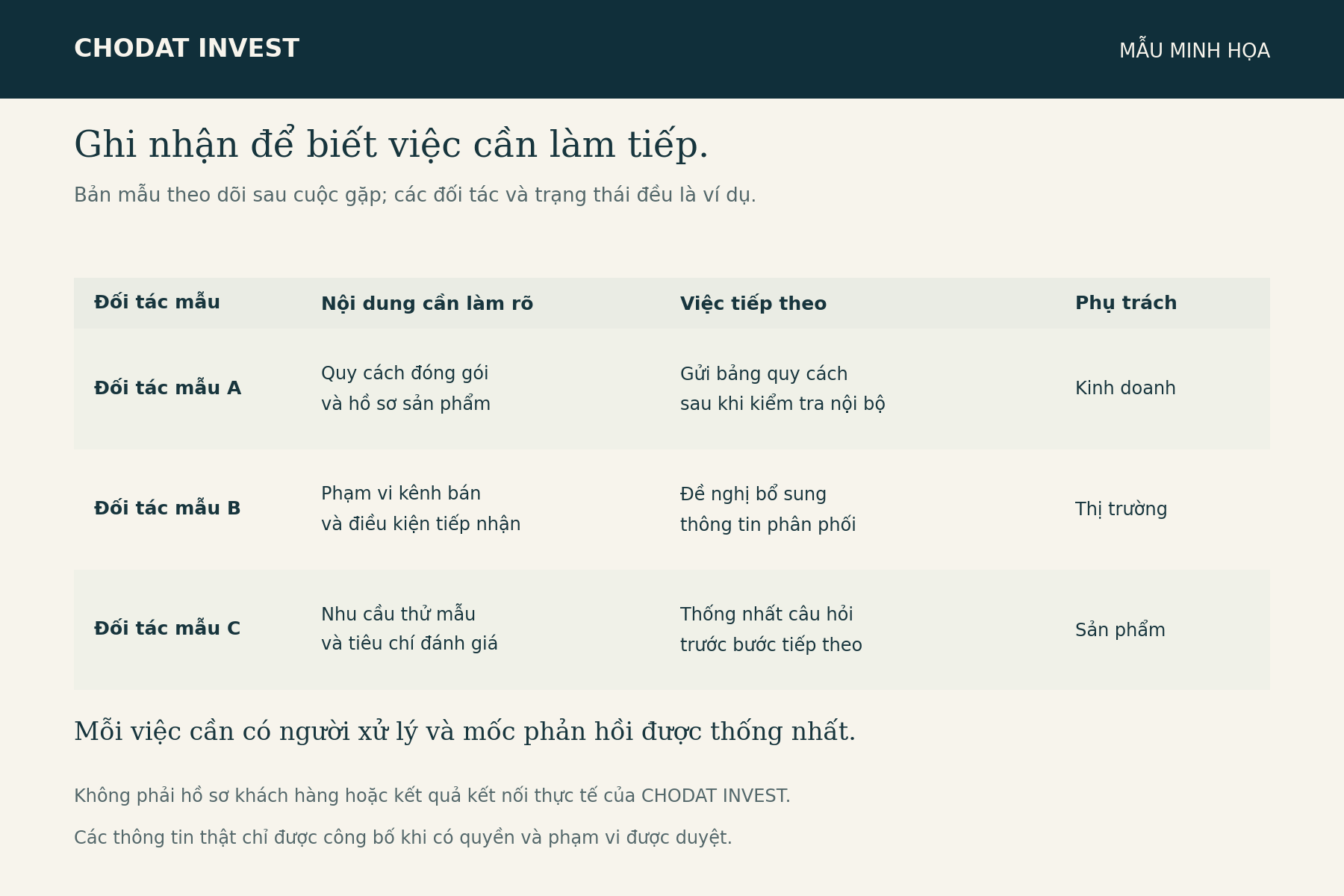
An illustration of how findings may be recorded. Deliverables and handover arrangements are confirmed in the service proposal.
View the sampleRecord products of interest, sample requests and conditions that need clarification.
Compare specifications, packaging and approaches for different customer groups.
Organise findings by priority, responsible person and proposed response date.
The goal is a transaction the company can deliver and develop over time. Clear outputs support a decision to proceed, prepare further or adjust.
Select products, buyer profiles and objectives that fit the business.
Output to agreeMarket direction and priority actions.Review profiles, samples, specifications, pricing and missing requirements.
Output to agreeA product information pack and preparation checklist.Arrange online discussions and in-person research under the confirmed programme.
Output to agreeBuyer needs, feedback and an assessment of fit.Clarify import responsibility, documentation, logistics and payment with relevant specialists.
Output to agreeRequirements to confirm before an offer or shipment.Support discussion of open commercial points and specialist coordination as required.
Output to agreeTerms, responsibilities and decisions still to settle.Follow up introductions and agree coordination for orders and future opportunities.
Output to agreeAn implementation plan with owners and review dates.CHODAT supports the pursuit of a successful transaction. Signing and performance depend on the parties, product and transaction conditions. Outputs, duration, responsibilities and follow-up are agreed in the service contract; these milestones do not make every specialist service included or guarantee an order.
Discuss your company’s export journeyVIETNAMESE PRODUCTS · INTERNATIONAL REACH
Each product group calls for a relevant opening conversation. Choose a category to explore the discussion and information worth preparing.
Specifications, batch quality and the type of buyer you want to reach.
Discuss this product group ↗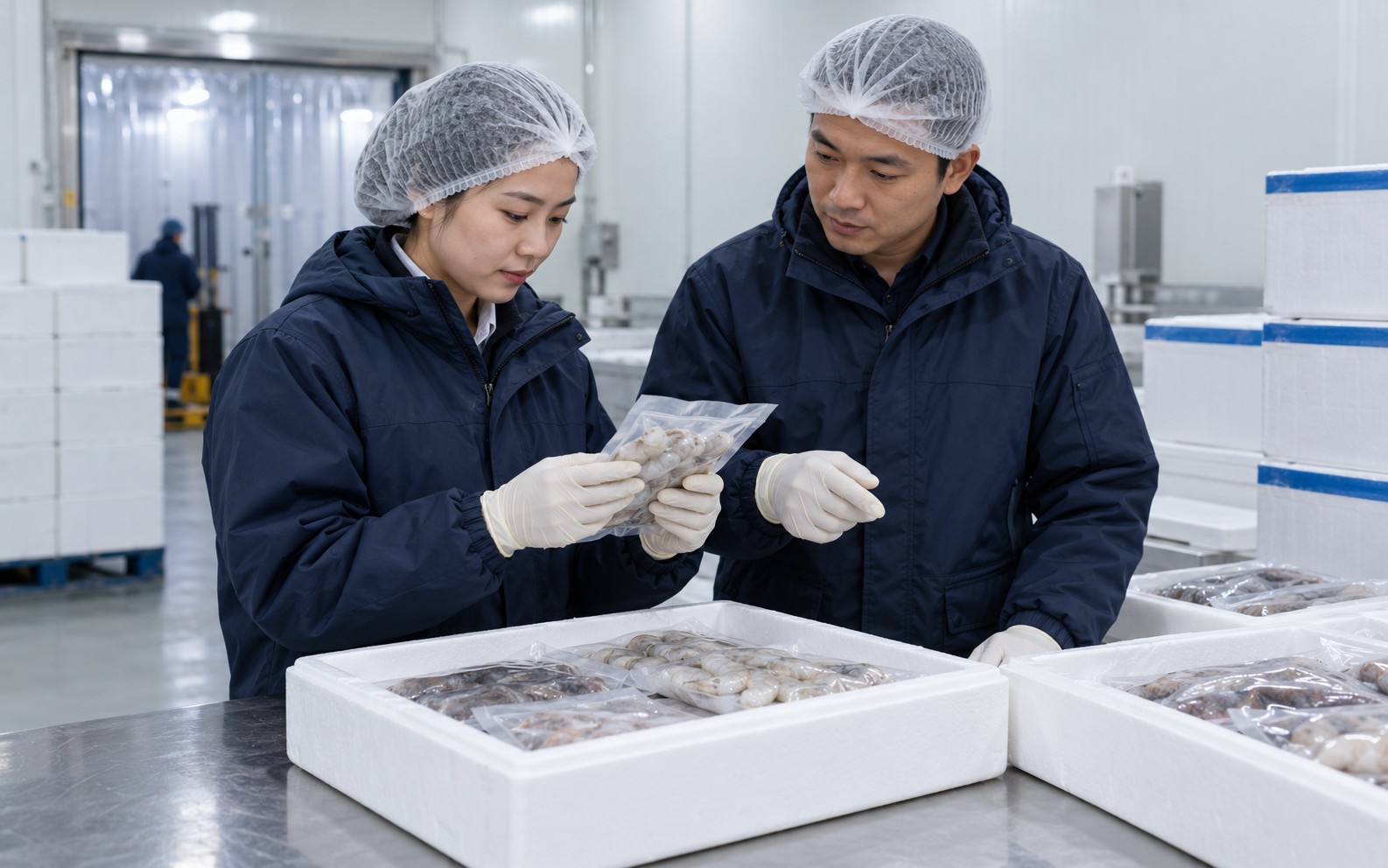
Ingredients, intended use, shelf life and storage requirements.
Discuss this product group ↗
Materials, finish, export packing and supply capacity.
Discuss this product group ↗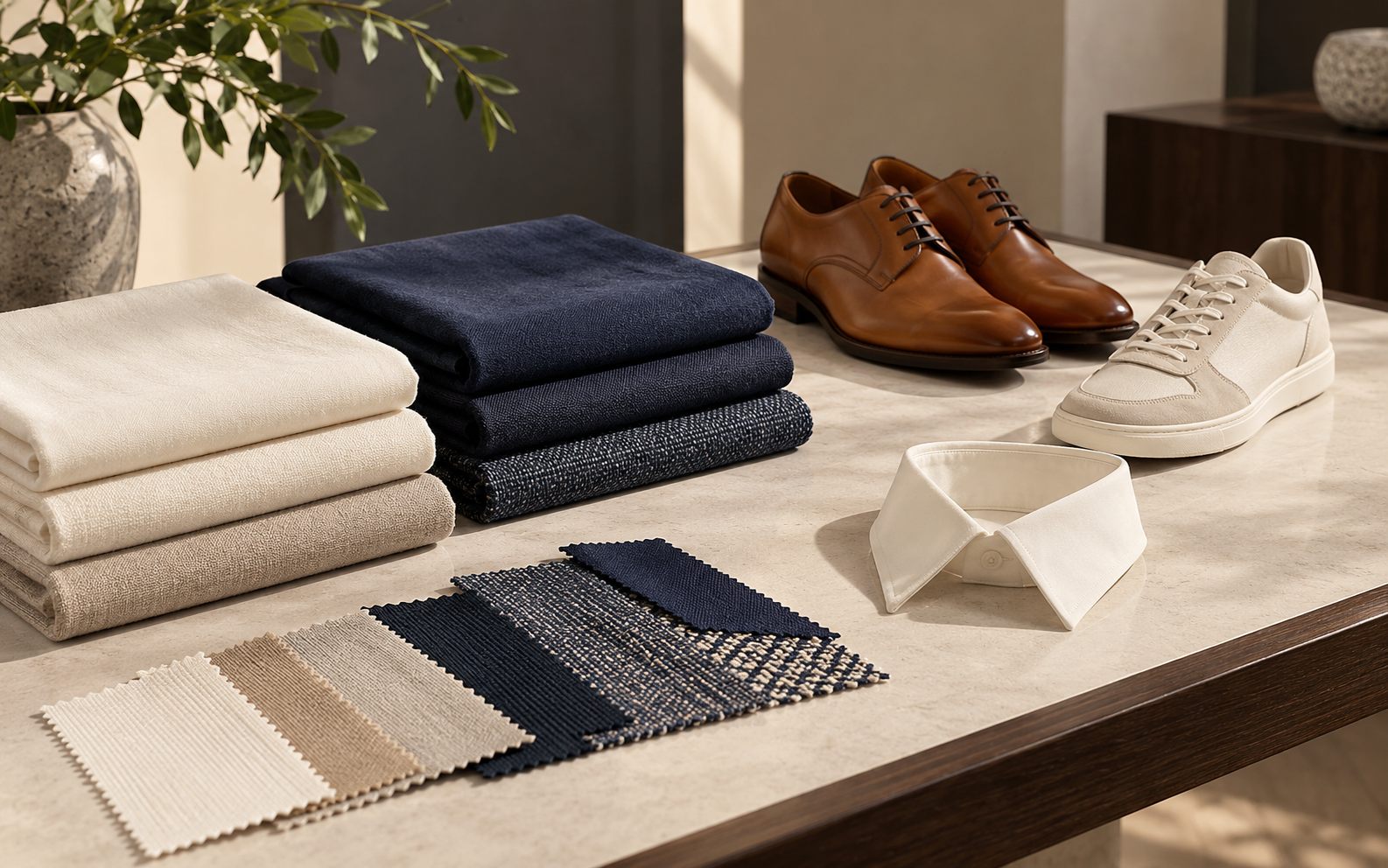
Sizing, materials, sampling time and branding arrangements.
Discuss this product group ↗
Intended users, indicative offer price and proposed distribution channels.
Discuss this product group ↗
Technical specifications, inspection criteria and consistent supply capacity.
Discuss this product group ↗PREPARE IN VIETNAM · WORK IN DEPTH IN RUSSIA
Prepare the right information, meet relevant partners and agree the next action.



MARKET IMMERSION · BUSINESS CONNECTIONS
A worthwhile visit brings back information you can act on: product fit, sales channels, pricing and delivery conditions. Choose a duration around the questions your business needs to answer.
Meet relevant partners, assess your core products and define next steps.
More time for retail research, distribution, logistics and follow-up meetings.
Study Moscow in greater depth; consider Saint Petersburg when objectives and confirmed appointments justify it.
Durations include outbound and return travel. Flights, working days and venues are confirmed before agreement. Extra days do not automatically increase meeting targets or service fees.
CHOOSE YOUR NEXT STEP
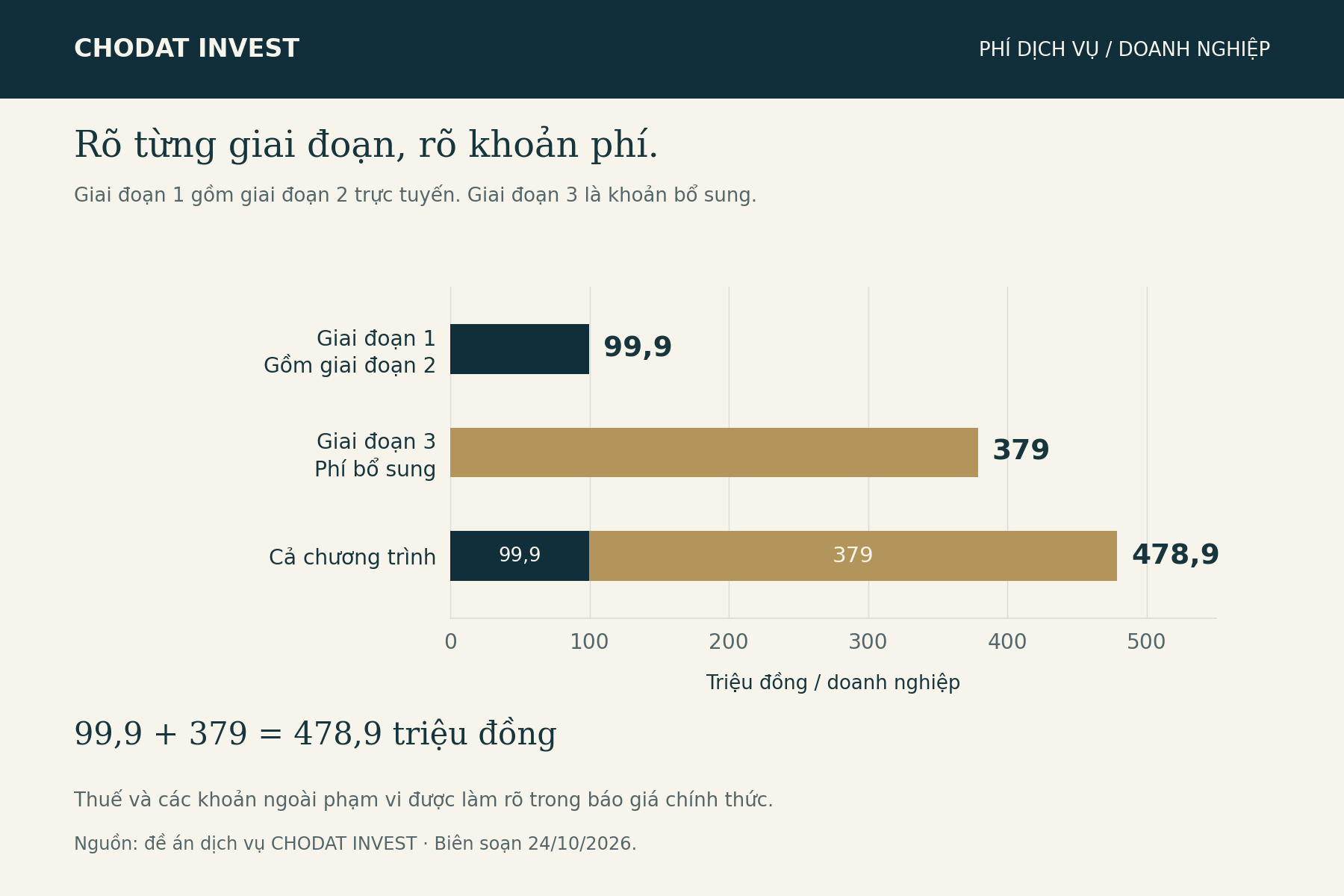
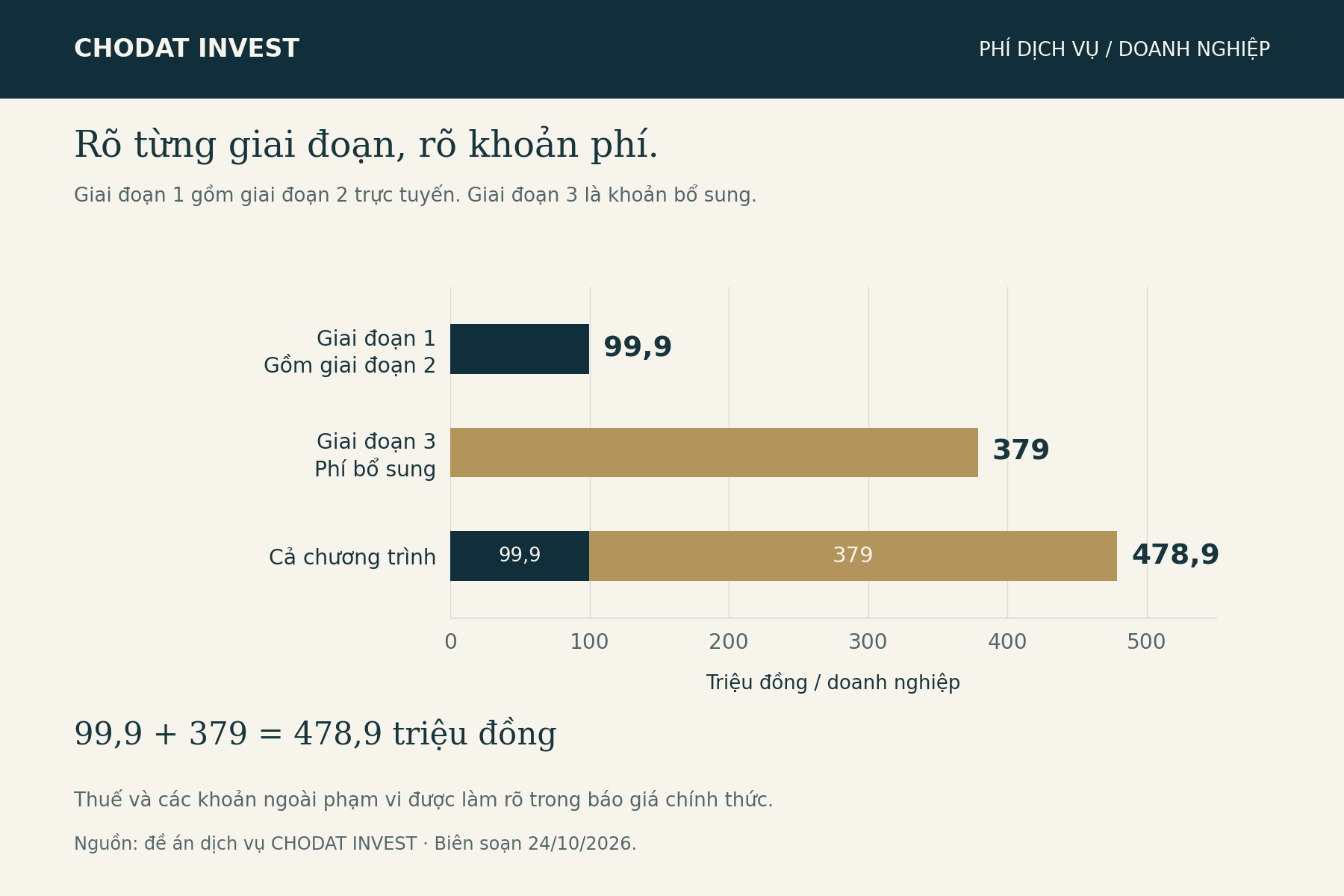
Stage 2 is included in the phase 1 online connection package.
The service fee corresponds to agreed work, outputs and responsibilities: understanding the opportunity, preparing the business, sustaining relevant conversations and progressing the next step towards a transaction.
Explore the partnership milestones ↗PHASE 1 · INCLUDING STAGE 2
PHASE 3 · ADDITIONAL FEE
Taxes, delegate numbers, flights, accommodation, visas, insurance and in-person interpretation are confirmed in the formal quotation.
 View larger image ↗
Confirmed service fees; taxes and out-of-scope costs are specified in the quotation. Sample report in Vietnamese.
Download report image ↓CHOOSE AN APPROACH · PREPARE FOR THE NEXT STEP
Trade fairs, missions, in-house outreach and advisory support serve different objectives. Compare the work covered, resources needed and follow-up after the first meeting.
| Approach | Useful when you need | Scope to check |
|---|---|---|
| CHODAT INVEST — advisory partnership | A coordinated journey from preparation and introductions to transaction requirements, within an agreed scope. | Milestone outputs, buyer criteria, handover, follow-up period and excluded work. |
| Industry trade fair | Product exposure and contact with multiple relevant businesses at one event. | Booth, samples, staff, appointments and resources to qualify and follow up contacts. |
| Trade mission | Research and introductions within the organiser’s sector, location and shared programme. | Industry fit, matching criteria, individual support and follow-up responsibilities. |
| In-house buyer outreach | Control over targets, messaging and timing using an existing internal team. | People, language, data, buyer verification and sustained follow-through. |
A qualitative comparison for choosing according to need; approaches can be combined. Unverified market costs or success rates are not a basis for declaring a universal winner.
Turn interest into an executable opportunity by clarifying requirements that affect timing, cost and cash flow.
Identify product-specific requirements, Form EAV and the response to an origin enquiry.
Read the practical guide02 ↗Cross-check the contract, invoice, transport documents, origin evidence and credit terms where applicable.
Read the practical guide03 ↗Compare the same delivery point, trade term, quote validity and additional charges.
Read the practical guide04 ↗Clarify banking, signing authority, force majeure and dispute resolution before shipment.
Read the practical guideSTART WITH YOUR PRODUCT
Start with your product, the partners you want to find and the questions you need answered. CHODAT will help clarify a suitable scope.

Enquire directly · No account required
THE BUSINESS GUIDE
From product opportunities and export requirements to budgeting and field research. Go directly to the topic your business needs.
Images and reports beside the text help put each topic into a practical context.
A new market usually begins with practical questions. Is the product suitable? Who can actually import it? What selling price leaves room for a distributor? And should the business meet potential partners online before committing to a trip?
CHODAT INVEST helps Vietnamese businesses prepare for exports to Russia step by step: defining the product offer, identifying the types of partners to approach, arranging online discussions and developing a Moscow meeting programme when the conditions are right. The aim is to enter each conversation with clear product information, a properly considered price and specific questions that can move the discussion forward.
Businesses can start with online business matching at VND99,900,000 per enterprise, covering phase 1 and the online meetings in phase 2. The in-person market research and Moscow B2B programme is phase 3, with an additional service fee of VND379,000,000 per enterprise. Selecting both brings the combined service fee to VND478,900,000 per enterprise. Taxes and related expenses are specified in the formal quotation.
Submit an enquiry directly without creating an account. Start with the product you want to introduce; the remaining details can be clarified during the consultation.
A list of companies becomes useful when you understand why each company fits your plans. Does it import for retail, redistribution, restaurants or manufacturing? Is it looking for a private label or a contract manufacturer? Does it prioritise the lowest price, supply consistency or a differentiated product range?
The programme therefore starts with the Vietnamese business’s criteria. An importer needs a clear commercial offer; a retailer needs to understand shelf readiness; an industrial customer needs specifications, capacity and consistency between batches. The same product can open a more productive discussion when it is presented in a way that answers the recipient’s concerns.
The planned scope includes an initial outreach list of 40 Russian companies, 7 coordinated online B2B meetings with online interpretation, and 5–10 in-person meetings in Moscow. Market research visits are designed around 7-, 10- or 14-day itineraries, giving businesses time to examine retail channels, distribution and the conditions for market entry. Durations refer to the overall outbound-and-return itinerary; actual flights are confirmed when the programme is prepared. The initial list does not mean that 40 buyers have confirmed purchase requirements. Individual meetings are confirmed before delivery.
Each meeting should produce information that supports a decision: which products the other party needs, acceptable specifications, missing documents, sample requirements, the person responsible for responding and an agreed next contact. A worthwhile conversation makes these questions clearer.
CHODAT provides business matching within the agreed service scope. Sample approval, contracts, orders, payments and trading terms remain decisions for the businesses involved. This approach helps enterprises assess opportunities using specific information and choose a level of commitment that fits their resources.
This option suits businesses that want to understand partner interest before deciding whether to travel. Work begins with the core products, indicative offer prices, supply capacity, customer criteria and conditions the business can meet. These inputs guide the initial outreach list and the relevant conversations.
Phase 1 includes the online meeting work in phase 2. The VND99,900,000 fee should therefore not be read as a separate charge for a contact list followed by another fee for the seven online meetings. The quotation defines the tasks, information required from the business, meeting confirmation process and acceptance criteria so both sides can follow delivery.
Select a focused range of competitive products for the first discussions. A short range with clear specifications, prices and availability is often more useful than a very large catalogue. Participants should be able to answer product questions and record anything that needs input from the factory or management.
The outcome helps the business decide its next step: improve the offer, send samples, revise a quotation, prioritise certain partners or prepare an in-person programme. If the foundations are not yet suitable, the feedback can still help revise the plan before a larger budget is committed.
The in-person phase is for businesses with a clear purpose for working in Russia and the ability to prepare the products, documents and team. The programme plans 5–10 meetings, subject to confirmation, alongside a market research trip of approximately 7–14 days. Representatives can present samples, examine how products reach customers, discuss buying requirements and agree follow-up work.
Seven days concentrates on Moscow and the most important questions. Ten days leaves more room to study sales channels, examine logistics and revisit partners where deeper discussion is needed. Fourteen days suits businesses studying a product category in greater depth or considering an additional location. A second city is included only where it has a business purpose and a workable schedule. Networking supports commercial relationships without displacing research time.
The VND379,000,000 amount is the additional phase 3 service fee. The work covered for a 7-, 10- or 14-day option is set out in the quotation; extra days or locations do not create an unagreed charge automatically. Delegate numbers, flights, hotels, visas, insurance, sample transport, in-person interpretation and any exclusions must be clarified before confirmation. Read the itinerary together with the inclusions and exclusions to establish the full travel budget.
A business with suitable products, implementation resources and a clear market development objective may consider the full route at a combined service fee of VND478,900,000 per enterprise. The decision should also reflect the ability to act after the meetings: who handles samples, who approves prices, who owns the documentation and whether funding for the first shipment is ready.
For a business still exploring, online discussions can be a sensible first step. An experienced exporter seeking additional distribution may start with a more detailed conversation about segments, regions and partner requirements. CHODAT clarifies the need before proposing an appropriate scope.
CHODAT and the company work towards a successful export transaction and a relationship that can develop. Preparation starts before a meeting; afterwards, buyer feedback should become specific actions, owners and dates. Progress may mean negotiation, sample testing or a trial order, or a decision to adjust the product before committing more funds.
Agree outputs, handover, follow-up period and responsibilities in the service scope. Specialist contracting, conformity, freight and order implementation require an agreed scope and cost. The goal of a transaction remains distinct from a guaranteed order.
Russia is often described as a large market, but a business does not sell to an entire market at once. It sells to a particular customer group, through a particular channel, at a particular price. Opportunity should therefore be assessed through the product and buyer rather than geography or broad statements about purchasing power.
An AsemconnectVietnam publication dated 17 June 2026, citing Vietnam Customs data, reported bilateral trade of approximately USD4.77 billion in 2025: nearly USD2.26 billion in Vietnamese exports to Russia and approximately USD2.51 billion in imports. Total trade increased by around 4%, while Vietnamese exports declined slightly by 3.2%. These figures demonstrate an established trading relationship, while also showing why overall growth does not make every product category easy to sell. [1]
A manufacturer should ask which existing choice its product would replace. Can it offer more consistent quality, better specifications, suitable delivery timing or a stronger brand proposition? If that is unclear, expanding the contact list alone may not create more meaningful opportunities.
Vietnamese exports to Russia have included coffee, cashews, pepper, textiles, seafood and electronics. Russia supplies Vietnam with various raw materials and production inputs. This provides a basis for examining complementary trading relationships, but commercial attractiveness still depends on the individual tariff line, supplier and distribution channel. [1]
A Vietnamese supplier’s advantage may come from a product it knows exceptionally well. A cashew processor can explain consistency, breakage, flavouring, packaging and shelf life. A furniture factory can show its ability to meet designs, protect products in transit and maintain delivery schedules. These details are more useful than a claim to supply almost anything.
Moscow is the meeting location for this service. It does not automatically determine where products will be sold. A company headquartered there may distribute to other regions, while a regional buyer may not import directly.
Ask potential partners about their sales territories, receiving warehouses, end-customer channels and experience with similar goods. A business serving one city needs a different volume plan from a distributor operating across several regions. A relevant outreach list should reflect those distinctions rather than simply classify companies by head-office address.
The free trade agreement between Vietnam and the Eurasian Economic Union was signed on 29 May 2015 and entered into force on 5 October 2016. It provides an important basis for examining preferences for qualifying goods entering member markets, including Russia. [2]
Turn that potential benefit into a verifiable pricing calculation. Establish the HS code, applicable tariff schedule, origin rule and required supporting documents. A favourable import duty can improve the price to an importer, but it does not resolve transport costs, technical requirements, distribution budgets or sales velocity.
The first plan does not have to cover Russia nationwide. A suitable product range, a capable partner and a prepared order process can form a realistic starting point. A trial phase can then provide evidence for expanding the range or entering another territory.
The quality of information gathered matters. Feedback on taste, sizing, packaging durability or ordering cycles can prevent a premature production decision. Business matching adds value when an interest in Russia becomes specific work with a responsible person.
Transport distance, documentation, language, payment arrangements and the cost of reaching a sales channel can all affect the outcome. An attractive ex-factory price may lose its advantage once freight, testing, labels, inventory and distribution allowances are added.
A sound plan explains both why the product could be chosen and how the business can deliver as promised. That makes it easier to decide whether the next investment belongs in partner introductions, product development or service capability.
A business advantage is more than a statement that Vietnamese goods are inexpensive or good. Buyers need evidence of what the supplier can deliver: monthly output, specification range, quality control, preparation time and the ability to respond when something goes wrong.
Choose three to five strengths with supporting information. A claim of consistency should come with a way of controlling batch quality. An offer to develop bespoke packaging should explain minimum quantities, design timing, sample approval and ownership of label content. A well-explained strength carries more weight than a long list of general claims.
Exporters can draw on experience in made-to-order production, inspection and shipping coordination. Previous sales elsewhere do not automatically establish compliance in Russia. Meeting materials should distinguish proven experience from requirements still being checked for the new market.
Where sharing is permitted, show production photographs, sample inspection reports and current certificates that cover the correct entity and scope. Do not use previous customers’ logos or documents without permission. Selective disclosure protects existing relationships and helps a new buyer assess the business seriously.
Trade discussions often move towards customisation: a different pack size, colour, accessory, sweetness level or quantity. Agreeing too quickly can leave the factory with a commitment it cannot meet.
Decide in advance what can be changed and what needs further review. Each modification may affect price, minimum quantities, lead time or technical documentation. A clear commitment to check and respond by a particular date is more credible than an unsupported yes.
State the unit, packaging, delivery condition, validity period and exclusions. Bulk ingredients for processing cannot be compared directly with a retail pack carrying a private label. A price delivered to a carrier in Vietnam is also different from one including part of the international transport.
Keep quotations concise but complete enough to compare on the same basis. This reduces repeated clarification and prevents an initial figure from being mistaken for a price covering every later expense.
Origin can help a product stand out, but the story should connect to what the customer receives. For food, that may be flavour, usage and consistency; for furniture, design, materials and finish; for consumer goods, convenience and reliable availability.
A compelling introduction explains who the product serves, what need it meets and why it fits the channel being discussed. These details position the Vietnamese brand as a reasoned commercial choice.
The categories below help businesses frame their matching needs. They are not a list of products guaranteed to sell or a substitute for checking import conditions. Choose a core product and a specific sales channel before broadening the brief.
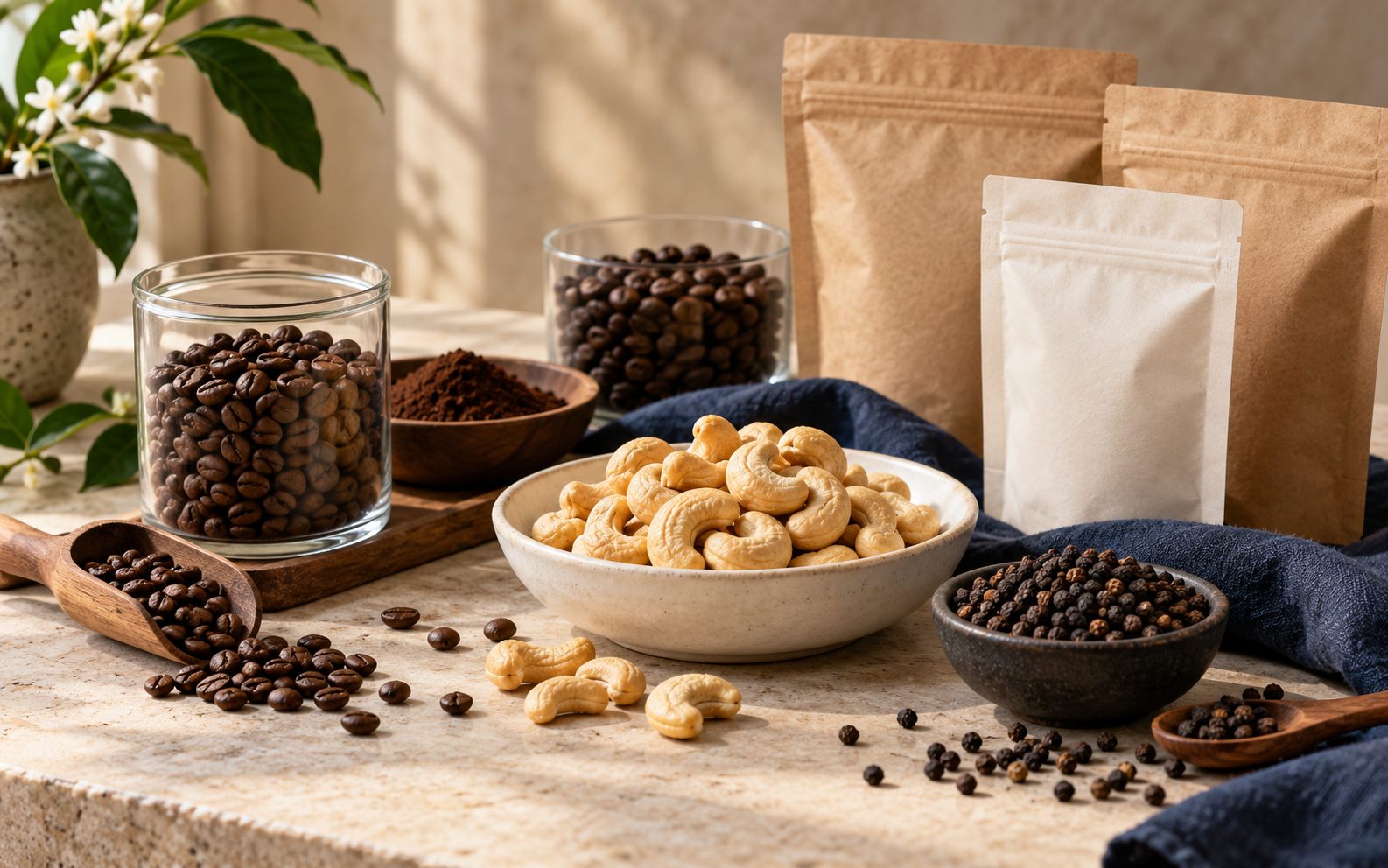
A coffee business might approach roasters, ingredient importers or distributors of packaged products. Each needs different information. Roasters examine raw material and batch quality; branded-product distributors need packaging, positioning, prices and a credible sales proposition.
For cashews or pepper, prepare specifications, quality criteria, packaging and storage conditions. Select samples that can be compared easily. Presenting many grades without explaining their price and intended use can make selection harder.
One possible route is a specification suited to processing or packing customers. Another is a branded retail product. These routes have different budgets and support requirements; decide the direction before developing the introduction pack and partner list.
Explain use, taste, ingredients, shelf life and transport requirements. A familiar Vietnamese food may need a clear introduction for a buyer who has never used it. Finished-product photographs and serving suggestions can make the conversation more practical.
For private-label development, establish who approves the formulation, who owns label accuracy and what changes are feasible at each production volume. Samples should represent what can actually be supplied at scale.
Products with specific ingredients, special claims or separate regulatory treatment require careful review before an offer is made. Choosing the right channel and preparing information early helps avoid spending on packaging, samples or meetings before market conditions are understood.
Price is only part of a refrigerated or frozen product discussion. Buyers also need specifications, processing details, storage conditions, batch traceability and a method for handling non-conforming quality. Product information should be detailed enough to distinguish the grades offered.
Check the production establishment’s conditions and the permitted product scope before deeper outreach. Status can change; an old list does not establish current eligibility, and different plants within the same group may not have identical conditions. Rosselkhoznadzor provides Vietnam-related information and establishment search resources for checking with the relevant specialists. [10]
Commercial representatives should be able to obtain prompt input from quality staff. Questions about temperatures, documents or specifications should not remain unresolved simply because the right person has not been involved.
Potential channels include projects, distributors, retail chains and private labels. A project customer may prioritise design and timing; a distributor may focus on packaging, assembly, spare fittings and replenishment.
Provide dimensions, materials, finish, detail photographs and packing information. Attractive imagery opens the conversation, while accurate drawings and descriptions support a commercial decision. For flat-pack products, prepare assembly instructions, a fittings list and a response to missing parts.
Furniture has specific technical requirements to review, including TR CU 025/2012 on furniture safety. Determine applicability and assessment requirements from the actual product rather than the broad description “wood products.” [8]
Start with the intended user, size range, materials, supply capability and inspection process. Distinguish stock from made-to-order goods, and separate sampling time from production lead time.
Clarify whether the partner wants a Vietnamese brand or production under its own label. Documentation, labels, packaging and ownership arrangements differ. Traceability, labelling and trade measures affecting the goods must be checked when preparing the proposal.
TR CU 017/2011 is among the technical regulations to examine for light-industry products within its scope. Children’s products may be covered by other rules, so the intended use and user must be classified before deciding the documentation required. [7]
Manufacturing buyers often require technical specifications and evidence of consistent supply. Prepare tolerances, materials, applicable standards, inspection conditions and sustainable production capacity, with units and document versions clearly identified.
The appropriate partner might be an end-user factory, an integrator or a technical distributor. A list based on the partner’s supply-chain role is more useful than one based solely on its industry name. Otherwise, meetings may stop at introductions because the participant has no need for the product.
Technical requirements, export controls and transaction restrictions must be reviewed separately where relevant, including the end user and intended use. Matching proceeds only when lawful implementation conditions have been established.
A company calling itself an importer is not enough to establish suitability. Understand its product experience, who handles procedures, where goods are received and who its customers are. The objective is a fit between the partner’s capability and your plan.
For packaged consumer products, ask how it develops brands and supports retail points. For ingredients, discuss inspection specifications, shipment sizes and order cycles. Strength in one category does not necessarily transfer to another.
A distributor may serve stores, business customers or smaller distributors. Each model has a different pricing structure. Understand which costs and margins are added before the goods reach the end customer.
Early discussions do not necessarily require disclosure of the full customer list. Begin with channels, territories, warehousing and existing product categories. Agree more detailed disclosure and confidentiality as discussions progress.
Entering a channel starts a continuing operational commitment. Product content, imagery, inventory, delivery, complaints and returns all need to be covered. A plan based only on expected sales can run short of operating funds after the first launch.
Establish the seller of record, importer, customer-service responsibility and rights to use the brand. Check each channel’s current terms, fees and policies directly when implementing; do not assume one fee structure applies to every platform.
A manufacturing customer may need sample testing or internal assessment before ordering. Ask who receives samples, which criteria are tested, when feedback can be expected and what allows the process to move to a trial purchase.
A useful meeting may conclude with a clear testing plan rather than a contract. Record that progress accurately so initial interest is not mistaken for a purchase commitment.
The duty applicable to exports to Russia cannot be determined accurately without a specific product. A commercial name is often insufficient. Composition, processing, use, materials, specifications, users and classification-sensitive characteristics may all matter.
Prepare a product sheet for each priority item: photograph, description, specifications, ingredients where relevant, packaging, relevant material origins and intended use. A shared information base helps the exporter, importer and customs representative work consistently.
Check the HS classification against the importing country’s applicable nomenclature and tariff schedule. Do not assume that a code used for a previous shipment covers every product version. Resolve uncertainty before finalising prices and documents.
Determine whether the goods are prohibited, temporarily suspended, restricted or subject to licensing, eligibility or specialised inspection. Read the foreign-trade framework together with the currently applicable product lists. Vietnam’s national legal database and Official Gazette are sources for checking legislation, amendments and applicability. [15]
The Ministry of Industry and Trade’s VNTR portal identifies export customs document categories such as declarations, commercial invoices or equivalents, and licences or inspection documents where required. Not every specialised document applies to every shipment. Establish the final file according to the product and transaction. [11]
Distinguish statutory procedure documents from materials a buyer needs to assess the offer. Catalogues, price lists, product sheets and draft contracts may be important to selling without being the same legal document category. Clear responsibility from the start reduces unnecessary work.
Goods shipped from Vietnam do not automatically acquire Vietnamese preferential origin. Review the agreement’s origin rules, product-specific rules and related conditions. The EEC publishes origin rules, product-specific rules using HS 2022 and the EAV certificate form. [3]
Businesses using imported materials need a clear traceability file. Purchasing, production and export staff should agree how to retain records, bills of materials and processing information. Waiting until the goods are ready to ask about preference can make corrections difficult or unsuitable.
An EAV certificate does not mean every product receives the same duty rate. Check the code, date, preference conditions, quota or relevant measure. The rates in the cost examples below illustrate variables; they do not establish a rate for any particular product.
A C/O is a certificate of origin. Form EAV is used under the Vietnam–EAEU agreement where the relevant conditions are met. The Ministry’s eCoSys system publishes Circular 01/2024/TT-BCT amending the agreement’s origin implementation rules, alongside general C/O provisions. Check current guidance and the receiving authority when applying. [4]
Use a master information sheet so names, codes and descriptions remain consistent across invoices, packing information, declarations and related documents. When specifications or composition change, identify which records need updating before final versions go to the partner.
Origin documentation should be part of purchasing and production preparation. Staff should not have to reconstruct the entire file when the shipping date is near. Good preparation also supports timely responses to requests for explanation or verification.
EAC is the common circulation mark associated with the EAEU technical regulation system. For regulated goods, determine the applicable conformity assessment before placing them on the market. “EAC certificate” should not be treated as one universal document: certification, declarations of conformity and other procedures can differ by product and rule. [9]
Ask the specialist to explain the basis: applicable regulation, eligible applicant, sample destination, product versions covered and validity. A low-priced document that does not cover the actual goods may not support the intended shipment.
Do not print a mark on packaging merely because a designer copied it from another product. Check the lawful documentation and conditions for its use before a large print run to avoid relabelling or repacking.
TR CU 021/2011 addresses food safety and TR CU 022/2011 food labelling. Categories such as juice, dairy, meat or seafood may require additional specific rules. A factory management-system certificate alone does not establish that all Russian circulation requirements for the product have been completed. [5][6][7]
Prepare the accurate formulation or ingredient list, appropriate production information, quality criteria, storage conditions and shelf life. Claims such as “natural,” “for children” or a special function also need review before appearing on labels or advertising.
A small formulation change can require an approved file to be reconsidered. Private-label development therefore needs a defined version: the approved sample, the ingredients used and the documentation corresponding to the actual production batch.
For prepacked food covered by TR CU 022/2011, information to review includes the product name, composition, quantity, production date, shelf life, storage conditions, relevant business details and other case-specific items. Check language and content requirements against the regulation, amendments and product category. [6]
Have the Russian wording reviewed by someone who understands both the language and the product. A term can be translated literally yet mislead users about ingredients, materials or storage. Technical review and language review should work together.
Approve labels at their actual printed size. Text that is legible on a large screen may be difficult to read on a small pack. Product codes, translations and importer information need responsible sign-off; labels are not solely a design task.
Agricultural products, animal-origin goods and other specially regulated categories need the appropriate checks. Establish whether the item requires phytosanitary or veterinary certification, safety inspection, establishment eligibility or another procedure. Confirm the current conditions for the actual goods instead of relying on another company’s shipment.
Where an establishment register applies, check the exact code, address, products and current status before shipping preparation. Resolve discrepancies before production for a new order. An undated screenshot of unknown origin is not a reliable basis for a commercial decision. [10]
ISPM 15 is the international standard on phytosanitary measures for wood packaging in international trade. It concerns raw-wood packaging and excludes certain processed materials under its provisions. Examine the actual pallets, crates and dunnage rather than assuming all materials described as wood have identical requirements. [12]
Agree packaging materials with the packing provider while planning. Discovering an issue after packing can increase cost and affect dispatch. Fragile or damage-sensitive products may also need packaging protection tested for the intended transport conditions.
Some Russian product groups are subject to identification and traceability under Честный ЗНАК, commonly called Chestny ZNAK. Check the product scope, implementation timetable, responsibilities and relevant date. The system’s guidance on imports from outside the EAEU addresses marking before the applicable customs release procedure. [13]
Agree who registers data, supplies codes, prints or applies them, verifies them and handles errors. Traceability codes, retail barcodes and the EAC mark have different purposes. Having one does not automatically satisfy the obligations of the others.
Import duty depends on classification, origin, preferences and applicable conditions. Import VAT is a separate obligation and does not automatically disappear when duty is reduced. According to the Russian tax authority, the standard VAT rate changed to 22% on 1 January 2026. Check the actual treatment for the product, including any different rate or exemption. [14]
Clarify who pays, what affects cash flow and what can be treated under the importer’s tax regime. Do not insert one VAT rate into every quotation or infer Vietnamese tax on CHODAT’s service fee from a Russian goods-tax rate.
| Product area | Starting point for checking scope and amendments |
|---|---|
| Food and labels | TR CU 021/2011, 022/2011 [5][6] |
| Additives and processing aids | TR CU 029/2012 [32] |
| Light industry and textiles | TR CU 017/2011; check the intended user [30] |
| Cosmetics | TR CU 009/2011 [29] |
| Electrical equipment | Check TR CU 004/2011, 020/2011 and product-specific rules [7][31] |
| Furniture | TR CU 025/2012 [8] |
Ask the specialist to identify the applicable assessment, applicant, evidence and testing plan. Certification, declarations, state registration and sanitary requirements are not interchangeable.
Form EAV is the origin certificate under the Vietnam–EAEU agreement. Use the product rule and official form instructions; neither 40% VAC nor a zero tariff is universal. Cross-check customs, invoice, packing, transport and production evidence. [3][21][22]
Obtain the official query, identify the issue, assemble material and production records, and coordinate with the issuing/verification authority. Discuss release conditions and possible duties or security with the importer’s customs adviser. Keep the decision and reconcile any adjustment, refund or release of security; none is automatic. The origin rules distinguish minor discrepancies and verification. [21]
A well-presented company profile helps a partner understand what the business does and where it fits. Lead with the principal products, delivery capability and responsible contact. Then provide what a buyer needs to continue: specifications, quality information, a conditional price offer, preparation time and product development capability.
There is no need to include every achievement. If some information cannot be made public, prepare a general introduction and a separate supplement for appropriate disclosure. Clarity saves the reader time, while controlled sharing protects commercially important information.
Include an accurate photograph, internal reference, description, specifications, packing, planned availability and storage conditions where relevant. Distinguish variants clearly so a question about one specification does not produce a quotation for another.
Coffee in a 250 g retail pack and bulk coffee for a roaster may both be in the company’s range, but their use, buying channel and costs differ. Separate product information keeps the discussion on the intended offer.
A quotation needs a currency, unit, specification, quantity basis, delivery location and validity period. Where a delivered-to-Russia price is not yet supportable, begin with a delivery condition covering what the business can control and develop the full proposal when freight and import information are available.
Do not leave conditions unstated and assume both sides will interpret them alike. Trial-order preparation may differ from repeat production, while bespoke packaging can depend on quantities or design rights. Clear conditions support meaningful comparison and protect the planned margin.
Confirm the recipient, address, purpose and required samples before dispatch. A carefully selected set with correct instructions and product sheets is often more useful than a large mixed shipment with no assessment guidance.
Agree a follow-up point after delivery. For technical testing, ask about criteria and recording results. For sensory assessment, request separate feedback on flavour, size, packaging or price positioning. Specific answers help more than a general statement that the sample looks good.
A sales profile, product label and contract are different writing tasks. The profile needs to be clear and persuasive; the label must accurately reflect the product and applicable rules; the contract must express rights and obligations precisely. Each needs appropriate review.
Clear Vietnamese source material matters too. An ambiguous source sentence tends to produce an ambiguous translation. Replace “leading quality” or “the most competitive price” with information that can be explained: product attributes, delivery capability, quality checks and supply conditions.
With the bank, check issuing-bank exposure, advice versus confirmation, expiry, shipment and presentation deadlines. Review invoice details, the required transport document, quantities and applicable origin/inspection evidence. Seek an amendment before accepting an unworkable condition.
Where UCP 600 is incorporated, read documentary consistency in context: it is not a universal demand for character-by-character identical text. Ask the bank how to correct or refer discrepancies; buyer acceptance alone is not a bank’s payment undertaking. An L/C retains documentary, banking and compliance risks. [23]
Give the freight provider the weight, dimensions, goods characteristics, origin, receiving point and required arrival timing. A port quotation is not directly comparable with delivery to a warehouse. Sample freight is not representative of the cost of a commercial shipment at a different scale.
Look beyond the main freight charge. Check origin and destination handling, last-mile delivery, expected storage and conditional surcharges. A lower total with many items missing may simply cover less.
Sea, air and multimodal options need assessment against availability when the service is booked. Request confirmation of schedules, transhipment points, responsibilities and conditions for the actual goods. Do not promise a delivery date using the transit time of a different route.
For short shelf-life goods, account for preparation, procedures, transport and onward distribution. Furniture needs suitable packing and handling. Cold-chain products need appropriate conditions throughout the journey and relevant monitoring records. The cheapest option on paper may not suit the shipment.
ICC’s Incoterms® 2020 rules clarify responsibilities relating to delivery, costs and risk transfer under the selected term. Specify the named place and edition. FCA, CIF and DDP have different scopes and obligations; they are not alternative labels for the same quotation. [16]
Choose a term the business can perform. Before offering delivery to a partner’s warehouse, establish who handles customs, pays taxes and responds if goods are held for inspection. Payment, ownership, quality and dispute resolution still need appropriate contract terms.
During the 7–14-day visit, a logistics discussion should establish where goods arrive, who inspects and stores them, and how they move onward. Prepare a flow of goods and a list of unresolved points before meeting a relevant operator.
Access to warehouses, distribution centres or operating facilities requires prior permission. If a visit has not been confirmed, documents and processes can be discussed at a suitable meeting location. Merely knowing a facility’s name does not establish a right to visit.
Give providers the same origin and destination, named Incoterms place/version, package dimensions, weight, temperature needs and readiness date. Request separate freight, handling, storage, insurance, last-mile and tax responsibilities. Record validity, transhipment, estimated transit, free time and delay charges. Reconfirm the route and receiving arrangements when booking.
A convincing website, positive call or in-person meeting does not establish payment capacity. Check the legal entity, registration details, representative, signing authority and payment account. Retain the date and scope of any official register check, while recognising that registration information is not a complete financial assessment. [18]
Initially, ask how the partner organises imports and payments. Consider deeper checks as transaction value and exposure increase. Requests for information should be proportionate, explained and protective of both parties’ data.
Speak directly with the servicing bank about currency, documentation, beneficiary and processing capability for the specific transaction. A currency mentioned in bilateral trade does not mean every bank, partner and product can use the same payment route.
Agree fees, when payment is deemed received, document release conditions and the response to delay or rejection before signing. Account changes should be verified independently with an authorised person. An urgent email alone is not a sufficient reason to switch accounts.
The contract should define products, quality, inspection, delivery, payment and remedies for non-performance. Identify how an approved sample relates to the shipment. Where tolerances are allowed, state what they cover and the accepted limits.
Also address complaint notice, evidence, corrective action and disputes. Terms are useful only if they can be performed in the actual transaction. Complex or high-value agreements merit appropriate legal review before signature.
If a partner requests exclusivity, define the products, territory, term, purchasing obligations and assessment process. Broad rights without corresponding commitments can limit opportunities with others.
A trial period with clear objectives and review conditions may be considered. There is no single structure that works for every transaction. Rights should be proportionate to the partner’s demonstrable capability and commitments.
Present the bank with the parties, beneficiary, product, banks, currency, amount, route and documents. Confirm account-opening requirements, processing capability, fees, exchange terms and rejection/tracing procedures. RUB/VND or a non-SWIFT channel does not establish absence of risk; restrictions and authorisations depend on the transaction and applicable law. [28]
Do not automatically change the payer, account or currency after a problem. Independently verify and obtain the bank’s acceptance and valid agreement. Choose advances, security or L/C terms for the actual exposure.
Define notices, evidence, mitigation, renegotiation and consequences if performance cannot continue. Banking or transport disruption does not automatically excuse every obligation. Use the ICC framework as a starting point for tailored legal review. An amendment should identify changed terms, authorised signatories, effective date and language priority. [24]
For VIAC, consult its official model clause and agree applicable rules, seat, language, arbitrators and governing law. For ICAC at the Russian Chamber, check the agreement, rules, costs and enforcement requirements. Compare the same dispute value and representation needs; do not assume one option is always cheaper or immediately enforceable. [25][26]
The New York Convention provides a framework with grounds for refusal, not a guarantee of recovery. Preserve the agreement, signing authority, notices and delivery/payment evidence. Local counsel should confirm the competent authority, time limits, translations, authentication or exemptions and available assets. An award is not cash recovered. [27]
The phase 1 fee is VND99,900,000 per enterprise and includes phase 2. Phase 3 carries an additional VND379,000,000 per enterprise. The combined service fee is VND478,900,000. Read these amounts alongside the quotation’s scope, acceptance criteria and payment conditions.
This is a service fee, not the cost of exported goods, an investment in a transaction or a guarantee of orders. Assess it against the work delivered, information obtained and the ability to use the results.
Samples, testing, label changes, product photography or extra documents may cost money outside the agreed service scope. Reconcile inclusions before budgeting to avoid paying or counting twice for the same task.
Existing documents may already be usable. A product requiring development or unresolved import checks may need more work. Separate each task, provider, quotation basis and the approval that triggers expenditure.
A 7-, 10- or 14-day visit needs a budget based on the actual delegates and itinerary. Consider international flights, accommodation, meals, transfers, entry documents, insurance, in-person interpretation, sample transport and additional locations. Identify anything already included so it is not added again.
A longer visit creates more research time and also uses more money and staff time away from Vietnam. Choose duration according to the questions still to be answered. Extra days without a purpose may not produce proportionate value.
After introductions, resources are still needed for production, freight, documents, taxes and commercial operations. Building a brand in retail may also require content, display or distribution support agreed with the partner. Base these costs on an actual plan.
An attractive order can still put pressure on cash flow if production is funded upfront, stock is held for a long time or payment is delayed. Assign responsibility for the budget, cash flow and expenditure approval at each stage.
Assume a business selects the VND99.9 million matching service. Outside the defined scope, it sets illustrative budgets of VND12 million for new samples, VND18 million for sample shipping and VND25 million for additional testing and labels. These are assumed internal figures, not market quotations or compulsory charges.
| Item in this hypothetical case | Million VND |
|---|---|
| Phase 1 service fee, including phase 2 | 99.90 |
| New samples outside the service scope | 12.00 |
| Assumed sample shipping | 18.00 |
| Assumed additional testing and labels | 25.00 |
| Subtotal before contingency | 154.90 |
| Business-selected contingency: 10% of that subtotal | 15.49 |
| Illustrative total budget | 170.39 |
Only VND99.9 million is the stated service fee. Replace other items with actual needs and quotations. The 10% contingency is an illustrative management assumption, not a general recommended rate or an extra CHODAT charge. Tax on the service fee is clarified in the formal quotation.
To isolate the effect of duration, assume two delegates, a fixed internal allowance of VND70 million for flights, documents and insurance, and VND5 million per day for the whole delegation’s selected local expenses. Assume all those items are outside the service fee, with no second-city costs and no service tax included. These are budgeting assumptions, not current offers for flights, hotels or services.
| Calculation under the same hypothetical assumptions | 7 days | 10 days | 14 days |
|---|---|---|---|
| Phase 3 service fee, million VND per enterprise | 379.0 | 379.0 | 379.0 |
| Assumed fixed travel budget, million VND | 70.0 | 70.0 | 70.0 |
| Variable allowance: VND5 million × number of days | 35.0 | 50.0 | 70.0 |
| Travel costs outside the service fee | 105.0 | 120.0 | 140.0 |
| Assumed 10% contingency on travel costs only | 10.5 | 12.0 | 14.0 |
| Phase 3 plus travel budget and contingency | 494.5 | 511.0 | 533.0 |
| Adding the VND99.9 million phase 1 service fee | 594.4 | 610.9 | 632.9 |
The table does not confirm that every external item will arise or can be purchased at the assumed amount. Remove included items, add omissions and check delegate numbers when actual quotations are obtained. A 14-day itinerary with another city needs its own travel calculation rather than a Moscow-only budget.
Compare the cost of additional days with the information they can produce. Three extra days may be worthwhile for another substantive discussion, a closer look at a channel or resolution of a logistics obstacle. Days without a useful programme should be reconsidered before services are booked.
Assume a non-excisable shipment with an already established customs value equivalent to VND1 billion for illustration. Compare hypothetical import-duty rates of 0% and 5%; neither is a confirmed rate for a specific product. Assume 22% VAT in this example, VND60 million in additional post-import local costs and 10,000 saleable units.
Under Article 160 of Russia’s Tax Code, the import VAT base in the ordinary case relevant here comprises customs value, import duty payable and excise where applicable. Actual treatment must be checked for the transaction. [17]
| Illustrative item, million VND | 0% import-duty scenario | 5% import-duty scenario |
|---|---|---|
| Assumed customs value | 1,000 | 1,000 |
| Import duty | 0 | 50 |
| VAT base in the example | 1,000 | 1,050 |
| Assumed VAT at 22% | 220 | 231 |
| Assumed additional local costs | 60 | 60 |
| Total cash requirement for the items shown | 1,280 | 1,341 |
| Average over 10,000 units, VND per unit | 128,000 | 134,100 |
The difference is VND61 million: VND50 million of duty and VND11 million of additional VAT under these assumptions. A preference can therefore affect more than the duty line, but a real proposal can use it only after eligibility and calculation are confirmed.
Import VAT may be treated under the importer’s tax regime where the necessary conditions are met. Cash required and final economic cost can therefore differ. This table illustrates cash flow; it does not state that all VAT is irrecoverable. Actual assessment and payment use the applicable official currency, exchange rate and rules.
Establish which currency pays each item and when. Do not base a long-term contract on an informal exchange-rate estimate. Scenario calculations can show what movement would erode the margin before the finance team and bank consider suitable arrangements.
Unit cost also depends on what is actually sold. Damage, returns or markdowns may reduce revenue-producing units below the quantity shipped. Separate trial-shipment budgets from steady-state plans; one unusual shipment should not define the annual business case.
A simple management calculation divides the promotion cost to recover by expected contribution per unit or order. Contribution must be calculated consistently after the relevant variable costs. Revenue is not a substitute for contribution.
For example, recovering an assumed VND170.39 million at VND20,000 contribution per unit requires approximately 8,520 units, rounded up. This illustration excludes other fixed costs, timing and the probability of receiving orders. Its purpose is to ask the right question about the volume required, not to promise payback.
For each approach, list work included, additional work, owner, cost basis and required output. Separate programme fees from staff time, samples, travel, verification and follow-up. Advisory value also lies in evidence for the next commitment: what must improve, what remains unverified, and whether to proceed. Track action completion and information quality alongside meetings; do not treat a fee as a promised return.
Depth requires more than a full appointment book. Businesses need time to inspect retail points, compare products, revisit discussions and test assumptions made in Vietnam. Some questions become clear only at the shelf: how products are packed, which prices represent the same segment and what information is presented to customers.
Phase 3 therefore has three design frameworks: 7, 10 and 14 days, each with a different emphasis. The longest trip is not automatically the best. Choose enough time to answer the questions with the greatest effect on the investment decision.
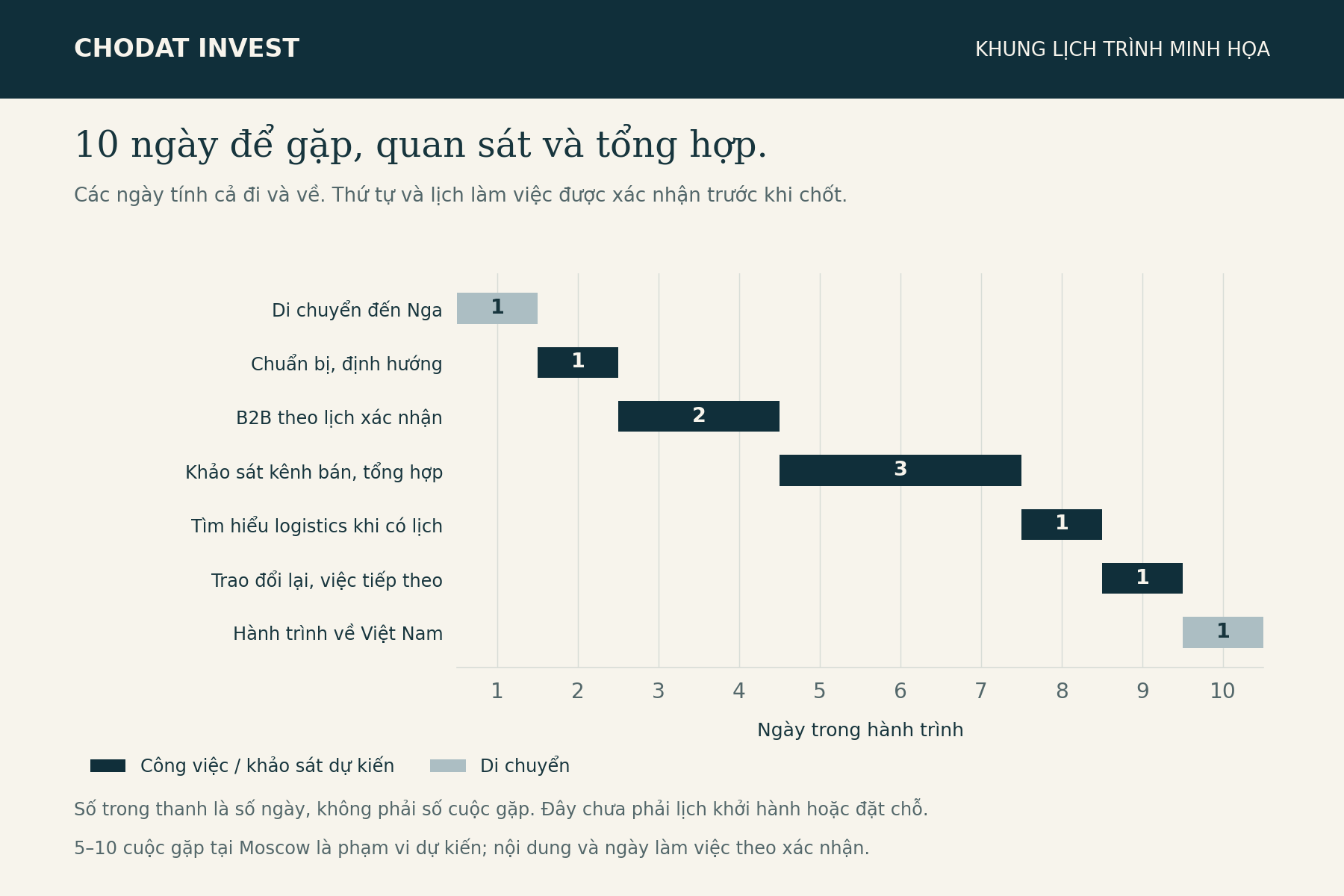
The following schedules are planning frameworks covering outward and return travel. They must be adjusted for flights, working days, holidays and individual confirmations. Programme days are not all full meeting days; travel, preparation and synthesis are included deliberately.
This framework suits businesses with reasonably complete materials that want to test product fit and assess a focused partner group in Moscow. Concentrating on one principal category makes best use of the available time.
| Day | Planned focus | Information to take away |
|---|---|---|
| 1 | Vietnam–Russia travel and hotel arrival according to flights | Updated schedule, contacts and samples |
| 2 | Preparation and an initial look at selected retail points | Comparison of products, pack sizes and observed shelf prices |
| 3 | Confirmed B2B meetings with the first partner group | Requirements, buying conditions and open questions |
| 4 | Confirmed B2B meetings with the next group | Sample and document requirements; distribution capability |
| 5 | Remaining B2B or deeper channel and logistics discussions | Operating obstacles and information needed for quotations |
| 6 | Synthesis and follow-up with priority partners where scheduled | Next tasks, responsible people and response points |
| 7 | Return to Vietnam under the confirmed itinerary | Working file and follow-up plan |
The target of 5–10 meetings is distributed according to meeting length, travel distances and partner availability, rather than compressed to satisfy a count. Sample reviews and technical discussions need adequate time. A deeper conversation may be worth more than another poorly matched appointment.
Seven days provides less flexibility when schedules move. Prepare documents, questions and team roles carefully, and complete discussions that can be held online before departure. Use time in Russia for matters that benefit from direct observation or personal contact.
Ten days allows space between meeting buyers, observing sales channels, understanding logistics and following up. It is the proposed main option for combining B2B matching with field research while keeping the programme focused on Moscow and suitable nearby locations.
| Day | Planned focus | Intended output |
|---|---|---|
| 1 | Travel to Russia according to flights | Updated schedule and contacts |
| 2 | Preparation, document review and orientation | Questions to test in the market |
| 3 | B2B with suitable importers or buyers | Recorded needs and initial fit |
| 4 | B2B with distributors or other partners | Receiving conditions, product criteria and next steps |
| 5 | Retail visits in selected segments | Comparison of prices, specifications, labels and displays |
| 6 | Public sales-channel observation and review | Permitted photographs and consistently structured notes |
| 7 | Online-channel research and interim synthesis | Assumptions confirmed or needing revision |
| 8 | Confirmed logistics or distribution discussion | Flow of goods, responsibilities and quotation inputs |
| 9 | Priority-partner follow-up and plan refinement | Priorities and a product trial plan |
| 10 | Return to Vietnam under the agreed itinerary | Internal handover file and follow-up schedule |
Days 6 and 7 can accommodate public observation and synthesis if they fall on a weekend. The order is adjusted to the departure date so appointments requiring Russian business staff take place when they are available. The programme does not assume organisations work on their days off.
Intervals between meetings also allow the delegation to improve its presentation during the trip. If an early partner asks about a specification that was unclear, the team can obtain better information before the next meeting. A misunderstood quotation basis can be clarified before the same issue recurs.
The 14-day framework suits businesses with deeper research needs and resources to act on the findings. It may stay in Moscow to explore additional distribution layers or include Saint Petersburg when products, partners and appointments justify the move. A second city is conditional, not a mandatory stop.
| Day | Planned framework | Purpose |
|---|---|---|
| 1–2 | Travel, settle in and prepare in Moscow | Ensure documents and appointments are ready |
| 3–5 | Confirmed B2B and product discussions | Clarify demand, buying terms and sample requirements |
| 6–7 | Public-channel observation and interim synthesis | Compare how products appear across segments |
| 8 | Permitted logistics, warehouse or operations discussion | Review delivery and distribution feasibility |
| 9 | Priority-partner follow-up in Moscow | Resolve open matters before leaving the location |
| 10 | Travel to a second location if justified; otherwise research further in Moscow | Allow real time for transfers or additional study |
| 11 | Confirmed second-location meetings or a category session in Moscow | Test the chosen distribution direction |
| 12 | Retail observation and supplementary discussions | Collect comparable information consistently |
| 13 | Synthesis and plan development; return to international departure point if required | Finalise priorities and implementation conditions |
| 14 | Return travel to Vietnam according to booked flights | Complete the agreed overall itinerary |
If a second location lacks enough valuable appointments, use the time for deeper work in the market already being studied. Adding a destination for its own sake can increase cost, reduce research time and leave the delegation with photographs rather than usable information.
For a longer visit, appoint someone able to synthesise findings and make changes within delegated authority. Keep the factory and relevant staff in Vietnam reachable for samples or quotation revisions. If everything must wait until the return, much of the benefit of additional time may be lost.
Each observation should identify the date, place, channel, product, origin shown on the label, pack size and displayed price where recording is permitted. Include promotions and units. A discounted 200 g pack should not be compared directly with a regular-price 500 g pack to conclude which product is cheaper.
Photographs must respect venue rules and relevant rights. A useful report does not require collecting shoppers’ personal data. Product details, displays and publicly available information can answer many initial questions.
The selected retail points form a purposeful research sample, not a statistically representative survey of Russia. Report what was observed, where it was observed and what still needs checking. Clear limits help management use findings responsibly.
Possible deliverables include meeting notes, retail product comparisons, distribution observations, a document completion list and a follow-up plan. Scope, formats, handover timing and responsibilities should be agreed in the service proposal rather than left until the end.
Distinguish partners waiting for a revised price, samples or internal approval from those not currently suitable. Each group needs different follow-up. A single undifferentiated list of “potential partners” does not tell the business what to do next week.
The visa route must suit each delegate’s nationality, purpose and circumstances. The Russian consular e-visa portal publishes unified visa conditions; check the current rules, permitted border points and stay calculations before fixing the itinerary. A programme duration on this page does not establish an individual’s eligibility to enter. [20]
Review change conditions, insurance coverage and responsibility for itinerary changes before confirming tickets, accommodation and local services. Passport and entry information should be collected through an appropriate process only when required, not on the initial public consultation form.
The visit provides information for the next decision; market development continues after returning home. Set priorities, identify approvals needed and assign responsibility for responding to each partner.
Group the work into immediate replies, internal preparation and commercial decisions. Immediate replies include promised materials, revised prices or sample information. Internal tasks may involve formulation, packaging or cost checks. Commercial decisions include continuing, selecting a trial partner or pausing a direction that is not yet suitable.
Each task needs an owner, expected date and evidence of completion. Sending an email is not acceptance; receiving a sample is not an order; a trial order does not demonstrate repeat demand. Accurate records reveal real progress and help allocate resources.
For promising discussions, prepare the first-order process: who approves prices, confirms specifications, authorises production and completes documents before shipment? Clear answers make it easier to respond when an opportunity becomes actionable.
Findings that support product changes or a decision not to proceed are useful too. They may prevent a larger premature commitment. Record the conclusion against the evidence gathered and the assumptions still needing verification.
Yes. Describe the product, documentation status, supply capability and current objective. This helps assess whether preparation, online matching or further foundational work should come first. An enquiry does not mean every business is ready for an immediate visit to Russia.
It is the phase 1 service fee and includes phase 2 online meetings. The planned scope includes clarification of the offer, an initial list of 40 Russian companies and seven coordinated online meetings with online interpretation. Tasks, conditions and acceptance are specified in the quotation and contract.
It is the additional phase 3 service fee for market research and in-person connections under the agreed proposal. Selecting both online matching and phase 3 gives a combined service fee of VND478,900,000 per enterprise. Travel and other expenses must be reviewed against inclusions and exclusions.
They are three itinerary frameworks. The phase 3 service fee remains VND379,000,000 per enterprise; the work covered by each framework is defined in the formal proposal. Expenses varying by duration, delegates or locations are calculated separately from actual arrangements rather than inferred from an unconfirmed all-inclusive price.
Ten days allows B2B, channel research, operational discussions and follow-up before returning. It is a design recommendation for deeper research, not a compulsory duration. A well-prepared business with a narrow objective may prefer seven days; broader questions may justify fourteen.
No. This is an initial outreach list based on product and partner criteria. A response, a meeting and a purchase decision are separate stages. The list is not a count of contracted customers or companies that have completed comprehensive due diligence.
Orders depend on product fit, price, documentation, supply capability and decisions by the parties. CHODAT supports matching within the agreed scope. The visit is designed to develop understanding, assess opportunities and establish evidence-based next steps, with defined service deliverables.
Provide a name or criteria for assessment of outreach feasibility. Naming a company in an enquiry does not mean it has agreed to attend. A meeting becomes confirmed only when participants, purpose, timing and organisation conditions have been established.
Public observation and an official working visit have different conditions. Access to operating areas, staff discussions and use of images require suitable permission. The proposal distinguishes confirmed arrangements from items still being organised; an address in a draft is not a right of access.
This can be considered within fourteen days if product objectives, appointments and travel arrangements support it. Without sufficient business purpose for a second location, deeper Moscow research may be more useful. Transfers, costs and the international return departure point must be agreed with the whole itinerary.
Yes. Explain the preparation already completed and the objective. The proposal will clarify whether additional pre-trip work is needed. A travel budget does not replace product definition, partner criteria and document preparation.
These must be specified in the quotation. The page separates service fees from the full budget to avoid misunderstanding. Delegate numbers, duration, locations, in-person interpretation, samples, visas and insurance also need confirmation. An included item is not added again.
No blanket conclusion is possible. Check the HS code, tariff schedule, origin rules, documents and applicable conditions at import. Agreement preferences and VAT are separate matters and should be clarified before pricing and cash-flow planning. [2][3][14]
Provide the product, desired partner type, timing and responsible contact. Do not upload passports, identity documents, banking files or a complete confidential commercial dossier to the public form. Required documents are collected through a suitable process at the relevant next stage.
Yes. Select an approximate period or indicate that it is undecided. A 7-, 10- or 14-day preference helps clarify the need; actual dates are checked against flights, preparation and partner confirmations. A form selection does not book flights or confirm a departure.
Registration information is used to receive and process the service enquiry under the stated consent. Receiving future market or programme communications is a separate choice. Confidential information is not published; sharing with partners follows an appropriate purpose and scope.
If you have a core product but need suitable partners, tell CHODAT what needs to be resolved. It may be an importer search, a distribution assessment, a pricing question or a sufficiently detailed research visit before further commitment.
Describe the category, principal specifications, supply capability and the partners you want to meet. For a proposed visit, select seven, ten or fourteen days, or ask for help choosing. A few accurate details allow the first conversation to focus on the work.
Prepare the right next step into the Russian market.
Step 1 — Product and objective: product category, main product, partner type and questions to resolve.
Step 2 — Connection plan: online matching, a Russian research visit, the complete programme or advice. For a visit, indicate 7, 10, 14 days or undecided, expected delegates and possible travel period.
Step 3 — Contact details: enterprise name, responsible person, work email and telephone.
Contact consent: I agree that CHODAT INVEST may use the information provided to contact me and process this service enquiry under the privacy policy.
Separate optional choice, not preselected: I would like to receive further market information and relevant programmes from CHODAT INVEST.
After successful receipt, the page displays a request reference for future contact. This starts the discussion and proposal process. The research schedule, quotation and delivery conditions are confirmed separately.
Prepared in October 2026. Trade data is dated; cost examples are hypothetical. Tax, documentation and entry conditions must be checked for the product, traveller and transaction date.
Some company or facility registers restrict access. Links are checking resources, not confirmation of any specific partner or plant.
VIETNAM · RUSSIA
Submit an enquiry to clarify the scope; this does not create a payment obligation.