CHODAT INVEST / PRIVATE MARKET PERSPECTIVES
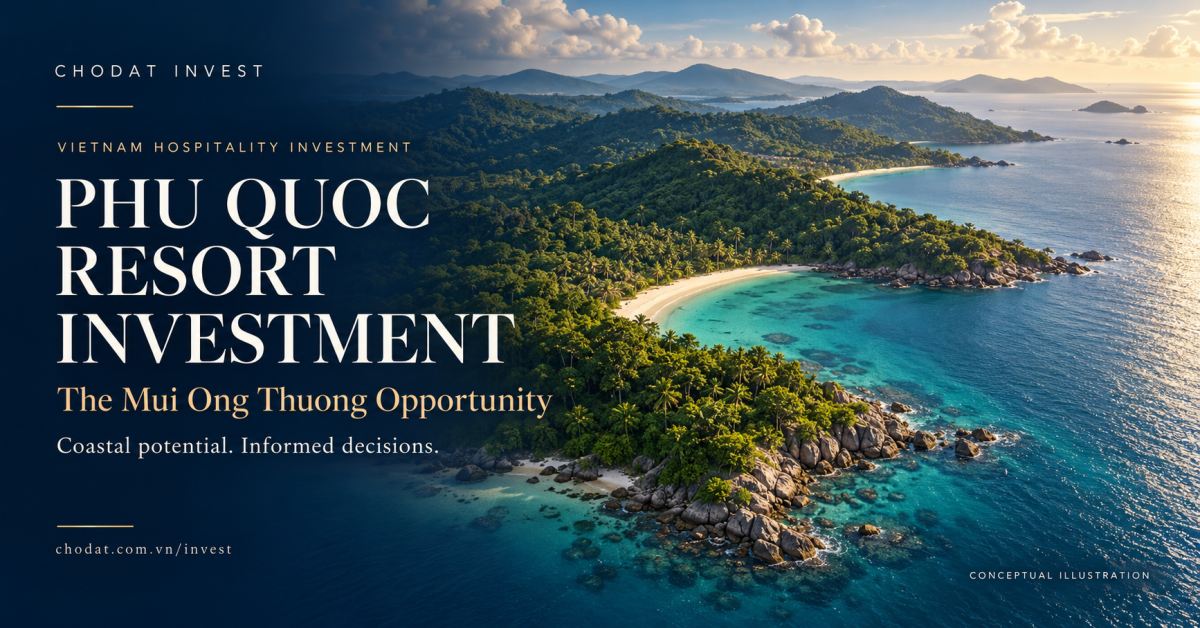
Phu Quoc Resort Investment: Discover the Mui Ong Thuong Opportunity in Vietnam
A strategic guide for international investors exploring coastal hospitality, development partnerships and long-term value creation in Vietnam.
Discuss Your Investment MandateExplore OpportunitiesInvestment guide • Approximately 40 minutes to read
Project figures are supplied information, pending independent verification.
Vietnam rewards investors who can see beyond a beautiful location and recognize the business that could be built around it. A coastal setting may attract attention. A credible development concept, a disciplined capital structure and an evidence-based route to execution are what turn that attention into a serious investment conversation.
For international investors exploring Vietnam hospitality investment, Mui Ong Thuong in Phu Quoc presents a proposition worth examining through that lens. The supplied introductory brief describes approximately 12 hectares of land, an associated 31-hectare sea area and around 1,300 metres of coastline. Together, these figures suggest the possibility of studying a differentiated coastal destination. They do not, by themselves, establish ownership, development permission, sea-use rights or a financeable project.
This distinction is the foundation of a stronger opportunity. Instead of asking investors to accept a vision on trust, the right process connects every important assumption to a document, a technical assessment, a commercial test or a negotiated protection. It gives potential partners a practical way to decide whether the opportunity fits their mandate and what must happen before capital is committed.
This investment guide examines the Mui Ong Thuong concept, potential resort business models, transaction pathways, financial considerations and the questions foreign investors should bring to the table. It also explains how to begin a structured discussion with CHODAT INVEST, a Vietnam-focused platform supporting investment preparation, opportunity discovery and business advisory coordination.
A compelling destination starts with a landscape. An investable opportunity starts with evidence, operating discipline and the right partnership.
Navigate this investment guide
01–06 · Opportunity, location and asset assessment
07–10 · Resort concepts, investor fit and participation
11–13 · Legal, technical and environmental diligence
14–17 · Financial model, capital and development phases
18–20 · Governance, operations and exit
21–24 · Documents, site visits and advisory process
25 · Investor questions answered
26 · Start your investment conversation
01 | The opportunity at a glance
The starting point is a coastal hospitality concept described in an introductory document supplied for this article. That document is the source of the project dimensions below. No cadastral records, sea-area allocation decision, approved master plan, valuation report or operating feasibility study accompanied it. Investors should therefore treat the figures as screening information awaiting independent confirmation.
| Item | Information supplied and verification required |
|---|---|
| Location | Mui Ong Thuong, Phu Quoc, Vietnam; precise coordinates and parcel boundaries to be confirmed. |
| Land component | Approximately 12 hectares; land-use category, tenure, rights holder and development capacity to be verified. |
| Sea component | Approximately 31 hectares described in association with the concept; legal status and permitted activities remain unverified. |
| Coastline | Approximately 1,300 metres; measurement, accessibility, setbacks and usable frontage require survey review. |
| Combined description | Approximately 43 hectares of land and sea area combined; this is not 43 hectares of developable land. |
| Participation concepts | Potential full or partial investment and strategic cooperation, subject to legal feasibility and agreement. |
| Commercial terms | Asking price, capital requirement, valuation, returns and transaction timetable have not been supplied. |
The opportunity should be introduced as a proposition for assessment, rather than as an approved resort or a guaranteed acquisition. A buyer needs to establish exactly what is being offered: shares in a company, an eligible project transfer, a new equity subscription, a contractual partnership or another legally supportable arrangement.
That clarification changes the entire investment conversation. It determines which assets and obligations are included, who can negotiate, which approvals may be necessary and how the investor could eventually receive distributions or exit. It also prevents attractive headline dimensions from substituting for an accurate transaction perimeter.
For a qualified investor, the immediate objective is simple: determine whether the available evidence justifies a deeper review. The next commitment should be an appropriately scoped diligence process, with clear outputs and decision points, before an investment commitment.
02 | Why Vietnam deserves a place on the hospitality investment agenda
Vietnam offers international investors a broad setting in which to explore tourism businesses, operating partnerships and real estate development strategies. Its appeal includes varied landscapes, distinctive food culture and destinations serving different types of travel. The investment question is how a particular business can translate those attributes into repeatable demand and durable cash flow.
Country-level enthusiasm is useful for generating a search mandate, but insufficient for underwriting a resort. A project competes in a much narrower market: a particular destination, a particular price category and a particular travel occasion. An investor should therefore connect the national narrative to a local customer proposition, rather than assume that a positive view of Vietnam automatically validates every hospitality development.
For Mui Ong Thuong, the relevant questions include which guests would choose this location, what alternative resorts they would compare it with and what would persuade them to stay longer or return. The answers should be expressed in booking behaviour, achievable room rates, distribution economics and service expectations. General statements about tourism potential cannot replace that analysis.
Foreign investors can contribute more than financing. An experienced partner may bring development discipline, hospitality operating systems, distribution relationships, procurement capabilities or access to specialist design expertise. These contributions should be valued against specific responsibilities and measurable outcomes, rather than treated as an abstract strategic premium.
A thoughtful Vietnam investment strategy also recognizes the value of patient preparation. Understanding counterparties, assembling a reliable bilingual dossier and testing execution assumptions can reduce expensive misunderstandings later. The most useful local support helps investors ask better questions and obtain more decision-relevant evidence.
The attraction is therefore not a promise of effortless growth. It is the possibility of building a differentiated business in a destination with recognizable visitor appeal, provided that the investment structure, commercial proposition and delivery plan can withstand scrutiny.
03 | Phu Quoc: translating destination appeal into a specific business case
Vietnam's official tourism website presents Phu Quoc as an island destination with beaches, nature, cultural experiences and a range of visitor activities. That overview provides useful destination context. It does not establish the market position, environmental condition or investment performance of any particular site. [Source 1]
For a resort investor, the island's visitor appeal creates a research agenda. Which experiences motivate travellers to choose Phu Quoc? Which customer segments seek privacy rather than proximity to entertainment? How much inconvenience will guests accept in exchange for seclusion? What level of service makes a higher room rate credible? These questions turn broad destination awareness into a testable positioning strategy.
Location analysis should consider the full guest journey. Travel time from arrival to check-in, transfer reliability, luggage handling, signage and the final approach all affect perceived quality. A spectacular view can lose commercial value if arrival is stressful or essential services are unreliable. Conversely, a well-managed transfer can become a memorable part of the stay.
Research should distinguish annual market averages from the months and segments that matter to the proposed resort. Domestic leisure, international leisure, family travel, wellness retreats and small corporate groups can have different booking windows and price sensitivities. A credible market study should explain the mix that supports the concept and the evidence behind that expectation.
Competing supply must also be examined carefully. An investor should compare operating properties, announced developments and realistic future openings, while avoiding the assumption that every announced project will be delivered. The most relevant competitors are those guests would actually substitute for the proposed experience.
Mui Ong Thuong should earn its place within this landscape through a clearly defined proposition. The name of the destination may open the conversation. A reason to choose this specific resort must sustain it.
04 | Understanding the 12-hectare land component
The reported 12-hectare land component is the logical starting point for a development assessment. Its commercial significance depends on the rights attached to it and the physical constraints affecting it. Gross area is only an introductory measure; the land that can support buildings, infrastructure and guest activities may be materially smaller.
An investor should request a parcel schedule that reconciles each plot with the relevant documentation and a surveyed boundary plan. The schedule should identify the recorded rights holder, stated land use, remaining term where applicable, financial obligations and any encumbrances or disputes requiring examination. Qualified Vietnamese advisers should verify the legal conclusions rather than relying on translated marketing descriptions.
Technical work should then connect the documented area to the actual site. Topography, ground conditions, drainage, vegetation, access corridors and coastal restrictions can influence the location and cost of construction. The development team should map these constraints before producing a room count or a valuation based on assumed capacity.
A useful planning exercise separates the site into functional categories: potentially buildable areas, landscape conservation areas, circulation, service infrastructure, utilities and any required buffers. This does not prejudge approval. It gives architects and engineers a common basis for testing whether the proposed guest experience is physically and commercially coherent.
The land should also be assessed from an operating perspective. Housekeeping routes, waste collection, emergency access and staff movement may be less visible than sea-facing accommodation, but they shape daily service quality and recurring costs. A plan that ignores them can produce an attractive rendering and an inefficient resort.
The investment case becomes stronger when it can explain what the land permits, what it constrains and how those conditions influence the business model. That is far more useful than applying a generic value per hectare to an unverified site description.
05 | Evaluating the associated 31-hectare sea area
The reported 31-hectare sea area requires a separate assessment from the land. A sea-area description in a promotional brief does not establish private ownership, exclusive access or authorization to construct facilities. Investors should avoid treating it as interchangeable with developable land or automatically assigning it the same economic value.
The first task is to determine what documentation exists and what it actually permits. Relevant specialists should examine the geographic boundary, legal basis, duration, permitted purposes, conditions and any ability to maintain or change the arrangement under the contemplated transaction. Where no supporting documentation exists, that absence should be recorded explicitly.
The second task is physical and environmental. Water depth, wave exposure, seasonal conditions, sensitive habitats, navigation patterns and public or community uses may affect what activities could be considered. A calm appearance during one visit is not a reliable basis for year-round operating assumptions. Marine specialists should define the evidence needed for each proposed activity.
Potential experiences might include guided non-motorized recreation, nature interpretation or carefully managed guest excursions, where permitted. A jetty, marina, floating structure or over-water accommodation would raise additional questions and should not appear in the base development plan as an approved entitlement. Their feasibility must be established independently.
Financially, the sea component is best approached through specific operating possibilities and obligations. What revenue could an authorized activity generate? What safety, staffing, insurance, equipment and monitoring costs would it require? Would it improve room demand, guest satisfaction or length of stay even if its direct revenue were modest?
This approach allows investors to explore the strategic value of the coastal setting without overstating the rights involved. It also keeps the core hospitality case from depending on a marine concept that may prove technically, environmentally or legally unsuitable.
06 | What approximately 1,300 metres of coastline could mean commercially
A long coastline can offer multiple ways to organize a resort experience, but its commercial value depends on quality and usability. Investors should distinguish measured frontage from accessible shoreline, safe swimming areas, usable beaches and locations appropriate for permitted visitor activities. Those categories may differ significantly.
The supplied figure of approximately 1,300 metres should be checked against a survey and the actual transaction boundaries. The team should also determine whether the measurement follows an irregular shoreline and how seasonal changes affect access. A single frontage number does not reveal the guest experience available along it.
If conditions support development, an extended coastal edge could help separate quieter accommodation from more active communal spaces. It might allow different landscape experiences, more varied walking routes or multiple vantage points. Each potential advantage should be tested through a concept plan that respects environmental constraints and operating practicality.
Privacy also needs precise language. A secluded resort atmosphere can be created through design, landscaping and service management, but it should not be confused with a legal right to exclude others from a beach or surrounding waters. Marketing promises should follow verified rights and actual operating conditions.
Coastal exposure brings maintenance obligations as well as visual appeal. Materials, landscaping, outdoor furniture, mechanical systems and access paths may need designs suited to their environment. Investors should ask technical advisers to translate those requirements into lifecycle costs and replacement schedules.
The right valuation question is therefore not simply how much coastline is present. It is how the verified coastal conditions support achievable revenue, acceptable operating costs and a distinctive experience over time. That analysis can reveal genuine value while exposing assumptions that a headline frontage figure might conceal.
Could this opportunity fit your investment mandate?
Start with your preferred ticket size, asset stage and control requirements. Request an initial discussion before committing to a deeper review.
07 | A resort concept built around a reason to visit
The most convincing development concept begins with the guest rather than a predetermined collection of buildings. Investors should define the travel occasion, the expected stay, the service promise and the experience that makes the property worth choosing. Architecture should then support that proposition.
One concept worth testing is a low-density coastal retreat focused on privacy, thoughtful design and attentive service. This could appeal to travellers who value a quieter environment, provided that access, staffing and operating economics support the positioning. The introductory brief does not establish an approved density or accommodation count, so those elements remain study variables.
A second concept could emphasize nature-based experiences with a strong educational and conservation component. Such positioning requires credible environmental practices and qualified partners. The resort would need to demonstrate what guests can responsibly experience, what areas remain protected and how activities are managed. Environmental language should be earned through operating choices.
A third possibility is a destination designed for longer stays, combining comfortable accommodation with food, movement, relaxation and local discovery. Longer stays may change housekeeping patterns, food and beverage demand and the mix of amenities guests expect. Those differences should be modeled before selecting a product format.
The development team should compare concepts using the same evaluation framework: market evidence, achievable pricing, capital intensity, staffing needs, seasonal resilience and environmental compatibility. A more prestigious concept is not automatically the more profitable one. Complexity can create costs that exceed the additional revenue it attracts.
The preferred concept should be expressible in one clear sentence, followed by an operating plan that makes the promise credible. If the investment committee cannot explain who the resort serves and why those guests would choose it, the project is not yet ready for a detailed return discussion.
08 | Wellness, experience and responsible coastal recreation
Wellness can be a useful area of hospitality differentiation when it is defined carefully. Restorative stays, fitness, mindful movement, balanced food and a peaceful environment are different propositions from clinical treatment. Each carries different staffing, facility, service and regulatory implications.
For Mui Ong Thuong, a preliminary concept could explore non-clinical wellness experiences that fit the setting and the intended guest. The feasibility study should test willingness to pay, programme participation and the cost of delivering consistent quality. An attractive label will not generate repeat bookings if the experience is generic or poorly staffed.
Food and beverage can reinforce the concept through thoughtful sourcing, menu design and service. However, a destination restaurant, an all-day dining operation and an intimate wellness menu have different economics. The team should define which facilities primarily support room demand and which are expected to earn meaningful standalone profit.
Coastal recreation deserves the same discipline. Activities should be matched to verified permissions, environmental conditions and safe operating windows. Equipment care, supervision, emergency procedures and weather-related cancellation policies belong in the feasibility assessment. The presence of water is not enough to establish a commercially viable recreation business.
Partnerships with specialist operators may help the resort access expertise without building every capability internally. Investors should still examine service standards, insurance, revenue sharing, customer ownership and the consequences of operator failure. Outsourcing an activity does not remove its effect on the resort's reputation.
The strongest experience strategy creates a coherent stay rather than a long amenities list. Every additional offering should answer a practical question: does it improve the guest proposition enough to justify its space, investment and recurring cost? This keeps differentiation focused and prevents the concept from becoming operationally unwieldy.
09 | Which foreign investors could be a suitable fit?
Different investors can look at the same coastal opportunity and reach different conclusions for valid reasons. The fit depends on the stage of development, available evidence, risk tolerance, operating capability and intended holding period. Identifying the right investor profile early makes outreach more productive.
A hospitality developer may focus on whether the project can support a deliverable concept within a controlled budget. Such a partner is likely to examine planning assumptions, infrastructure, contractor capacity and procurement risks in detail. Its contribution may include a development team and execution systems alongside equity.
A family office may place greater emphasis on long-term stewardship, governance and the ability to preserve flexibility through market cycles. That does not imply a willingness to accept weak documentation. A patient investor still needs a clear understanding of capital calls, distributions, decision rights and the potential routes to liquidity.
A private equity or real assets investor may require a more explicit value-creation plan with measurable milestones. The investment must fit the fund's mandate, deployment period, control expectations and exit constraints. A concept that needs extensive preparation may be unsuitable for a vehicle seeking near-term operating income.
A strategic hotel group or operator may be interested primarily in management, branding or a combination of operating involvement and selective investment. Investors should distinguish a potential operator relationship from a financing commitment. Commercial interest in managing a property is not evidence that the project is funded or approved.
The most useful introduction therefore begins with mandate matching. Asset stage, ticket range, desired control, development experience and hold period should be discussed before extensive document exchange. A strong opportunity presented to an unsuitable investor still consumes time without improving the probability of a transaction.
10 | Potential participation structures: match the transaction to the objective
The supplied brief contemplates flexible participation, but it does not define a legally verified transaction structure. Full investment, partial investment and strategic cooperation are commercial intentions that need to be translated into a specific arrangement. The translation should be led by qualified advisers and grounded in the actual rights and entities involved.
A share acquisition could be considered if a relevant company holds the necessary project interests and the transaction is legally feasible. Its scope would include the company's liabilities, contracts, tax position and governance history. Acquiring a corporate vehicle is not equivalent to acquiring a clean asset without legacy exposure.
A new equity investment could provide development capital to an existing or appropriately structured vehicle. The parties would need to agree the pre-investment position, valuation basis, use of funds, ownership consequences and controls on future spending. The economic value of contributed rights should be independently examined.
A development partnership could divide responsibilities between a local project party and a capital or operating partner. This requires precise provisions on deliverables, timing, funding, decision rights and remedies. Informal expectations about who will secure approvals or arrange infrastructure can create serious disputes if not documented.
A partial participation concept requires particular care. The intended portion must be legally and operationally separable, or the agreement must clearly define shared infrastructure and interdependencies. An investor should not assume that a conceptual zone on a master plan can automatically be transferred or financed independently.
The best structure is the one that reflects the verified circumstances and the parties' capabilities. It should make obligations understandable, align incentives and protect against foreseeable failure. Complexity should serve a commercial purpose rather than create the impression of sophistication.
11 | Cross-border diligence: establish the rights before pricing the opportunity
Foreign investors assessing Vietnam real estate opportunities need a transaction-specific legal review. The applicable analysis can depend on the investor, the entity, the rights involved, the location, the business activities and the proposed method of participation. This article does not assert that any particular acquisition or development route is available for Mui Ong Thuong.
An early legal workstream should establish the identity and authority of each party. Who holds the documented interests? Who can negotiate and sign? Are there shareholders, lenders, contractual partners or other stakeholders whose consent might be necessary? These questions should be answered before substantive commitments are made.
The next workstream should examine the land, project and associated sea-area documentation separately. A coherent dossier should identify what has been granted, what remains conditional, what has expired or changed and what additional steps may be required. A planning illustration should never be presented as a substitute for the underlying approval.
Counsel should also review whether the contemplated transaction changes obligations or requires additional procedures. The buyer should request a written explanation of the proposed route, outstanding conditions, material uncertainties and consequences if those conditions cannot be satisfied. Current rules and relevant local implementation should be checked at the time of the transaction.
Translation deserves professional attention. Terms describing land rights, investment permissions and corporate interests may not map neatly onto terminology used in another jurisdiction. The investor should maintain a clear relationship between original Vietnamese documents, translations and the conclusions drawn from them.
The purpose of this process is commercial clarity. Reliable legal analysis helps define the value being purchased, the timing of capital deployment and the protections required. It also allows an investor to stop early when the proposed transaction cannot support the intended business model, preserving resources for better-suited opportunities.
12 | Technical feasibility and the real cost of infrastructure
A resort's infrastructure is part of its product. Reliable power, water, wastewater treatment, communications and access are essential to the guest experience. They also determine whether operating margins and construction budgets are realistic. A coastal setting should be assessed through those practical requirements as early as possible.
The technical team should identify existing infrastructure and distinguish documented capacity from anticipated future provision. An informal expectation that a road will improve or a utility connection will become available is not a sufficient basis for a funded development schedule. Each dependency should have an owner, an evidence source and a fallback plan.
Water supply requires attention to both quantity and quality. The proposed concept should estimate guest, staff, kitchen, laundry, landscaping and other demand, then evaluate feasible supply and treatment arrangements. Conservation measures should be incorporated into the design rather than used only as marketing language after construction.
Wastewater and solid waste planning should follow the anticipated operating load and environmental sensitivity of the site. Space, access, maintenance and contingency capacity matter alongside treatment specifications. A technically appropriate system that cannot be maintained reliably will not protect the business over its life.
Construction logistics can also affect cost. The team should evaluate access for materials and equipment, storage, workforce accommodation where needed, work sequencing and weather exposure. These factors should be reflected in the programme and quantity surveyor's estimate, including contingencies proportionate to uncertainty.
A useful technical feasibility output is a constraints-and-solutions register. It records each material issue, the proposed response, cost implications, evidence quality and remaining decision. This gives investors a better foundation for capital allocation than a design package that shows the finished resort while leaving its enabling infrastructure unresolved.
13 | Environmental quality as an operating asset
A nature-oriented resort depends on the condition of its surroundings. Landscape degradation, poor water management or insensitive construction can damage the very proposition used to justify premium pricing. Environmental analysis should therefore influence site selection, concept design and investment decisions from the beginning.
The first step is to establish a credible baseline. Qualified specialists should identify habitats, sensitive areas, drainage patterns and other relevant conditions, together with the surveys required to understand seasonal variation. The original brief's descriptions of natural beauty are not a substitute for this work.
The design response should explain how impacts will be avoided or reduced. Building placement, circulation, lighting, drainage, vegetation retention and construction methods may all matter. Some parts of the site may be more valuable to the resort as protected landscape than as additional built area.
Operational commitments should be specific and measurable. Water consumption, wastewater performance, energy use, waste handling and supplier practices can be monitored through defined indicators. Investors should ask who collects the data, who reviews it and what corrective action follows when performance falls short.
Community relationships belong in this assessment. Existing uses, access expectations, livelihoods and local concerns should be understood before the concept is finalized. Constructive engagement can identify design problems that a remote investment team would otherwise miss. It should be treated as an ongoing relationship rather than a one-time presentation.
For investors, the value lies in a more resilient business and a more credible guest promise. Environmental claims should be supported by evidence, and any certification objective should remain an objective until independently achieved. A disciplined approach protects reputation while helping preserve the setting on which the hospitality proposition depends.
Turn a compelling concept into a testable investment case.
Explore support for preliminary assessment, project preparation and transaction workstreams. Scope and provider responsibilities are agreed for each engagement.
14 | Building a financial model that can support an investment decision
No price, development budget, revenue forecast or target return has been supplied for this opportunity. A responsible financial discussion must therefore start with the architecture of the model, rather than a headline IRR. The objective is to discover which assumptions determine viability and what evidence is needed to support them.
The model should separate acquisition or entry costs, development expenditure, financing costs, pre-opening expenditure and operating working capital. It should also identify taxes, transaction expenses, professional fees and reserves that may be relevant. Omitting these items can make a project appear more attractive than its actual funding requirement warrants.
Revenue should be built from operating drivers. Accommodation revenue depends on available rooms, operating days, occupancy and average daily rate. Other revenue streams require their own assumptions about participation, spending and capacity. The model should avoid counting the same guest expenditure twice through overlapping packages and ancillary categories.
Costs should follow the proposed service standard. Payroll, distribution, utilities, maintenance, insurance, food costs and administration may behave differently as occupancy changes. Some costs remain largely fixed during weak periods, while others vary with activity. That distinction is central to downside analysis.
Development timing should be explicit. The model needs to show when capital is spent, when revenue can begin and what happens if opening is delayed. A profitable stabilized year does not establish that the project has sufficient cash to survive the path to stabilization.
The resulting output should be readable by the investment committee. Assumptions, sources, version dates and unresolved inputs should be visible. A transparent model that reveals uncertainty is more useful than a polished spreadsheet that conceals it behind an apparently precise return figure.
15 | Revenue quality: look beyond occupancy and room rates
Occupancy and average daily rate are important hospitality indicators, but neither explains profitability on its own. Investors should examine how bookings are acquired, what services are included and how much contribution remains after the associated costs. A full resort at heavily discounted rates can still disappoint financially.
Revenue per available room combines occupancy and room rate, but investors should connect it to distribution costs and operating margins. Direct bookings, travel agents, online channels and group business may carry different economics. The relevant question is the quality of net revenue, not simply the volume of reservations.
Guest mix influences spending and service requirements. A couple on a short celebratory stay, a family on an extended holiday and a small retreat group may use facilities differently. The proposed resort should be designed around a mix that the market study can support, rather than assuming every segment will arrive in the most profitable proportions.
Food, wellness and recreational revenue should be evaluated for their own contribution. Some amenities may strengthen room pricing or guest satisfaction even if direct profit is limited. Others may consume excessive capital or staff time. The model should distinguish strategic support functions from genuine profit centres.
Repeat visitation and recommendation can matter over time, but they should not be assumed without an operating strategy. Service consistency, guest communication and thoughtful recovery from problems all influence loyalty. These capabilities require systems and training, not simply an attractive brand identity.
A commercially mature investment case explains how the resort attracts guests, earns their trust and retains enough revenue to fund maintenance and returns. That is the bridge between a desirable destination and an economically durable hospitality business.
16 | Capital structure, downside scenarios and liquidity discipline
The funding plan should be matched to the project's uncertainty and development stage. Early investigation, legal clarification and design work may not support the same financing approach as a completed operating property. Investors should avoid assuming that future debt will be available on terms that have not been discussed with credible lenders.
Equity commitments should cover a clearly defined scope and include a realistic contingency approach. The parties need to understand what happens if additional funds are required, who can approve them and whether participation is mandatory or optional. Unresolved capital-call arrangements can destabilize an otherwise promising partnership.
Debt analysis should examine interest, repayment timing, covenants, security and the consequences of delay. If borrowing and revenue are denominated differently, currency exposure should be assessed with appropriate advisers. The model should distinguish project-level performance from returns to equity after financing costs.
At least three operating cases should be developed: a supported base case, a downside case and a severe but plausible stress case. They should vary the inputs that matter, including opening date, construction cost, occupancy, pricing, expenses and exit assumptions. Changing only one variable may understate the effect of a difficult market.
Liquidity is a separate question from long-term value. A project can appear attractive over a full holding period while running out of cash during development or early operation. Investors should identify the maximum funding requirement and the period in which capital pressure is greatest.
The purpose of scenario work is to inform action. Each material risk should connect to a mitigation, a contractual protection, additional diligence or a decision to reduce exposure. Sensitivity analysis earns its place when it changes the structure of the investment rather than merely decorating an investment memorandum.
17 | A phased development strategy with meaningful decision gates
Phasing can help align capital deployment with improving information, but only if the stages are defined around genuine decisions. Dividing a large budget into smaller labels does not reduce risk. Each phase should answer a question that determines whether the next commitment is justified.
An initial phase could focus on identity, authority, land and sea-area documentation, boundary confirmation and mandate fit. Its deliverable would be a screening conclusion and a prioritized list of unresolved matters. Where a fundamental issue prevents the intended transaction, the investor should be able to stop without having committed a construction-scale budget.
A second phase could test market positioning, technical constraints and concept options. The objective would be to establish whether a commercially coherent resort could be developed under the verified conditions. Outputs should include preliminary capital estimates, infrastructure requirements and an assessment of the proposed operating model.
A subsequent phase could deepen design, financial modeling, operator engagement and transaction negotiation. Commitments at this stage should depend on defined approvals, documentation and funding conditions. Professional advisers should determine the appropriate sequence for the actual project.
Physical development could also be phased if the concept and permissions support it. An opening phase would need enough infrastructure and guest amenities to function convincingly on its own. Later works should not undermine the experience of paying guests or impose costs omitted from the initial model.
Good phasing preserves optionality without creating an incomplete resort. It gives the investment committee clear points at which to proceed, redesign, renegotiate or stop. That flexibility can be commercially valuable when it is supported by realistic budgets and enforceable arrangements.
18 | Governance: make the partnership work before it is tested
A development partnership is likely to face decisions that were not fully predictable at signing. Budgets may change, design assumptions may evolve and market conditions may shift. Governance determines whether those decisions can be handled constructively or become a source of delay and conflict.
The parties should agree decision rights in proportion to their responsibilities and exposure. Reserved matters might address material spending, borrowing, changes to the business plan, related-party transactions and major contracts. The exact provisions should be designed by counsel for the chosen structure rather than copied mechanically from another transaction.
Reporting should make performance visible. A useful package could include budget versus actual expenditure, forecast cost to complete, schedule changes, material risks, procurement status and cash requirements. During operation, the focus would extend to revenue quality, margins, guest satisfaction and maintenance obligations.
Related-party arrangements deserve particular attention. If a shareholder provides construction, management, procurement or other services, the terms should be transparent and subject to an agreed approval process. Economic value can leave a project through fees and contracts even when ownership percentages appear balanced.
The agreement should also address underperformance and disagreement. Investors need a workable escalation process, defined remedies and realistic treatment of deadlock. Exit or transfer rights should be examined for legal feasibility and practical usefulness, including the impact on financing and operations.
Trust is easier to sustain when expectations are explicit. Strong governance does not replace a good relationship; it gives that relationship a structure that can withstand difficult decisions. For international and local partners, this clarity can be one of the most valuable investments made before development begins.
19 | Operator selection and the route from opening to stabilization
Choosing an operator should follow the concept and the economics. A recognized name may support positioning, but the value of the relationship depends on the actual team, distribution capability, operating standards and contract. Branding alone cannot correct an unsuitable product or an unrealistic development budget.
The selection process should compare relevant experience. Has the prospective operator managed properties with similar scale, remoteness, service intensity and guest mix? Can it explain how the proposed resort would reach its target customers? References and operating evidence are more useful than broad claims of international reach.
Commercial terms should be modeled carefully. Base fees, incentive fees, central services, marketing charges, technical services and other obligations can influence owner returns. The investor should understand how the operator is rewarded and whether incentives remain aligned under weaker operating conditions.
Pre-opening planning is essential. Recruitment, training, systems, procurement, sales activity and operating procedures require time and funding before the first paying guest arrives. The development programme should integrate these activities rather than treating them as an afterthought once construction is complete.
The stabilization period should have a realistic management plan. Early trading may reveal issues with pricing, channels, service delivery or the amenity mix. The owner and operator need a process for reviewing performance and making changes while preserving the integrity of the guest proposition.
A useful operator discussion therefore extends beyond opening day. It asks how the business will mature, how standards will be maintained and how the owner will receive reliable information. The right partner helps convert a completed asset into a functioning hospitality enterprise.
20 | Exit strategy and long-term ownership options
An exit strategy should be considered before entry, even for investors willing to hold for many years. The eventual buyer or refinancing party will examine the same fundamentals that matter today: valid rights, operating performance, maintainable earnings, governance and the remaining economic life of the investment.
Potential routes might include a sale of an eligible interest, a strategic acquisition, a recapitalization or continued ownership with distributions. None should be assumed to be available automatically. The legal structure, market conditions, financing arrangements and investor consent requirements will shape the actual possibilities.
A project designed only for an optimistic resale can become fragile. Investors should test whether the resort remains an acceptable holding if the exit takes longer than expected or pricing is less favourable. This places appropriate emphasis on operating cash flow and maintenance rather than speculative appreciation.
Documentation quality can influence future transaction readiness. Clear financial records, reconciled ownership information, organized contracts and evidence of compliance make it easier for another investor to assess the business. These disciplines should begin during development rather than being assembled hurriedly when an exit is desired.
Asset condition also matters. A resort can report attractive short-term profit by postponing maintenance, but the deferred cost will eventually affect guest experience or valuation. A credible long-term plan includes replacement reserves and periodic reinvestment consistent with the positioning.
The preferred exit is therefore an outcome supported by the business, not an assumption used to rescue the model. Investors should be able to explain what creates value during ownership and why a future buyer would recognize that value without needing to accept the original sponsor's optimism.
Explore Vietnam with a clearer investment framework.
Compare this concept with other opportunities and deepen your understanding of investment preparation before selecting your next diligence priority.
21 | The first information package investors should request
An efficient first review does not require every document at once. It requires the documents that establish the opportunity's identity, boundaries and readiness. The requesting investor and the disclosing party should agree a proportionate information package and the conditions under which more sensitive material can be shared.
The initial package should include a clear project description, a transaction perimeter, a rights-holder overview and a document index. Site maps should distinguish confirmed boundaries from conceptual areas. Any commercial summary should state what is known, what is estimated and what has not yet been established.
A deeper review could then request the underlying land and project documents, relevant sea-area records if any, planning material, corporate information, contracts, encumbrance details and technical studies. The precise list should be tailored by advisers to the proposed structure and findings from the first review.
Financial information should include the basis for the owner's expectations, historic expenditure where relevant and any existing development assumptions. If a valuation is presented, the investor should ask who prepared it, when it was prepared, what rights it values and which assumptions materially affect its conclusion.
A document register should record source, date, version, language and review status. Missing or inconsistent documents are findings to resolve, not gaps to conceal with a polished presentation. This approach allows the investor to compare the narrative against evidence and decide where additional professional work is justified.
22 | Site visits that improve the investment decision
A site visit should be designed around unresolved questions. Before travelling, the investor should identify what can be confirmed through observation and what still requires documents, surveys or professional analysis. A visit can reveal practical constraints, but it cannot certify legal rights or replace environmental and engineering studies.
The itinerary should cover the arrival route, access points, boundaries visible on site, surrounding uses and proposed service areas. The team should examine how guests, staff, deliveries and emergency vehicles would move. Where possible and authorized, the visit should also consider conditions that may differ by season or operating period.
Participants should bring a shared question list and record observations consistently. Photographs should be dated and located, with permission where appropriate. Any difference between the briefing material and the observed site should be documented for follow-up rather than resolved through informal assurances.
Meetings with the relevant project representatives should focus on authority, documentation, responsibilities and next steps. Technical specialists may need separate visits with appropriate equipment and access arrangements. An impressive presentation should not crowd out the time required to understand practical constraints.
The best outcome is a concise decision note: what the visit confirmed, what it challenged and what remains unknown. It should identify the additional work required before the investor advances. This converts travel time into investment evidence and helps both sides maintain a focused process.
23 | How CHODAT INVEST can support the next conversation
CHODAT INVEST provides a starting point for businesses and investors seeking to organize a Vietnam investment discussion. Its published real estate M&A service scope includes preparation, opportunity screening and transaction coordination, with the specific scope and professional responsibilities agreed for each engagement. [Source 2]
For this opportunity, a useful first conversation would define the investor's mandate and the information needed to assess fit. It could establish whether the priority is project screening, a preliminary financial framework, dossier preparation or coordination with appropriately qualified specialists. The availability of project documents and the authority to disclose them must be confirmed.
Investors should arrive with a concise brief. State the investing entity, preferred participation structure, indicative capital range, target holding period and relevant hospitality experience. Explain whether the objective is development control, minority participation, an operating partnership or a broader search for Vietnam resort investment opportunities.
The initial engagement should produce a clear next step. That might be a scoped information request, a preliminary review proposal or a discussion about another opportunity better aligned with the mandate. Fees, deliverables, timing and responsibilities should be clarified before substantive advisory work begins.
CHODAT INVEST should be evaluated on the usefulness and transparency of that process. The platform's role is to help structure an informed conversation; project approvals, investment performance and a successful closing depend on separate evidence, professional work, counterparties and decisions.
24 | From interest to a controlled investment process
International investors do not need to begin with a binding offer. They need a disciplined sequence that protects time, confidential information and decision quality. For Mui Ong Thuong, an appropriate proposed workflow begins with mandate alignment and a review of the available public or authorized introductory material.
Where both sides wish to proceed, identity and representative authority should be established. Confidentiality arrangements can then be considered before sensitive information is requested. Signing an NDA should not be interpreted as automatic access to every document; disclosure still depends on the relevant owner's authorization and any applicable controls.
The next stage is a scoped diligence programme. Each workstream should have an accountable lead, defined questions and a clear output. Legal, technical, environmental, market and financial findings should be reconciled so that one team's assumption does not contradict another team's conclusion.
Indicative terms can develop as the evidence improves. The parties should distinguish commercial alignment from binding obligations and document which conditions must be satisfied before closing or further capital deployment. Qualified advisers should design the appropriate protections for the actual transaction.
The process should remain capable of ending constructively. A decision not to proceed may reflect mandate mismatch, unresolved risks or economics that do not support the required return. Identifying that conclusion early is a useful outcome. Where the evidence supports continued engagement, both sides can negotiate with a clearer understanding of the opportunity and its conditions.
25 | Frequently asked questions about Mui Ong Thuong investment
Is the opportunity a 43-hectare land acquisition?
No such conclusion can be drawn from the supplied material. The introductory brief describes approximately 12 hectares of land and an associated 31-hectare sea area. Their legal status must be assessed separately. The combined figure should not be marketed as 43 hectares of developable land or as proof of a single transferable ownership interest.
Has the project received resort development approval?
No approval documents were supplied for this article. The resort concepts discussed here are analytical possibilities, not representations of an approved development. Investors should request the relevant records and have qualified advisers verify their scope, validity, conditions and relationship to the proposed transaction before relying on any development assumption.
Can foreign investors participate in the opportunity?
Potential participation must be assessed against the actual investor, entity, rights, location and transaction structure. This article does not establish eligibility for a particular route. A transaction-specific review by qualified Vietnamese counsel should clarify available options, applicable conditions and procedures before the investor enters a binding arrangement.
Can a marina or over-water villas be developed?
These should not be assumed. Marine construction and activities require their own legal, technical, environmental and commercial assessment. The reported sea area does not establish permission for such facilities. A base investment case should remain understandable without depending on speculative amenities whose feasibility has not been verified.
What is the asking price and expected investment return?
Neither an asking price nor a substantiated return forecast was provided. Investors should request the proposed commercial terms and supporting assumptions. Expected returns can only be assessed after the transaction perimeter, capital budget, operating forecast, financing, timing and exit assumptions have been developed and tested.
Is partial investment possible?
The introductory brief expresses openness to partial participation and strategic cooperation. That is an invitation to discuss structure, not confirmation that a legally separable portion is available. Advisers must examine the proposed arrangement, shared infrastructure, control rights and obligations before a partial investment can be evaluated properly.
What should I send when requesting a consultation?
Provide your name, organization, business email, preferred contact channel and a short investment mandate. Include indicative ticket size, desired control, investment stage and relevant experience. Avoid sending sensitive financial or identity documents through an unsecured initial message; agree an appropriate channel if additional verification is required.
Will an inquiry or membership give access to confidential files?
An inquiry starts a conversation; it does not create document-access rights. Any confidential disclosure should follow the relevant qualification, confidentiality and authorization requirements. Investors should confirm which materials are available, who may receive them and whether any separate engagement or access conditions apply. [Source 3]
Is this article a recommendation to invest?
It is an introductory analytical guide based on limited project information, together with general investment evaluation principles. It is not a verified feasibility study, valuation, offer or individualized investment recommendation. Investors remain responsible for their decisions and should obtain independent professional advice appropriate to the transaction.
26 | Begin with the right questions. Build toward the right opportunity.
Mui Ong Thuong offers a starting point for an ambitious hospitality conversation: a reported coastal land component, an associated sea area and a setting within Phu Quoc's wider visitor economy. Whether that starting point can support an attractive investment depends on the evidence assembled and the business that can realistically be delivered.
The strongest investors bring both imagination and discipline. They can recognize the potential of a destination while asking precise questions about rights, customers, infrastructure, capital and governance. They know that a well-designed partnership can create value, but that the partnership must be supported by documents, capability and aligned incentives.
For project owners, the same discipline improves credibility. A clear dossier, an honest statement of unresolved matters and a realistic view of commercial terms make it easier for serious counterparties to engage. Preparation is part of the value proposition, especially when the prospective investor is assessing opportunities across several countries.
If your organization is exploring Phu Quoc resort investment, Vietnam hospitality partnerships or real estate M&A opportunities, start a focused discussion with CHODAT INVEST. Share your objectives and ask what information can be made available for an initial review. The next step should be proportionate to your mandate and the opportunity's demonstrated readiness.
A successful investment journey begins with a conversation worth having: commercially ambitious, transparent about uncertainty and grounded in the work required to move forward. That is the conversation this opportunity should invite.
Sources, evidence and editorial scope
[Source 1] Viet Nam National Authority of Tourism, official Phu Quoc destination overview. Used only for general destination context; it does not validate the Mui Ong Thuong opportunity or its dimensions. Source URL: https://vietnam.travel/places-to-go/southern-vietnam/phu-quoc
[Source 2] CHODAT INVEST, Real Estate M&A service page. Referenced for the platform's published service scope; engagement terms and provider responsibilities require confirmation. Read source
[Source 3] CHODAT INVEST, Trust, NDA and Transaction Controls. Referenced for the distinction between initial engagement, confidentiality and authorized access. Read source
Project dimensions and participation intentions originate solely from the introductory brief supplied for this article. No independent project verification has been completed for this publication. All development concepts, diligence sequences and evaluation frameworks are proposed analytical approaches, not statements of existing approvals, committed financing or guaranteed results.
Investment involves the risk of loss. This article does not constitute an offer of securities, an assurance of ownership or development rights, or legal, tax or individualized investment advice. Information and applicable requirements can change. Obtain current documents and independent advice before committing funds.
YOUR NEXT INVESTMENT CONVERSATION
Explore the opportunity.
Understand the evidence.
Define your next step.
Contact Mr Hoan Nguyen at CHODAT INVEST to discuss your Vietnam investment mandate and the information needed for an initial assessment of Mui Ong Thuong.
Message AdvisorRequest a ConsultationMr Hoan Nguyen · +84 90 632 68 79. Please include your organization, indicative investment range and preferred participation structure. Initial contact does not guarantee project availability or confidential document access.